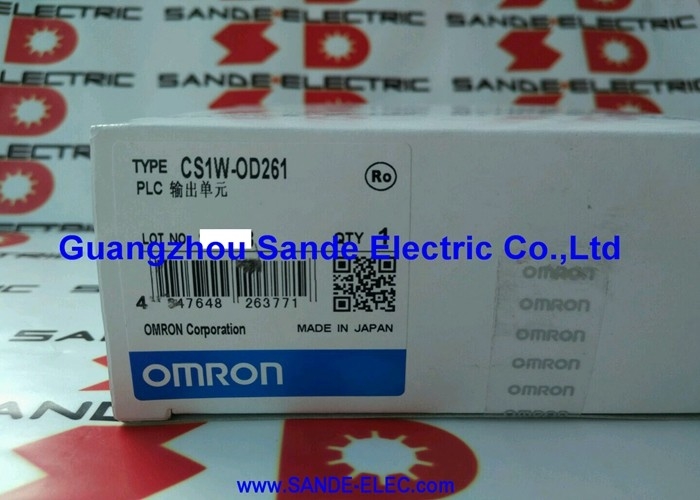
Omron CS1W-OD261 | CS1 Series 64-Point NPN Transistor Output Unit — 12–24V DC / 0.3A/Point / 0.5ms Response
64 NPN Outputs at 0.5ms Response in a 34.5mm Slot
The CS1W-OD261 provides 64 NPN transistor output points from a single CS1 rack slot, 34.5mm wide. At 0.3A per point with a 0.5ms ON and 1.0ms OFF response, it drives the full range of standard 24V DC field devices — solenoid valves, relay coils, contactor coils, signal lamps, and motor starter auxiliaries — with the response speed that tight machine cycle timing demands.
SYSMAC CS1 was Omron's high-density, high-speed PLC platform for machine and process automation. The CS1 architecture allows multiple I/O modules to populate a single rack, and the 64-point density of the CS1W-OD261 means one module delivers twice the output count of a typical 32-point unit in the same rack slot width. For machines where output count is high and rack space is limited, the 64-point format reduces the module count and leaves rack slots available for specialised function modules.
The NPN sinking output type means output transistors switch the low (common/negative) side of the load circuit. This is the correct selection for PNP-sourcing sensor circuits and for installations following the NPN load-switching convention. Confirm the field device polarity and wiring arrangement before specifying NPN vs PNP for a given installation.
Key Specifications
| Parameter |
Value |
| Points |
64 (NPN, sinking) |
| Output Voltage |
12–24V DC |
| Current per Point |
0.3A max |
| Current per Common |
1.6A max |
| ON Response Time |
0.5ms max |
| OFF Response Time |
1.0ms max |
| Module Width |
34.5mm |
| Mounting |
CS1 rack / backplane |
| IP Rating |
IP20 |
| Compliance |
cULus Class I Div 2, CE |
FAQ
Q1: What is the maximum current the CS1W-OD261 can sink across all 64 outputs?
Each point handles 0.3A maximum. Each common terminal handles 1.6A maximum. The 64 points share multiple common groups — the 1.6A common limit applies per group. Calculate simultaneous load current per group and confirm it stays within 1.6A. Exceeding the per-common limit causes overheating even when individual point currents are within rating.
Q2: Is the CS1W-OD261 compatible with CS1D redundant systems?
The CS1W-OD261 is a standard CS1 I/O unit and is compatible with CS1 systems. For CS1D (dual-redundant) systems, verify the specific compatibility requirements in Omron's CS1D system configuration documentation — certain modules are supported in CS1D configurations and certain are not.
Q3: The output is commanded on by the PLC but the field load does not activate. How is the fault isolated?
Use the module's point indicator LEDs — each output point has an LED that illuminates when the point is commanded on. If the LED is on but the load does not activate, the fault is in the external wiring or the field device itself. If the LED is off when the PLC output bit is set, the fault is in the PLC programme, I/O allocation, or the module. Verify the output forced on with CX-Programmer to confirm the module responds independently of the programme logic.
Q4: How many CS1W-OD261 modules can be installed in one CS1 rack?
The CS1 backplane determines the maximum slot count — CS1 backplanes are available with different slot configurations. Any combination of CS1 I/O and intelligent modules can populate the available slots, subject to the CPU's I/O word allocation. The 64-point CS1W-OD261 occupies fewer words than two 32-point modules, using I/O allocation more efficiently.
Q5: What is the effect of exceeding the 0.3A per-point current rating?
Exceeding the per-point current rating causes the output transistor to operate outside its safe operating area, producing thermal stress that shortens its service life or causes immediate failure. For loads drawing more than 0.3A (such as large solenoid valves or DC motor starters), interpose an intermediate relay — the output transistor drives the relay coil (typically 50–100mA), and the relay contact switches the higher-current load.


 Your message must be between 20-3,000 characters!