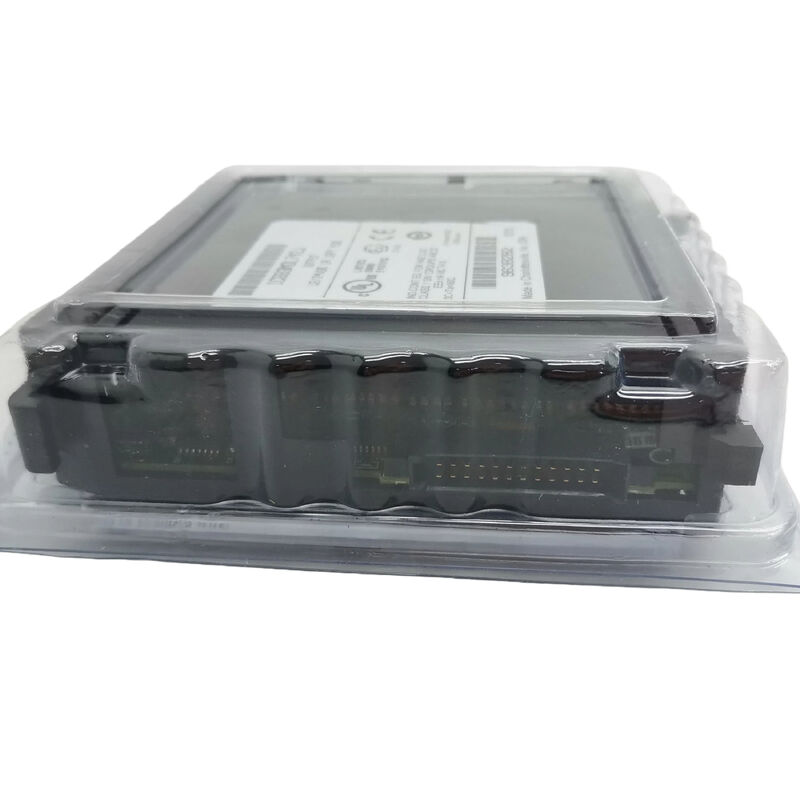
IC693MDL741 | GE Fanuc Series 90-30 16-Point DC Output Module — 12/24VDC / 0.5A per Point / Negative Logic / 2×8 Groups / 1500V Isolation
Negative Logic — What It Means in the Field
Negative logic (sinking) means each output channel connects the load's negative/common side to the module's output terminal. The positive supply voltage comes from the user's external power supply directly to one side of the load. When the output activates, the IC693MDL741 provides a current path from the load through the output transistor to the negative bus — completing the circuit.
This sinking arrangement is the standard for many industrial DC field devices in Japanese and Asian machine tool conventions. NPN-type solenoid valves, indicators, and relay coils wired for sinking inputs connect directly to the IC693MDL741's outputs without polarity reversal. For sourcing (PNP) loads, an interposing relay or a different module variant is required.
The user's external 12V or 24V DC supply powers all field devices. The IC693MDL741 only provides the switching transistor — no field voltage is derived from the backplane.
Key Specifications
| Parameter |
Value |
| Output Points |
16 (2 groups × 8) |
| Output Voltage |
12–24V DC (+20%/–15%) |
| Output Current |
0.5A/point, 2A/common |
| Logic |
Negative (sinking) |
| Field-to-Logic Isolation |
1500V |
| Group-to-Group Isolation |
500V |
| Voltage Drop |
max 0.5V |
| Leakage (off state) |
max 1mA |
| Response Time |
max 2ms |
| Backplane Current |
110mA |
Two Groups of Eight — Organised Wiring and Isolation
The 16 output points are divided into two equal groups of 8. Each group has its own common output terminal. This means:
- Wiring clarity: Group 0 (points 0–7) and Group 1 (points 8–15) connect to separate power commons. Field devices in different voltage circuits can use different groups without cross-contamination.
- Current capacity: Each common supports 2A maximum — 8 outputs at 0.5A fully loaded. The common terminal must be rated for the aggregate load of all 8 points in that group under worst-case conditions.
- Group isolation: 500V isolation between the two groups allows different external supply potentials for Group 0 and Group 1, within the isolation limit. For completely separate load power circuits, this provides safe electrical separation between groups.
Application Scenarios
Solenoid valve control on a machine tool: Series 90-30 controller manages 12 pneumatic solenoid valves (NPN, sinking) across a workpiece clamping system. The IC693MDL741's two groups provide separate control for left and right clamping circuits with a common per group.
Indicator panel control: Sixteen status indicator lamps on a machine operator panel connected to the 16 output points. LED indicators in the IC693MDL741 allow the HMI operator to verify lamp wiring continuity during commissioning without a separate lamp test instrument.
Relay coil drive for high-current loads: The IC693MDL741 drives 16 interposing relay coils (24VDC, sinking). The relays switch higher-current 240VAC motor contactors. The 0.5A per point comfortably handles standard relay coil current of 0.1–0.3A.
FAQ
Q1: What is the difference between IC693MDL741 (negative logic) and IC693MDL740 (positive logic)?
The IC693MDL740 uses positive logic (sourcing) — its outputs supply current from the positive bus to the load. The IC693MDL741 uses negative logic (sinking) — its outputs provide a return path for the load current to the negative bus. The choice depends entirely on the field device wiring convention. NPN field devices use sinking (IC693MDL741); PNP field devices use sourcing (IC693MDL740). Check the field device specifications and existing wiring standards before selecting.
Q2: Can the IC693MDL741 be installed in any slot of a Series 90-30 baseplate?
Yes. The IC693MDL741 installs in any I/O slot of a Series 90-30 baseplate — the module is not slot-specific. The PLC programmer assigns I/O addressing to the slot in the system configuration. The slot position determines the I/O address mapping, not the module function.
Q3: What external power supply is needed for the IC693MDL741's field circuits?
The user must supply an external 12V or 24V DC power supply for the field devices — the IC693MDL741 does not internally generate field power. The external supply voltage must remain within the module's operating range: 12 to 24V DC, with a tolerance of +20% and –15%. This means the supply can range from approximately 10.2V to 28.8V and still be within specification.
Q4: What types of loads can the IC693MDL741 drive directly at 0.5A per point?
Solenoid valves (24VDC, 0.1–0.4A coil current), indicator lamps and LEDs (24VDC, up to 0.5A), relay coils (24VDC, 0.1–0.3A), and small contactor coils are all within the 0.5A rating. For inductive loads (solenoids, relay coils), add suppression diodes across the coil — back-EMF on de-energisation can damage the output transistor without suppression. Motor loads and large contactors exceeding 0.5A require interposing relays.
Q5: Are revision suffixes (741C, 741E, 741F, 741G) functionally equivalent?
The letter suffixes (C, E, F, G) identify hardware revisions of the IC693MDL741. All revisions are functionally equivalent — same 16-point 12/24VDC 0.5A negative logic specification, same wiring, same slot compatibility. Revisions reflect internal component or manufacturing updates while maintaining backward compatibility. A 741G replacement in a system that previously used a 741C requires no program changes.



 Your message must be between 20-3,000 characters!