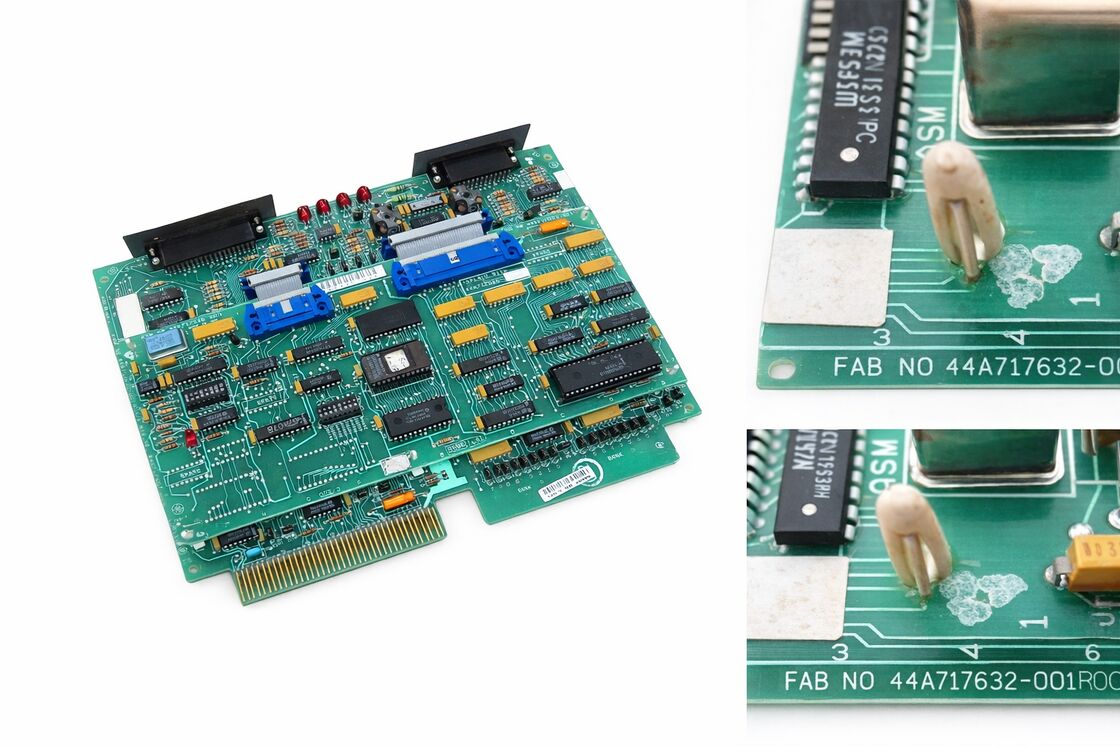
GE Fanuc Emerson IC600YB801
Remote I/O Receiver Module for Series Six Control Systems
Main Description
The GE Fanuc Emerson IC600YB801 is a Remote I/O Receiver Module designed for the Series Six platform. In a rack-based PLC system, this module supports communication between the controller and remote I/O structure, helping the system manage signal exchange outside the main CPU rack.
With 8 input references and 8 output references, the IC600YB801 is suited to distributed I/O environments where stable communication between racks is essential to daily operation.
In practical maintenance work, this module is often involved when technicians are dealing with remote rack communication faults, unstable signal transmission, or continuity issues across the I/O chain.
Because it belongs to a legacy Series Six environment, this model remains useful in plants that continue to operate long-service equipment and need the correct replacement module to preserve the original control architecture.
Parameter Table
| Parameter |
Value |
| Part Number |
IC600YB801 |
| Manufacturer |
GE Fanuc Emerson |
| Product Type |
Remote I/O Receiver Module |
| Product Line |
Series Six |
| Weight |
6.00 lbs (2.72 kg) |
| Faceplate |
No |
| Approximate Dimensions |
28 × 2 × 21 cm |
| Number of Input References |
8 |
| Number of Output References |
8 |
| Storage Temperature |
0 to 70°C |
| Operating Temperature |
0 to 60°C |
| Relative Humidity |
5 to 95%, non-condensing |
Applications
The IC600YB801 is well suited to Series Six remote I/O systems, especially where field-side or remote-rack communication must remain stable without redesigning the original PLC installation.
Typical applications include:
- Remote rack communication support in Series Six systems
- Distributed I/O signal exchange
- Legacy PLC maintenance and refurbishment
- Replacement of failed remote I/O receiver modules
- Spare-parts inventory for long-running industrial control systems
Service Notes
Because this module works in the remote I/O path, fault diagnosis should include more than the module itself.
Good service practice is to check rack address settings, downstream rack continuity, and the condition of communication links before replacing the receiver module.
This approach helps reduce unnecessary board changes and improves repair efficiency.
FAQ
Q1: What is the primary job of the IC600YB801 in a Series Six system?
Its main role is to receive and handle remote I/O data within a Series Six architecture. Public documentation also indicates that it monitors several fault conditions tied to data parity and downstream rack continuity, so it functions as more than a simple passive interface board.
Q2: What do the 8 input and 8 output references mean in practice?
They define the module’s reference capacity for communication within the remote I/O scheme. The Series Six manual excerpt notes that the 8 output references are reserved for future use, while the 8 input references provide the user with module information according to rack address switch selection.
Q3: Is this module mainly for new systems or legacy support?
In real-world procurement, it is primarily relevant to legacy support. Series Six is an older GE PLC platform, and today this module is most often used for maintenance, repair, or system-life extension rather than new automation design.
Q4: What should technicians check before replacing an IC600YB801?
They should verify the rack address settings, inspect remote I/O continuity, and confirm that the fault is genuinely in the receiver path rather than elsewhere in the chain.
Because this module is associated with parity and continuity monitoring, troubleshooting should include both data integrity and downstream rack conditions.
Q5: Why is exact part-number matching important for this module?
Remote I/O modules are tightly tied to their control family and rack communication method. Since the IC600YB801 is specifically identified as a Series Six Remote I/O Receiver Module, using the exact model is the safest way to preserve compatibility in a legacy system.



 Your message must be between 20-3,000 characters!