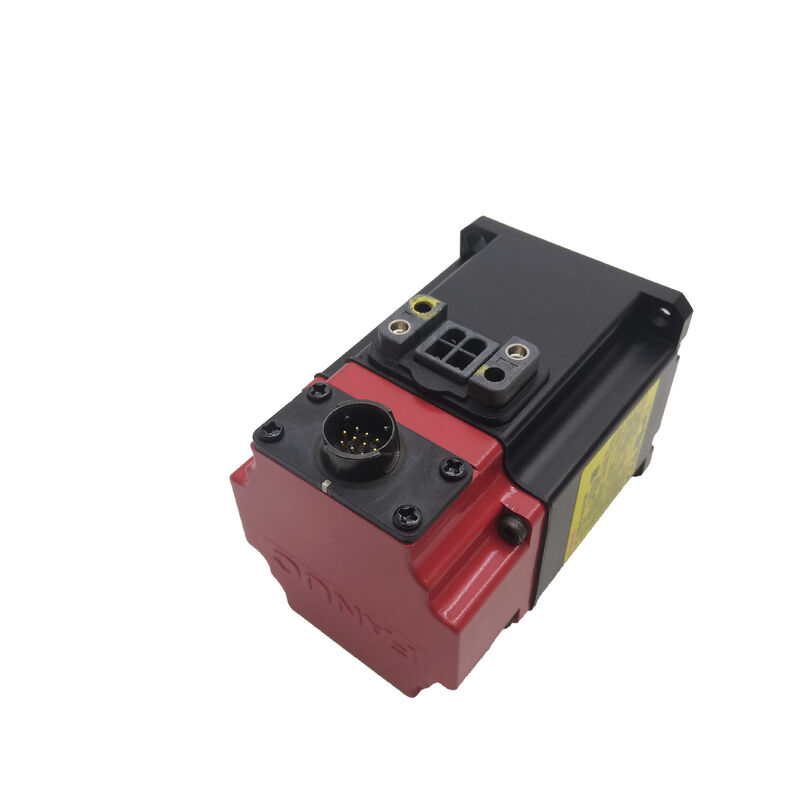
FANUC A06B-0115-B203 AC Servo Motor — βiS 0.5/6000 | 0.5 kW | 1.2 Nm | 6,000 rpm | Keyed Shaft | B64iA Absolute Encoder | IP65
Specifications
| Parameter |
Value |
| Part Number |
A06B-0115-B203 |
| Alternate Code |
A06B0115B203 |
| Manufacturer |
FANUC Corporation |
| Motor Model |
βiS 0.5/6000 (Beta iS 0.5/6000) |
| Series |
FANUC βiS (Beta iS) |
| Rated Output |
0.5 kW |
| Supply Voltage |
200 V AC |
| Rated Current |
2.3 A |
| Stalling Torque |
1.2 Nm |
| Maximum Speed |
6,000 rpm |
| Rotor Inertia |
1.0 × 10⁻⁵ kg·m² |
| Shaft Type |
Straight with Keyway |
| Encoder |
B64iA Absolute Pulsecoder |
| Electromagnetic Brake |
None |
| Protection Rating |
IP65 |
| Mass |
1.0 kg |
| Operating Temperature |
0 °C to +40 °C |
| Compatible Amplifier |
FANUC βi SV series |
| Condition |
In Stock |
A Small Motor That Earns Its Place
Most conversations about CNC servo motors focus on the high-power end — the 5 kW and 7 kW units driving main feed axes through heavy cuts. But not every axis in a machine is a main feed axis. Tool changers, live tooling drives, peripheral positioning axes, sub-spindle indexing mechanisms, and auxiliary automation axes all need precise, responsive servo control in a compact body at a fraction of that power level. That is where the FANUC A06B-0115-B203 operates.
At 0.5 kW continuous with 1.2 Nm stalling torque and a maximum speed of 6,000 rpm, this βiS motor delivers genuine FANUC closed-loop servo performance — B64iA absolute feedback, FSSB digital communication, and full integration with FANUC 0i/16i/18i/21i/30i/31i CNC systems — in a package weighing just 1 kilogram. That size-to-function ratio is the point. The machine builder who needs to add a positioning axis to a live tooling turret or drive a compact rotary indexer does not need 500W of thermal headroom. They need a FANUC axis that responds like a FANUC axis, fits the available space, and works correctly within the machine's existing control architecture without exception handling or special amplifier configurations.
The A06B-0115-B203 delivers exactly that.
The Keyed Shaft: Secure Torque Transmission at 6,000 rpm
The 203 suffix within FANUC's part number structure identifies the straight shaft with keyway configuration. At 6,000 rpm, the forces acting on a shaft-to-coupling interface are not trivial, even at 0.5 kW. Friction clamp couplings on plain shafts are suitable for many applications, but wherever a belt pulley, timing sprocket, or keyed coupling hub is the mechanical interface — or wherever load reversals are frequent enough to risk micro-slippage at a friction joint — the keyed shaft provides a positive mechanical connection that clamp force alone cannot match.
FANUC's own safety documentation for the βiS series includes a specific note on this: a key must be installed when running a keyed-shaft motor. Operating the motor with the keyway empty causes mechanical imbalance and risks torque transmission failure. Any replacement installation should confirm the key is correctly fitted before initial startup.
The shaft diameter on the βiS 0.5/6000 is 9 mm — sized for compact coupling hardware appropriate to the motor's output class.
B64iA Absolute Encoder: Position Retained Through Every Power Cycle
The feedback device built into the A06B-0115-B203 is FANUC's B64iA absolute pulsecoder — a multi-turn absolute optical encoder that retains full axis position data through power interruptions without a reference return sequence.
This is operationally significant even on auxiliary axes. A live tooling drive that needs to index to a specific angular position, a secondary axis that drives a rotary table, or any positioning axis where the home position is mechanically awkward to reach — these all benefit from startup without homing. Power on, the CNC reads position from the encoder, confirms the axis is where it was at shutdown, and allows immediate motion.
The B64iA communicates over FANUC's high-speed serial encoder link to the βi servo amplifier. Position data, motor temperature status, and encoder fault flags all travel on the same interface — there is no separate thermistor wiring or status sensor circuit to install or maintain.
Compared to the incremental pulsecoder variants (used on many αiS motors), the absolute encoder on the A06B-0115-B203 removes one recurring operational step from every machine startup. On a machine with multiple axes, that compounds across the number of axes involved.
Ultra-Low Inertia: 1.0 × 10⁻⁵ kg·m²
The rotor inertia of 1.0 × 10⁻⁵ kg·m² is extremely low for any servo motor — necessary at this power class where the motor body is compact and the rotor is correspondingly small. Low rotor inertia means the motor accelerates and decelerates quickly in response to velocity commands, with minimal electromechanical lag between command and motion.
For the type of applications the βiS 0.5/6000 handles — live tool drives that must accelerate to cutting speed between part features, indexing axes that position and settle as quickly as possible to minimize cycle time — that acceleration authority relative to connected inertia matters. The FANUC βi servo amplifier's HRV (High Response Vector) control algorithm exploits that low inertia to maintain tight velocity tracking, even through frequent start-stop cycles.
The recommended load inertia ratio for this motor class is up to 4–7 times the motor rotor inertia. Keeping the reflected load inertia within that range ensures the servo loop remains stable without requiring extreme gain settings.
System Integration: FANUC βi Servo Amplifiers
The A06B-0115-B203 is designed for FANUC's βi SV (Servo) amplifier family — specifically the βi SV 4 (single-axis, 4 A peak) and the βi SV 20/20 (dual-axis, 20 A peak per axis), which both accommodate the βiS 0.5/6000 motor at its 2.3 A rated current.
These amplifiers connect to the CNC via FSSB (FANUC Serial Servo Bus) — the high-speed fiber optic serial bus that carries axis commands from the CNC to all connected servo modules simultaneously. FSSB eliminates the individual pulse-train wiring between controller and amplifier that older servo architectures required, replacing it with a single fiber connection per bus segment that supports up to 8 axes.
The βi amplifier ecosystem is paired with FANUC 0i-D, 0i-F, 16i, 18i, 21i, 30i, and 31i CNC series. Parameter recognition is automatic: when a βiS motor is connected to a βi amplifier and the CNC reads the motor model via the encoder, it loads the appropriate servo parameters automatically — no manual entry of motor constants required on initial setup.
Where the A06B-0115-B203 Is Installed
Live tooling drives on CNC lathes — milling and drilling tools mounted on turning center turrets require servo-controlled rotation at speeds that match cutting requirements. The 6,000 rpm ceiling covers the speed range for small-diameter live tool operations, and the compact 1 kg motor body fits within tight turret mechanical constraints.
Rotary axis indexers on machining centers — trunnion positioners, small rotary tables, and angular indexing fixtures on smaller machining centers where the load mass is moderate and the compact motor envelope is a design requirement.
Peripheral automation axes — parts loaders, part ejectors, gantry positioners, and workpiece clamping actuators integrated into FANUC-controlled machining cells, where the axis must perform like a CNC servo and respond to the same position command structure as the machine's main axes.
Robotic joint drives on compact FANUC robots — small payload collaborative and industrial robots where sub-kilogram motor mass is a direct contributor to the robot's own payload-to-arm-weight ratio.
Feed axes on small-format CNC machines — benchtop machining centers, engraving machines, and precision drilling centers where the table mass is low, travel distances are short, and the full 6,000 rpm speed range is usable without the motor ever reaching its thermal limit.
A06B-0115 Variant Guide
The βiS 0.5/6000 motor body is available in several configurations. All share the same 0.5 kW output, 1.2 Nm stall torque, 6,000 rpm speed, and IP65 protection:
| Part Number |
Shaft |
Brake |
Encoder |
| A06B-0115-B100 |
Straight, No Key |
None |
αiA 1000 (Incremental) |
| A06B-0115-B200 |
Straight, No Key |
None |
B64iA (Absolute) |
| A06B-0115-B203 |
Straight, Keyed |
None |
B64iA (Absolute) |
| A06B-0115-B400 |
Straight, No Key |
24V DC Brake |
αiA 1000 (Incremental) |
| A06B-0115-B403 |
Straight, Keyed |
24V DC Brake |
αiA 1000 (Incremental) |
The A06B-0115-B203 is correct when absolute position retention, a keyed shaft interface, and no brake are all required together.
FAQ
Q1: What encoder does the A06B-0115-B203 use, and does it retain position without homing?
The motor uses FANUC's B64iA absolute pulsecoder. It is a multi-turn absolute device, meaning full axis position data — including position across multiple shaft revolutions — is retained through any power cycle without a reference return sequence. The CNC reads the axis position immediately at startup. No backup battery in the motor itself is required; battery backup (if needed for extended power-off retention) is managed at the amplifier or CNC level depending on system configuration.
Q2: Which FANUC servo amplifier is compatible with the A06B-0115-B203?
The A06B-0115-B203 is compatible with FANUC's βi SV series amplifiers — including the βi SV 4 (single-axis) and βi SV 20/20 (dual-axis). These connect to FANUC CNC systems (0i-D/F, 16i, 18i, 21i, 30i, 31i) via the FSSB fiber optic servo bus. The motor's rated current of 2.3 A falls within the operating range of these amplifier modules.
Q3: What is the difference between A06B-0115-B200 and A06B-0115-B203?
Both use the B64iA absolute encoder and have no electromagnetic brake. The only difference is the shaft: B200 has a plain straight shaft (no keyway); B203 has a straight shaft with a machined keyway. Select B203 when the driven component — a pulley, sprocket, or coupling — has a keyway bore. Select B200 when using a friction clamp coupling on a plain shaft.
Q4: Can the A06B-0115-B203 replace an older βiS 0.5/5000 motor?
Yes, with a parameter update. The βiS 0.5/6000 is the direct successor to the βiS 0.5/5000, with the maximum speed extended from 5,000 rpm to 6,000 rpm. The motor body, mounting dimensions, shaft size, and encoder interface are compatible. FANUC's documentation confirms this as a planned upgrade path, but the servo parameters (motor model number and associated gain settings) in the CNC must be updated to reflect the new motor. The speed extension to 6,000 rpm requires a parameter change if that speed range is to be used.
Q5: Does the A06B-0115-B203 require a separate brake supply circuit?
No. The B203 configuration has no electromagnetic brake. There is no brake coil, no 24V DC brake supply required, and no brake release timing to manage in the motion program. For applications requiring mechanical shaft holding at power-down — vertical axes or gravity-loaded mechanisms — the brake-equipped variant A06B-0115-B403 (keyed shaft, 24V DC power-off brake, αiA 1000 incremental encoder) is the appropriate selection.


 Your message must be between 20-3,000 characters!