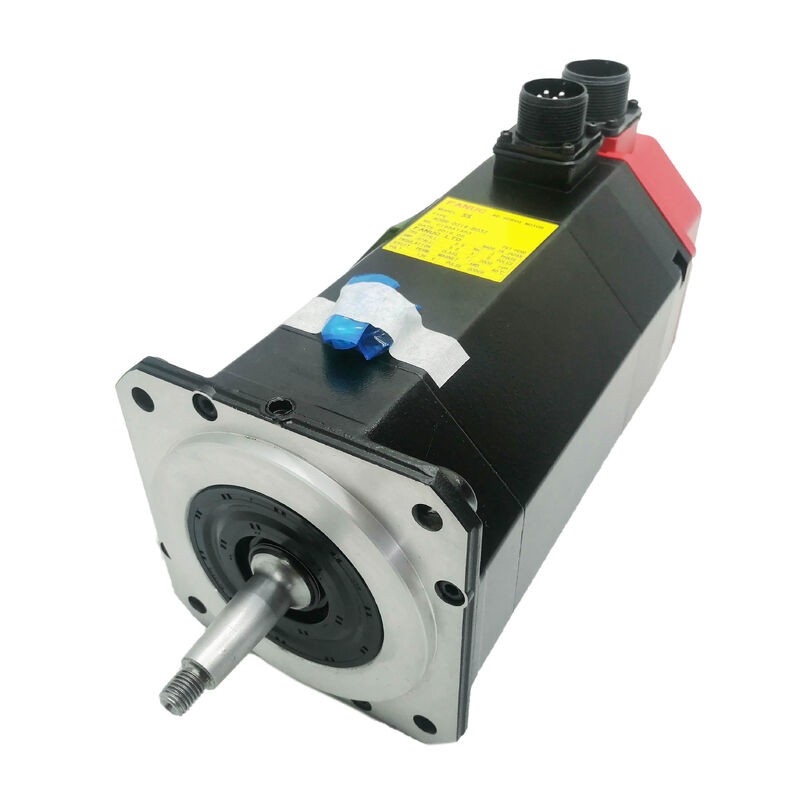
Fanuc A06B-0313-B169 AC Servo Motor — ZERO S, Taper Shaft, Brake, Serial Pulse Coder A
Product Overview
Part Number: A06B-0313-B169
Also Searched As: A06B0313B169, FANUC A06B-0313-B169, Fanuc A06B0313B169
Motor Model: 0S (ZERO S)
Classification: Fanuc ZERO S Series AC Brushless Servo Motor — 2.9 Nm Stall Torque, 3,000 rpm, Taper Shaft with Key, Spring-Applied Holding Brake, Serial Pulse Coder A (1,000,000 ppr)
Understanding the Platform This Motor Belongs To
The A06B-0313-B169 is a Fanuc ZERO S — an AC servo motor from the GE Fanuc generation that powered a large population of CNC machine tools before the alpha series took over. Many of those machines are still running in production facilities today, and when the 0S motor fails, a correct like-for-like replacement is the only path back to production without a costly and time-consuming drive system upgrade.
Getting the replacement right requires understanding three things about this specific motor: the torque and speed class, the shaft and brake configuration, and the encoder generation. All three are locked in by the part number, and any one of them wrong means the replacement does not fit, does not connect, or does not work with the existing control system.
The A06B-0313-B169 is the brake-fitted, taper-shaft, Serial Pulse Coder A variant in the 0S family. Each element of that description is specific and non-interchangeable.
Technical Specifications
| Parameter |
Value |
| Part Number |
A06B-0313-B169 |
| Motor Model |
0S (ZERO S) |
| Series |
Fanuc / GE Fanuc ZERO S |
| Stall Torque |
2.9 Nm |
| Stall Current |
4.2 A |
| Maximum Speed |
3,000 rpm |
| Motor Input Voltage |
~91V AC (3-phase) |
| Poles |
8 |
| Pulse Coder |
Serial Pulse Coder A (1,000,000 ppr, serial absolute) |
| Shaft Type |
Taper with key (TPR) |
| Electromagnetic Brake |
Spring-applied holding brake |
| Insulation Class |
Class F |
| Compatible Amplifiers |
Fanuc ZERO series servo amplifiers (Series 0 / 0C / 0D / 10 / 11 / 15 generation) |
| Compatible Controls |
Fanuc Series 0, 0C, 0D, 10, 11, 15, 16 (0S amplifier generation) |
| Origin |
Japan |
The ZERO S in the Fanuc Servo Family Tree
Positioning the A06B-0313-B169 correctly in Fanuc's historical motor lineup matters for sourcing, compatibility, and long-term maintenance planning.
The ZERO S generation preceded the alpha series motors that most engineers encounter today. In the 0S era — the late 1980s through the mid-1990s — Fanuc supplied the 0S motor as the standard small-frame servo motor for machine tools controlled by the Series 0, 10, 11, and 15 CNC platforms. The motors used a serial encoder interface — the Serial Pulse Coder A — that was Fanuc's encoder technology of that generation, providing absolute position feedback via a serial data protocol that the 0S-generation amplifiers were designed to read.
The alpha series motors that followed used different serial encoder protocols. The αi series after that used yet another protocol iteration. The 0S motor and its Serial Pulse Coder A are not electrically compatible with alpha or αi series amplifiers at the encoder interface — and this is the most important compatibility fact for anyone sourcing this motor. The A06B-0313-B169 goes back into the machine it came from, connected to the same amplifier generation it was designed for. It cannot be directly substituted into an α or αi amplifier system without a system-level upgrade.
For machines where the 0S drive system remains in service — and there are still substantial numbers of such machines running production — the A06B-0313-B169 is simply the correct motor. There is no modern equivalent that installs as a drop-in into the existing machine without modification.
Taper Shaft with Key: Designed for Secure Long-Term Service
The taper shaft with key (TPR) on the A06B-0313-B169 is the standard machine tool coupling interface for this motor generation. Understanding why this shaft design persists across decades of Fanuc motor design helps explain why it matters for replacement.
The taper geometry — a precisely machined cone angle on the motor shaft end — self-centres the coupling hub during installation. As the hub is drawn onto the taper using the shaft-end draw bolt, the tapered contact surfaces pull the hub into perfect coaxial alignment with the motor shaft automatically. No alignment jigs, no shimming, no trial-and-error. The hub seats in the same position every time it is installed, which means the driven mechanism returns to exactly the same geometric relationship with the motor shaft after every service event.
The key in the matched keyway carries the torque load through positive mechanical shear engagement rather than relying solely on the friction of the taper contact. At 2.9 Nm stall torque, the key is well within its load capacity — the primary function here is securing the coupling hub against rotation relative to the shaft under reversing torque loads and vibration, not transmitting torque at the limit of the key material.
For replacement purposes: when the A06B-0313-B169 is fitted as a like-for-like replacement, the existing coupling hub on the machine is already the correct taper bore and key bore for this shaft. Transfer the hub from the old motor to the new one using a proper gear puller for removal — never use impact or wedge tools on a taper coupling — and draw the hub to the correct engagement using the shaft draw bolt torqued to specification.
Spring-Applied Holding Brake: Safety That Works Without Power
The brake fitted to the A06B-0313-B169 is a spring-applied design — a fail-safe mechanism whose engagement state at power-off is not a choice but a physical law. The spring engages the brake disc mechanically when the brake coil is de-energised. Power is required to release the brake, not to apply it.
This fail-safe principle means that any loss of power — planned shutdown, emergency stop, amplifier fault, or mains interruption — immediately and automatically results in a mechanically held shaft. The motor cannot rotate until power is restored and deliberately applied to the brake coil to release it. On an axis carrying a gravitational load in the direction of shaft rotation — a vertical quill axis, an inclined feed, a Z-axis with a heavy spindle head — this mechanical engagement is the only thing preventing uncontrolled descent at servo-off.
At 2.9 Nm stall torque, the load this motor drives is modest, but even modest masses on a vertical axis fall under gravity in ways that damage tooling, fixtures, or workpieces. The brake holds the axis static regardless of load direction or magnitude within its rating.
The no-brake variants in the 0S family — identified by different B-series suffixes — are identical to the B169 in torque and encoder configuration but lack this mechanism. On horizontal axes with no gravitational load component along the shaft rotation direction, no-brake motors are correctly specified. On vertical or inclined axes, the brake variant — this motor — is the correct and safe specification. Fitting a no-brake replacement for a brake-equipped original is not acceptable on these axes without a complete review of the machine's safety architecture.
Serial Pulse Coder A: Absolute Feedback in the 0S Generation
The encoder fitted to the A06B-0313-B169 is the Serial Pulse Coder A — 1,000,000 pulses per revolution, serial absolute protocol. This is the encoder generation that Fanuc developed for the 0S motor family and the Series 0/10/11/15 CNC platforms of its era.
Absolute means no mandatory homing on power-up. The Serial Pulse Coder A retains multi-turn shaft position through power-off events via a backup battery — typically located in the motor or in the associated control panel battery box depending on the specific machine architecture. When the CNC powers up, the axis coordinate is re-established from the retained absolute position without requiring a reference-return traverse. This was a significant operational advantage for machines of this generation compared to the incremental encoder systems they replaced, and it remains operationally relevant on any machine where the ZERO S drive system is still in service.
At 1,000,000 counts per revolution, the Serial Pulse Coder A provides position loop resolution in the nanometre range on typical ball screw pitches — more than adequate for the positioning accuracy requirements of the machine tool generation this motor was designed for.
Critical compatibility note: The Serial Pulse Coder A is a specific encoder interface. The connector, cable, and serial protocol are specific to the 0S-generation amplifiers. Do not attempt to connect a Serial Pulse Coder A to an alpha or αi series amplifier — the interface is physically and electrically different. When replacing the A06B-0313-B169, the replacement must carry the same Serial Pulse Coder A. Other encoder variants in the 0S family — 2000P incremental, 3000P, high-resolution variants — are not compatible with the same amplifier parameter settings and will require amplifier reconfiguration at minimum.
Battery Maintenance on Absolute Encoder Systems
The Serial Pulse Coder A retains its multi-turn absolute position counter through a backup battery. The specific battery location varies by machine — it may be in the motor connector housing, in the machine's control panel battery box, or in the servo amplifier, depending on how the machine builder implemented the backup power circuit.
When the Fanuc CNC issues a battery alarm for an axis running a 0S motor with Serial Pulse Coder A, replace the battery promptly. Running the battery to full depletion resets the absolute counter, requiring the axis to be re-referenced to the machine coordinate. On machines where the homing reference mark position is not easily re-established — or where the machine's startup procedure does not include a supervised reference return — battery depletion causes a more disruptive recovery process than a simple battery replacement would have.
A06B-0313 Series: Key Variants
All variants in the A06B-0313 series share the same 0S (ZERO S) motor body with 2.9 Nm stall torque and 3,000 rpm maximum speed. The suffix encodes shaft configuration, brake, and encoder type.
| Part Number |
Shaft |
Brake |
Encoder |
| A06B-0313-B004 |
Taper |
No |
2000P absolute |
| A06B-0313-B033 |
Taper |
No |
3000P absolute, IP65 |
| A06B-0313-B072 |
Taper |
No |
Serial A (1,000,000 ppr) |
| A06B-0313-B172 |
Taper |
Yes (brake) |
Serial A (1,000,000 ppr) |
| A06B-0313-B169 |
Taper + key |
Yes (brake) |
Serial A (1,000,000 ppr) |
The B169 carries both the key in the taper shaft and the spring-applied brake — the full safety configuration for machines where the coupling requires positive key engagement and the axis requires mechanical holding at servo-off.
Compatible Controls and Amplifiers
The A06B-0313-B169 operates with the Fanuc ZERO-series servo amplifier generation — the servo modules designed for the Series 0, 0C, 0D, 10, 11, and 15 CNC platforms. These amplifiers read the Serial Pulse Coder A protocol directly and are parameterised for the 0S motor type.
This motor is not compatible with Fanuc alpha series SVU amplifiers or with Fanuc αi series αiSV amplifiers without a system-level conversion that replaces both the amplifier and the motor encoder interface. If a machine using this motor is being considered for a drive system upgrade, the upgrade path involves replacing both the amplifier and the motor together — the Serial Pulse Coder A motor cannot be retained with a new-generation amplifier.
Typical Applications
CNC machining centre feed axes on Series 0 controlled machines. X, Y, and Z feed axis drives on Fanuc Series 0, 0C, and 0D controlled vertical and horizontal machining centres where the 0S drive system remains in service and the A06B-0313-B169 is the original motor specification.
Vertical axis drives on Series 0 CNC lathes and machining centres. Z-axis and quill drive applications where the spring-applied brake provides mandatory safety holding at servo-off for axes carrying gravitational loads.
Fanuc robot joint drives on first-generation robots. Early-generation Fanuc industrial robots using the 0S motor family on joint axes where the Serial Pulse Coder A absolute encoder supports joint position retention through controller power-off.
Multi-axis CNC turning centre feed drives. Z and X axis carriage and cross-slide drives on Fanuc Series 0T and 0TC controlled turning centres where the 0S motor with Serial Pulse Coder A is the original axis drive specification.
FAQ
Q1: Is the A06B-0313-B169 compatible with modern Fanuc αi series amplifiers?
No — not directly. The A06B-0313-B169 uses the Serial Pulse Coder A, which is specific to the Fanuc ZERO-series amplifier generation. Fanuc αi series amplifiers use a completely different serial encoder protocol and physical interface. Connecting a Serial Pulse Coder A motor to an αi amplifier would require a full drive system conversion — replacing both the amplifier and the motor — not a simple motor swap. The A06B-0313-B169 must be used with the original 0S-generation servo amplifier installed in the machine.
Q2: The B169 has a brake — what happens if the brake circuit loses power unexpectedly?
The brake on the A06B-0313-B169 is spring-applied — it engages mechanically when the brake coil is de-energised, not when it is energised. Any loss of brake supply power, for any reason, causes the brake to engage and hold the shaft immediately. This fail-safe design means that power failures, E-stop events, amplifier faults, and planned shutdowns all result in a mechanically held axis automatically. No control signal is required for the brake to do its job at shutdown — it engages by default whenever electrical power is absent.
Q3: Does the Serial Pulse Coder A require a homing cycle on every CNC power-up?
No. The Serial Pulse Coder A is a serial absolute encoder — it retains multi-turn shaft position through power-off via a backup battery. When the CNC powers up, the axis coordinate is re-established immediately without any reference-return movement. However, when the backup battery depletes and the absolute counter resets, a one-time re-referencing procedure is required to re-synchronise the absolute position to the machine coordinate system. Replace the battery when the CNC issues a battery alarm to avoid this.
Q4: Is the B169 the same motor as the B172 — and can they be substituted for each other?
Both the B169 and B172 share the same 0S motor body, 2.9 Nm stall torque, Serial Pulse Coder A encoder, and spring-applied brake. The functional difference lies in the shaft: the B172 is a taper shaft without a key, while the B169 is a taper shaft with a machined keyway. If the machine's coupling hub has a keyed bore, the B169 is the correct replacement; if it uses a plain taper bore without a key, the B172 is correct. Fitting a keyed shaft where the hub has no keyway, or vice versa, creates a coupling mismatch that cannot be correctly assembled.
Q5: Can the A06B-0313-B169 be repaired rather than replaced outright?
Yes. The 0S motor family is a well-established and repairable platform. Qualified Fanuc servo motor repair facilities can replace bearings, rebuild or rewind stator windings, replace the Serial Pulse Coder A encoder unit, and service the spring-applied brake mechanism. For facilities maintaining machines with a 0S drive system where sourcing new 0S motors is increasingly challenging, repair is often the most practical and cost-effective route. Core exchange programmes are also available from some suppliers. When sending a motor for repair, use a facility with documented Fanuc 0S / GE Fanuc experience — the Serial Pulse Coder A requires specific calibration alignment after replacement that facilities without the correct test equipment cannot perform correctly.


 Your message must be between 20-3,000 characters!