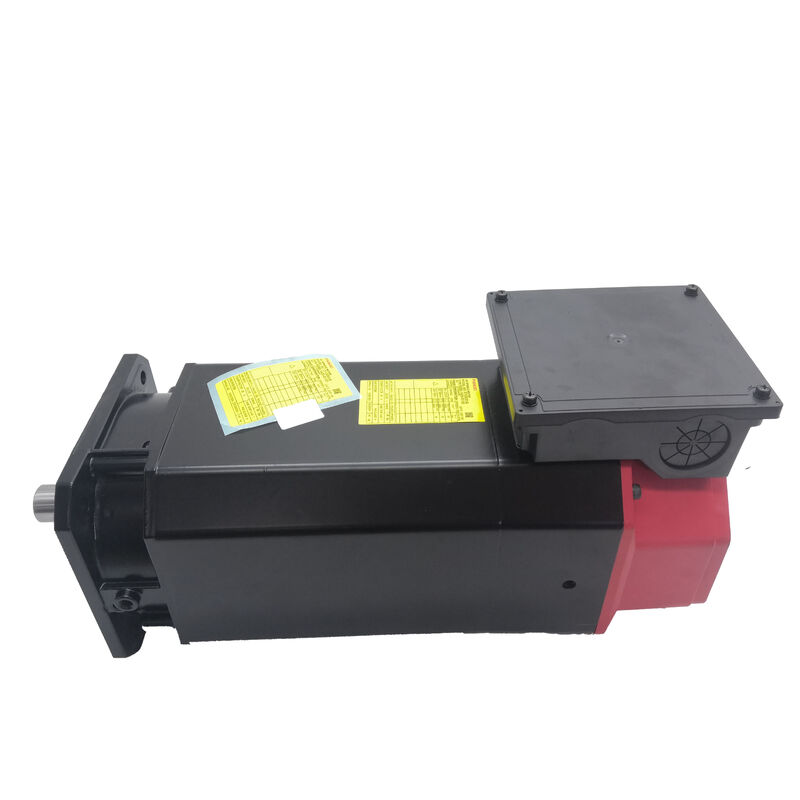
Fanuc A06B-1401-B105 AC Spindle Motor — αi 0.5/10,000, Flange Mount, Smooth Shaft, IMZ Sensor
Product Overview
Part Number: A06B-1401-B105
Also Searched As: A06B1401B105, FANUC A06B-1401-B105, Fanuc A06B1401B105
Motor Model: αi 0.5/10,000
Classification: Fanuc Alpha i Series AC Spindle Motor — 0.5 kW, 10,000 RPM Maximum Speed, Flange Mount, Straight Smooth Shaft, Built-In IMZ Magnetic Sensor, No Brake
Technical Specifications
| Parameter |
Value |
| Part Number |
A06B-1401-B105 |
| Motor Model |
αi 0.5/10,000 |
| Rated Output |
0.5 kW |
| Maximum Speed |
10,000 rpm |
| Phases |
3-phase |
| Poles |
4 |
| Input Voltage |
85–220V AC, 50/60 Hz |
| Mounting |
Flange |
| Shaft Type |
Straight smooth (SLK — no keyway) |
| Brake |
None |
| Spindle Sensor |
B-type with IMZ (integrated magnetic Z-pulse) |
| Cooling |
Forward-exhausting fan |
| Compatible Amplifiers |
Fanuc αi series spindle amplifiers (αiSP) |
| Compatible Controls |
Fanuc Series 0i, 15i, 16i, 18i, 21i, 30i, 31i, 32i |
| Origin |
Japan |
The Smallest in the αi Spindle Family — and the Right Choice for a Specific Job
At 0.5 kW and 10,000 rpm, the A06B-1401-B105 sits at the compact end of Fanuc's αi AC spindle motor range. It is not a motor for deep-cut roughing on large billets or heavy interrupted cutting on hard material — and it was never meant to be. This motor was designed for machine tools where the spindle envelope is physically small, the workpiece and tooling are similarly compact, and the ability to reach and sustain high speed matters more than raw torque output.
Drill-tap centres handling aluminium alloy workpieces, small-format machining centres for electronics and precision hardware components, compact CNC lathes in the 100–200mm swing class, and specialised machines for PCB drilling and micro-feature work are exactly where the αi 0.5/10,000 belongs. At 10,000 rpm, a 1mm diameter drill runs at the surface speed that non-ferrous drilling demands. At 0.5 kW, the power draw is modest enough that the machine's electrical design does not need to accommodate a heavy spindle power budget on top of the servo axis power.
The key insight is proportionality: the A06B-1401-B105 is not an underspecified motor fitted to save cost — it is the correctly sized spindle motor for a specific class of machine tool where the workpiece, tooling, and production process fit the 0.5 kW / 10,000 rpm operating window. Forcing a larger spindle motor into the same machine package would not improve cutting performance for the loads the machine actually sees. It would increase heat load, motor weight, amplifier rating, and cabinet power budget without delivering useful additional torque at the operating conditions the machine was designed for.
IMZ Sensor: Built-In Magnetic Z-Pulse for Orientation and Rigid Tapping
The IMZ designation in the A06B-1401-B105's description identifies one of the motor's most operationally significant features: a built-in integrated magnetic Z-pulse sensor fitted inside the motor body.
To understand why this matters, consider what happens during a rigid tapping cycle. The CNC commands the spindle to rotate at a speed precisely synchronised to the Z-axis feed rate, with the thread pitch defining the exact ratio of spindle revolution to linear advance. As the tap enters the material and reaches the programmed depth, the spindle must reverse — again at a precisely synchronised rate — without floating or slipping on the tap. Any angular position error during this reversal produces a torn or malformed thread, or a broken tap.
Achieving this level of spindle-to-feed synchronisation requires the CNC to know the spindle's angular position continuously throughout the cycle, not just its speed. The IMZ sensor provides a reference pulse once per revolution at a precise angular position — the magnetic Z-pulse — that the Fanuc CNC uses to synchronise the spindle to the linear axis. Without this reference, rigid tapping is unavailable and the machine must use floating tap holders, sacrificing thread depth consistency and pitch accuracy.
Spindle orientation depends on the same Z-pulse reference. When the CNC commands the spindle to stop at a specific angular position — for tool change, for in-position workpiece loading, or for C-axis operations — the IMZ sensor is what allows the drive system to identify and lock onto that angular position. On small machining centres where automatic tool changes happen dozens of times per shift, reliable spindle orientation is a production-critical function.
The integration of the IMZ sensor inside the motor body rather than as a separate externally mounted device is a packaging advantage: no external sensor head to align, no separate encoder cable running to a remotely mounted device, no mechanical coupling between the sensor and the shaft to introduce any angular error between the actual shaft position and what the sensor reports.
Flange Mount and Smooth Shaft: Standard Configuration for Small Spindle Drive Trains
The flange mounting of the A06B-1401-B105 allows the motor to bolt directly to the machine's spindle housing or drive bracket face, positioning the motor shaft in precise axial and radial alignment with the spindle drive input without requiring adjustable mounting feet or base plate alignment. On small machine tools where space is constrained and the motor sits close to or inside the machine structure, flange mounting is the standard approach.
The straight smooth shaft (SLK — no keyway) transmits torque to the spindle drive train through a friction-clamped coupling hub. At 0.5 kW, the torque being transmitted through the coupling is modest, and a properly specified split-hub clamp coupling provides reliable torque transmission without the stress concentrations that keyways introduce in small shaft diameters. The smooth shaft also makes the coupling easier to fit and remove during servicing without the need to handle and store a matching key and keep the keyway clean and undamaged.
For machines whose drive design requires a keyed shaft — where the coupling hub was designed around a positive key engagement — the A06B-1401-B155 is the keyed shaft variant within the same αi 0.5/10,000 family. Torque, speed, sensor, and mounting are identical; only the shaft configuration differs. Confirm the shaft type on the failed motor before ordering a replacement.
Amplifier and CNC Compatibility
The A06B-1401-B105 operates with Fanuc αi series spindle amplifiers (αiSP). At 0.5 kW, the αiSP 2.2 or the compact αiSP 1.5 units within the αi amplifier range are the appropriate pairing depending on the specific machine configuration. The motor connects to the amplifier via the standard Fanuc αi spindle motor power and signal cable set.
Compatible CNC platforms include Fanuc Series 0i-D, 0i-F, 16i, 18i, 21i, 30i-A, 30i-B, 31i-A, 31i-B, and 32i. The motor is not compatible with the original α (non-i) series spindle amplifiers, which use a different motor drive interface, or with Fanuc β (beta) series spindle drives.
When fitting this motor as a replacement on a machine that has the same model in service, verify that the CNC spindle parameters — motor type code, maximum speed setting, and gear ratio parameters — match the αi 0.5/10,000 specification before returning the machine to production. A parameter mismatch on a spindle motor can produce speed errors, amplifier faults, or incorrect spindle orientation behaviour that does not reflect any mechanical fault in the motor itself.
A06B-1401 Series: Variants at a Glance
The A06B-1401 series covers the αi 0.5/10,000 motor in several shaft and sensor configurations. Knowing which variant is fitted to the machine before ordering is essential — the wrong shaft type requires different coupling hardware and in some configurations different sensor wiring.
| Part Number |
Shaft |
Keyway |
IMZ Sensor |
| A06B-1401-B105 |
Straight smooth |
No (SLK) |
Yes (IMZ) |
| A06B-1401-B155 |
Straight |
Yes (keyed) |
Yes |
| A06B-1401-B175 |
Straight |
Yes (keyed) |
Yes (with brake) |
The B105 is the baseline no-brake, smooth shaft, IMZ-equipped configuration — the most common variant for small machining centres and drill-tap machines where no gravity-load holding requirement exists and the coupling design uses a smooth bore clamp hub.
Typical Applications
Compact CNC drill-tap centres. Small-format drill-tap machining centres handling aluminium alloy, brass, and engineering plastics at high spindle speeds, where 10,000 rpm enables productive cutting with small-diameter tooling and the IMZ sensor supports rigid tapping without floating tap holders.
Precision CNC machining centres for electronics and micro-components. VMCs producing precision hardware components, connector bodies, and electronic enclosures where the workpiece envelope and tooling diameters fit the αi 0.5/10,000 speed and power range, and surface finish requirements benefit from high spindle speed with low vibration.
Small CNC lathes. Compact turning centres in the 100–200mm swing class where the spindle is driven by an external αi spindle motor, the IMZ sensor provides position feedback for rigid tapping on the Y-axis (where fitted), and 10,000 rpm supports high surface speed on small-diameter workpieces.
PCB drilling machines and micro-machining platforms. Specialised CNC equipment for PCB through-hole drilling, micro-milling, and fine-feature engraving where small tool diameters and demanding surface speed requirements make 10,000 rpm spindle speed not merely useful but necessary.
Replacement for machines currently running A06B-1401-B105. Any Fanuc αi-controlled machine that was originally built around the αi 0.5/10,000 smooth-shaft spindle motor where the installed motor has failed and requires a like-for-like replacement to restore production.
FAQ
Q1: What does the IMZ feature on this motor actually do in practice?
The IMZ is a built-in magnetic Z-pulse sensor that generates one reference pulse per spindle revolution at a fixed angular position. The Fanuc CNC uses this pulse for two key functions: rigid tapping — synchronising spindle rotation with Z-axis feed during a tapping cycle so the thread pitch is mechanically controlled rather than dependent on a floating tap holder — and spindle orientation — stopping and holding the spindle at a commanded angular position for tool changes or C-axis operations. Without a functioning IMZ signal, rigid tapping and spindle orientation are unavailable on compatible machines.
Q2: Does the B105 have a different shaft from the B155 — and does it matter for replacement?
Yes, it matters. The B105 has a straight smooth shaft with no keyway (SLK); the B155 has a keyed shaft. The coupling hub on the machine's spindle drive is matched to one specific shaft type — a smooth bore clamp hub will not engage properly on a keyed shaft, and a keyed hub bore will not fit correctly on a smooth shaft without the matching key. Always confirm the shaft type on the original motor before ordering. If the motor being replaced is a B105, order a B105; if it is a B155, order a B155.
Q3: Which Fanuc spindle amplifier pairs with the A06B-1401-B105?
This motor requires a Fanuc αi series spindle amplifier (αiSP). At 0.5 kW, the appropriate αiSP module for this motor's power class should be specified by the machine builder's electrical documentation. Compatible CNC platforms are Fanuc Series 0i-D, 0i-F, 16i, 18i, 21i, 30i, and 31i. The motor is not compatible with original α (non-i) series spindle drives or with Fanuc β series spindle amplifiers, which use different interfaces and parameter structures.
Q4: Is a core exchange required when ordering this part?
Core exchange requirements vary by supplier. Many distributors and service facilities offering the A06B-1401-B105 operate on a core exchange basis — meaning a rebuildable failed unit must be returned as a condition of the transaction, or an additional core charge applies. This policy allows the supplier to maintain a rebuild stock and keeps pricing more competitive than purchasing outright without an exchange. If the failed motor has suffered physical damage to the housing or shaft, confirm with the supplier whether the unit qualifies as a valid exchange core before shipping it.
Q5: Can this motor be repaired rather than replaced outright?
Yes. The A06B-1401-B105 is a repairable motor. Qualified Fanuc spindle motor repair facilities can address the most common failure modes: bearing replacement (the most frequent cause of spindle motor failure in service), stator winding repair or rewind after an insulation failure, IMZ sensor replacement, and shaft repair or replacement after mechanical damage. For a motor at this price point and availability level, repair is often the faster and more cost-effective path — particularly for facilities that have a spare motor available to keep the machine running while the failed unit goes through a repair cycle. Always use a repair facility with documented Fanuc spindle motor experience and the ability to run-test the motor on a compatible αi amplifier after repair.


 Your message must be between 20-3,000 characters!