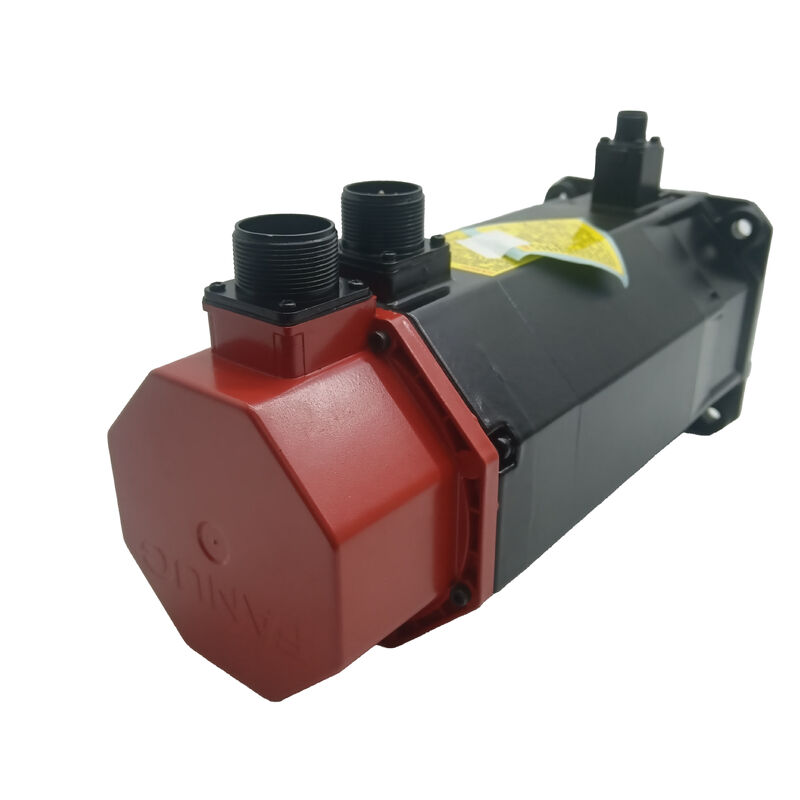
Fanuc A06B-0163-B175 AC Servo Motor — αM9/3000, Taper Shaft, Brake, A64 Encoder, Good Condition
Product Overview
Part Number: A06B-0163-B175
Also Searched As: A06B0163B175, FANUC A06B-0163-B175, Fanuc A06B0163B175
Motor Model: αM9/3000 Condition: Good — used, inspected, operationally verified
Classification: Fanuc Alpha Series AC Brushless Servo Motor — 9 Nm Stall Torque, 3,000 rpm, Taper Shaft with Key, Spring-Applied Holding Brake, A64 Incremental Pulse Coder, IP65
A Used Motor, Honestly Described
Maintenance teams replacing a failed A06B-0163-B175 face a straightforward decision: new stock (if available, and at new-motor pricing) or a quality used unit that gets the machine back running quickly at a fraction of the cost. This listing is the second option.
Good condition means what it says. The motor has been inspected — shaft geometry, encoder housing, connector integrity, brake function, and seal condition have all been checked. It turns freely with no bearing roughness. It is not a new motor, and listing it as one would be dishonest. What it is, is a properly functioning αM9/3000 ready to be installed on the machine it was designed for. For a production facility where downtime has a cost and lead time on a new Fanuc alpha series motor is measured in weeks, a good used A06B-0163-B175 available now is often the right answer.
Technical Specifications
| Parameter |
Value |
| Part Number |
A06B-0163-B175 |
| Motor Model |
αM9/3000 |
| Condition |
Good (used, inspected) |
| Stall Torque |
9 Nm |
| Rated Output |
1.8 kW |
| Stall Current |
10 A |
| Rated Current |
6.8 A |
| Maximum Speed |
3,000 rpm |
| Motor Input Voltage |
161V AC (3-phase) |
| Frequency |
200 Hz |
| Winding Configuration |
Y (star) |
| Pulse Coder |
A64 (incremental, 64,000 ppr) |
| Shaft Type |
Taper with key (TPR) |
| Electromagnetic Brake |
Spring-applied holding brake (90V DC) |
| Protection Rating |
IP65 |
| Insulation Class |
Class F |
| Weight |
~17 kg (38 lbs) |
| Origin |
Japan |
| Compatible Amplifiers |
Fanuc α series SVU amplifiers |
| Compatible Controls |
Fanuc Series 15, 16, 18 (original alpha generation) |
The αM9/3000 in the Fanuc Alpha Lineup
The αM motors represent a mid-generation update within the original Fanuc alpha servo series. Where the standard alpha motors (αA, αC designations) covered the core machine tool feed axis applications, the αM series was introduced to address specific applications — including robot joint drives — where a slightly different torque-speed characteristic and physical configuration were needed. The "M" designation identifies this variant, and it appears less frequently in the field than the standard alpha series, which is part of why finding good replacement stock requires more effort.
Nine Newton-metres of stall torque at 3,000 rpm puts the αM9/3000 in the middle of the original alpha series range — capable enough for the heavier CNC axis drives and robot joint applications it was specified for, compact enough to fit within the space constraints those applications impose at ~17 kg. The 1.8 kW continuous rated output at 161V, 200Hz reflects the original alpha amplifier platform's motor supply characteristics — different from the 200V input / 157V motor voltage of the heavier α22 and α30 series, but the same fundamental alpha-generation electrical interface.
Brake Fitted: Why the B175 Matters
The B175 suffix identifies the motor variant with a spring-applied holding brake — this is not an option or an accessory. It is a structural part of the motor that the original machine or robot design depended on, and its presence on the replacement motor is non-negotiable for axes where it was originally specified.
Spring-applied brakes work on a fail-safe principle. When power is absent — whether by design at controlled shutdown, or by circumstance during an alarm, E-stop, or power interruption — the brake spring engages and clamps the shaft mechanically. The motor shaft cannot rotate until the brake solenoid is energised and the spring is released. No power, no movement. This is the holding mechanism that vertical axes and robot joints rely on to prevent gravitational descent when the servo is de-energised.
The B075 variant of this same motor — same torque, same speed, same encoder — has no brake. If the failed motor on the machine was a B175, the B075 is not a safe replacement on a vertical axis or robot joint. The brake is not a convenience feature; it is the axis's mechanical safety mechanism. The A06B-0163-B175 listed here retains its brake, and the brake has been checked for engagement and release function during inspection.
For horizontal axes with no gravitational load component, servo lock provides adequate position holding and the brake is redundant — but fitting a braked motor on a horizontal axis causes no harm and no performance penalty. The machine simply has a brake it does not actively need.
Taper Shaft with Key: Secure Coupling at 9 Nm
The precision-ground taper shaft with key on the A06B-0163-B175 is the correct coupling interface for the machine or robot this motor was designed for. The taper geometry self-centres the coupling hub during installation — pull the hub onto the shaft with a draw bolt and the taper contact automatically aligns the motor and driven shaft axes to tight dimensional tolerance without manual adjustment. The key transmits torque through positive mechanical engagement rather than friction clamping, which is particularly relevant at 9 Nm stall torque where a purely friction-clamped straight shaft coupling requires careful torque specification to avoid slipping under peak load transients.
On this used motor, the taper has been visually inspected and shows no impact damage or fretting that would compromise coupling engagement. The keyway dimensions are intact. A replacement motor with a damaged or worn taper shaft is not a serviceable unit — this inspection step is not cosmetic.
A64 Pulse Coder: Original Alpha Generation Incremental Feedback
The A64 encoder delivers 64,000 counts per revolution using the parallel incremental pulse interface of the original Fanuc alpha series. This is not the serial absolute encoder of the αi generation. The distinction matters operationally and for amplifier compatibility.
Incremental means homing every power-up. When the CNC or robot controller powers up, the axis must execute a reference-return (homing) cycle before the control system knows where the axis is in the machine coordinate system. On a Fanuc robot joint fitted with an A06B-0163-B175, this manifests as the robot requiring a mastering or zero-return procedure after power interruption. On a CNC machine tool, it is a reference-return traverse. Both are standard procedures for original alpha series equipment — the machine's startup sequence accounts for this.
Amplifier generation matching is critical. The A64 encoder communicates via the original alpha parallel encoder interface. Fanuc αi series amplifiers expect the serial encoder protocol of αiS and αiF motors — the two are incompatible at the connector and protocol level. The A06B-0163-B175 requires an original Fanuc α series SVU amplifier (αSVU1-40 or αSVU1-80 depending on axis configuration). If the machine runs αi amplifiers, this motor is not compatible without an interface adapter. Always confirm the amplifier generation before ordering a replacement motor.
Robot and Machine Tool Applications
The A06B-0163-B175 was used across two distinct application categories during its production life, which explains why replacement demand for this part comes from both machine tool maintenance and robot maintenance teams.
Fanuc robot joint drives. The αM9/3000 with brake was a joint motor specification for several Fanuc robot models — including the M-710i family, which operated in material handling, machining, and assembly applications in automotive and general manufacturing. On a robot joint, the brake is essential at servo-off: joint position must be mechanically held so the arm does not fall under gravity when the controller powers down or faults. An A06B-0163-B175 pulled from a decommissioned Fanuc robot in serviceable condition is a legitimate replacement source for the same motor on an active robot — provided the unit has been correctly inspected.
CNC machine tool feed axes. On large-format machining centres and turning centres controlled by Fanuc Series 15, 16, or 18 CNCs with original alpha amplifiers, the αM9/3000 covered mid-range feed axis applications where 9 Nm stall torque and 3,000 rpm suited the axis load and speed requirements. These machines are mature — many well past their original design life — and the A06B-0163-B175 continues to be the correct replacement part for the original motor specification.
Amplifier and CNC Compatibility
The A06B-0163-B175 requires a Fanuc α series servo amplifier (αSVU) — the first-generation alpha SVU platform, not the αi series that succeeded it. Compatible CNC platforms include Fanuc Series 15, 16, and 18 on the original alpha generation, and Fanuc robot controllers from the same era (R-J2, R-J3 and equivalent). The motor is not compatible with αi or αiS amplifiers, or with β series drives.
When fitting this motor as a replacement, verify that the CNC or robot controller axis parameters are set correctly for the αM9/3000 motor type. A parameter mismatch — particularly current limit and motor type code — will cause unstable servo performance or amplifier overcurrent faults on startup even if the motor itself is in perfect condition.
A06B-0163 Series: Key Variants
| Part Number |
Shaft |
Brake |
Encoder |
| A06B-0163-B075 |
Taper with key |
No |
A64 incremental |
| A06B-0163-B175 |
Taper with key |
Yes (spring-applied) |
A64 incremental |
| A06B-0163-B075#7076 |
Taper with key |
No |
A64 (IP67 sealed) |
| A06B-0163-B175#7076 |
Taper with key |
Yes |
A64 (IP67 sealed) |
The B175 is the braked, taper-shaft, standard-IP65 configuration. Confirm the failed motor's part number exactly — fitting a brakeless B075 where a B175 was specified is a safety issue on vertical axes and robot joints.
FAQ
Q1: What does "good condition" mean — has the brake been tested?
Yes. Good condition on this motor includes a functional check of the brake. The brake was verified to engage (spring applied, shaft held) when de-energised and to release cleanly when the solenoid was powered. The brake engagement is not merely assumed — it was confirmed during inspection. The shaft, encoder housing, connector condition, and seal integrity were also checked. This is a used motor that has passed inspection, not one that was simply cleaned up and relisted.
Q2: Does this motor need a homing cycle every time the machine powers up?
Yes. The A64 is an incremental encoder — it does not retain shaft position through power-off events. Every time the CNC or robot controller powers up, the axis must perform a reference-return (homing) cycle to establish its position in the machine coordinate system. On Fanuc robots, this typically involves a mastering or zero-return procedure. On CNC machine tools, it is a reference-point return traverse. This is standard operating procedure for all original Fanuc alpha series equipment and is already built into the machine's startup sequence.
Q3: Is the A06B-0163-B175 compatible with Fanuc αi series amplifiers?
No. This motor uses the A64 parallel incremental encoder interface of the original alpha series. Fanuc αi amplifiers expect the serial encoder protocol used by αiS and αiF motors — the two systems are electrically and protocol-incompatible at the connector level. The A06B-0163-B175 requires an original Fanuc α series SVU amplifier. If the machine has already been upgraded to αi amplifiers, this motor will not work without an interface adapter. Confirm the amplifier generation before ordering.
Q4: Can the B175 (brake version) replace the B075 (no-brake version)?
On a horizontal axis with no gravitational load, fitting a B175 where a B075 was originally specified causes no harm — the brake simply remains engaged at startup and releases when the servo activates, and it engages again at servo-off as an added passive hold. On a vertical axis or robot joint, the distinction runs the other way: a B075 must never replace a B175, because the B075 has no mechanical hold at servo-off and a gravitational load will cause the axis or arm to fall. Always match the brake configuration to the original motor specification.
Q5: Why is the αM9/3000 harder to find than standard Fanuc alpha series motors?
The αM designation identifies a specific variant within the original alpha series that was introduced for particular applications — primarily robot joints and specialised CNC axes — rather than the general machine tool feed axis market that the standard alpha motors served. Fewer units were produced relative to the mainstream alpha range, which means fewer enter the used market and lead times on new old-stock units are longer. That scarcity is exactly why a good-condition used A06B-0163-B175 has real value for a maintenance team that needs one quickly rather than waiting on a supply chain for a motor that sees limited production volume.



 Your message must be between 20-3,000 characters!