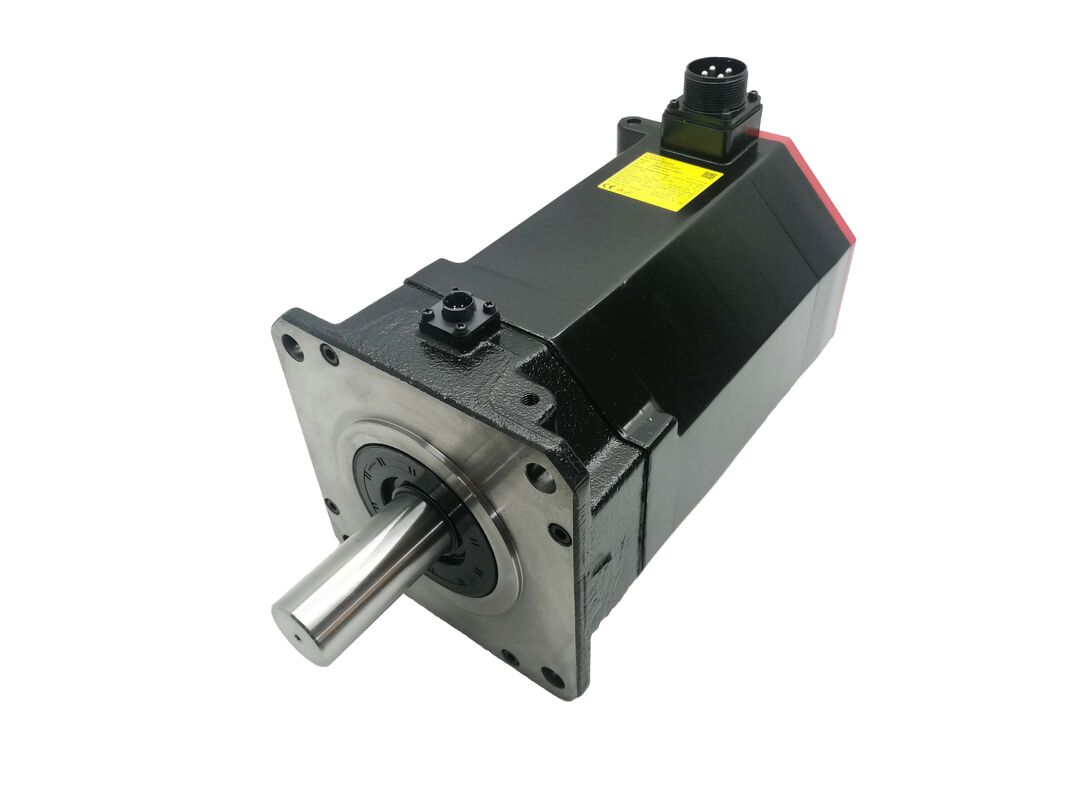
New Fanuc A06B-0205-B001 — α Series AC Servo Motor for Established CNC Platforms & Reliable Axis Replacement
FANUC · AC SERVO MOTOR · α SERIES · NEW UNIT
What You're Looking At
The Fanuc A06B-0205-B001 is a brushless AC servo motor from Fanuc's α series — the generation of Fanuc servo motors that defined the company's AC servo platform across a broad span of CNC machine tool production. This listing is a new unit: not remanufactured, not refurbished, not rebuilt from a used core. New old-stock in original factory condition, with the full mechanical and electrical integrity that implies.
That distinction carries real weight in the maintenance world. α series motors are mature components by any measure — the machines they were designed for have been running for years, sometimes decades. When a motor fails on that equipment, the replacement decision comes down to a straightforward question: do you want a unit with unknown service history, or one that has never been installed? For production-critical machines where unplanned downtime is expensive, the answer is usually clear.
The B001 suffix defines the encoder specification and connector configuration of this unit. It governs which cables connect, which amplifier modules are compatible, and whether the motor installs directly into the machine without wiring modification. The full part number — base model and B001 suffix together — is the specification. Neither element is a detail to approximate when sourcing a replacement.
Key Specifications
| Parameter |
Value |
| Model Number |
A06B-0205-B001 |
| Condition |
New |
| Motor Type |
Brushless AC Servo |
| Series |
Fanuc α Series |
| Feedback System |
Pulse Coder |
| Drive Compatibility |
Fanuc α Series Servo Amplifier |
| Cooling Method |
Self-Cooled (Natural Convection) |
| Mount Type |
Flange Mount |
| Generation |
α Series (Pre-αi Platform) |
| Application Focus |
CNC Machine Tools / Industrial Automation |
The α Series: Its Place in Fanuc's History and Your Maintenance Strategy
Fanuc's servo motor development has moved through several distinct generations — from early DC servo motors through the AC transition and into the current αi and βi platforms. The α series represents a pivotal chapter in that history: it was Fanuc's first fully mature AC servo product line, deployed at scale across global CNC machine tool production from the late 1980s through the 1990s and into the 2000s.
The machines built around α series motors are now well into their service lives. Some have been through spindle rebuilds, control upgrades, and multiple rounds of preventive maintenance. Many are still producing parts profitably — tool and die shops, subcontract machining operations, and automotive component facilities all have equipment in this category. Replacing functional machines that still hold tolerance isn't always the economically rational choice, particularly when the alternative is a capital expenditure that competes with other priorities.
For those machines, a supply of new α series motors is not a curiosity — it is a practical maintenance resource. A new A06B-0205-B001 goes into a machine the same way the original did: correct part number, correct encoder interface, correct connector geometry, no adaptation required.
Three things define the α series motor's operating characteristics in service:
Pulse coder feedback architecture. The α series uses Fanuc's pulse coder for position feedback — a digital encoder that transmits position data to the α series servo amplifier. This is a different encoder architecture from the serial encoder used in the αi and βi series, and the distinction is not cosmetic. The pulse coder signal protocol, connector type, and cable specification are all α series-specific. They do not cross-connect to αi or βi amplifiers without conversion hardware, which is why matching the motor generation to the amplifier generation matters in any replacement or procurement decision.
Proven reliability profile. The α series has accumulated an enormous service history across global manufacturing. Its failure modes, maintenance intervals, and remanufacturing procedures are well documented. For maintenance engineers managing a fleet of Fanuc α series machines, the failure characteristics of these motors are known quantities — which simplifies both preventive maintenance scheduling and post-failure diagnosis.
New unit condition — no service history, no wear. A remanufactured motor is only as good as the rebuild it received. Bearing replacement, encoder condition, winding insulation integrity — these are all outcomes of the rebuild process, not guarantees. A new unit starts with none of those uncertainties. The bearings have zero hours. The encoder has never been subjected to thermal cycling or vibration in service. The windings have not been exposed to contamination or partial thermal stress. For applications where return-to-service reliability is the priority, new condition is the straightforward choice.
System Compatibility & Architecture
The A06B-0205-B001 operates within Fanuc's α series servo drive architecture. It connects to α series servo amplifier modules — the earlier-generation amplifiers that match the α series motor's pulse coder interface and power connector specification.
The compatibility boundary between the α series and the current αi/βi platforms is firm at the amplifier level. The α series motor's pulse coder is not directly compatible with αi or βi amplifiers, which use Fanuc's serial encoder protocol. Connecting an α series motor to a current-generation amplifier is not a valid configuration without encoder conversion hardware — it is a system change, not a component swap.
For machines where the α series amplifier is functional and the motor has failed, sourcing a new A06B-0205-B001 is the correct maintenance path. For machines where both motor and amplifier have failed, or where a control upgrade is already planned, the scope of work expands to a full drive system replacement — a different project with different engineering requirements.
Controller families that run α series servo systems include: Older variants of the Fanuc Series 0, Series 15, Series 16, and Series 18 CNC controllers configured with α series servo amplifier modules. The specific controller and amplifier pairing in a given machine is defined by the machine builder's original design — confirm the amplifier module type from the machine's electrical documentation before sourcing a replacement motor.
Typical Machine Applications
The A06B-0205-B001 is found across the range of CNC machine types that were built on Fanuc α series servo systems during the platform's production years:
- CNC machining center primary feed axis drives — X, Y, Z
- CNC lathe longitudinal and cross-slide axis drives
- Horizontal boring and milling machine feed axes
- CNC grinding machine table traverse and cross-feed drives
- CNC gear hobbing and gear grinding machine axes
- Transfer line rotary and linear positioning drives
- Large-format CNC router and plasma cutting axis drives
- Five-axis machining center rotary and tilt axis positioning
- Pallet changer and workpiece handling automation
Why Condition Matters on Legacy Motor Sourcing
The α series motor market operates across a spectrum of conditions — new old-stock, remanufactured, repaired, and used pull units are all present in the supply chain. Understanding what you're actually buying matters:
New old-stock (this listing): Factory-built unit, never installed, in original condition. Full mechanical and electrical integrity. No service history. Correct choice when return-to-service reliability is the primary concern and budget allows.
Remanufactured: Used core rebuilt to serviceable condition. Quality varies significantly by rebuilder. A rebuild from a reputable center with documented bearing replacement, encoder validation, and performance testing is a legitimate option. A rebuild with no documentation of what was replaced is a gamble.
Repaired: A failed unit with specific faults corrected. May not address underlying wear that was not the immediate failure cause. Appropriate for budget-constrained situations where the repair scope is clearly defined and documented.
Used pull: Removed from a machine, condition unknown. Appropriate only when nothing else is available and the risk of early failure is acceptable in the application.
For a production-critical axis on a machine where downtime costs are real, new condition eliminates the uncertainty that the other categories carry.
Practical Replacement Guidance
Part number matching is the first priority. The B001 suffix is a functional specification — encoder type and connector configuration. A motor with a different suffix installed in a machine wired for B001 will present connector mismatch, incorrect encoder signal, or both. Confirm the full part number from the nameplate of the failed motor before procurement.
Back up parameters before starting. CNC controller parameters — axis travel limits, acceleration settings, torque clamp values, backlash compensation — are stored in the controller, not the motor. Back up the full parameter set before removing the failed motor. Restoring parameters from a current backup after motor replacement is a ten-minute task. Reconstructing them from documentation is not.
Inspect the cable assemblies. On machines where the original motor cable set has been in service for ten or more years, encoder cable insulation, connector contacts, and shield continuity should be inspected during the motor replacement. Cable-induced encoder faults on a freshly installed new motor are a frustrating diagnostic scenario that a proactive cable inspection during the planned replacement avoids entirely.
Verify axis operation before returning to production. After installation and parameter restoration, run the axis manually through its full travel range at low speed before switching to automatic operation. Confirm correct direction, smooth motion, and absence of position feedback alarms. A brief manual verification takes minutes; it catches wiring errors and parameter mismatches before they cause a machine fault or collision during an automatic cycle.
FAQ
Q1. What servo amplifier is the Fanuc A06B-0205-B001 compatible with?
It is designed for use with Fanuc α series servo amplifier modules. The α series motor uses a pulse coder encoder interface that is specific to the α series amplifier generation and is not directly compatible with Fanuc αi or βi series amplifiers, which use a different serial encoder protocol.
Q2. What is the advantage of purchasing a new unit versus a remanufactured one?
A new unit has never been installed or subjected to operational stress — bearings, encoder, and windings are all in factory-original condition with no accumulated wear or service history. A remanufactured unit has been rebuilt from a used core, and quality depends entirely on the rebuild process. For production-critical axes where return-to-service reliability matters, new condition removes the uncertainty that remanufactured units carry.
Q3. Can the A06B-0205-B001 be used with a current-generation Fanuc αi or βi amplifier?
Not as a direct replacement. The α series pulse coder interface and the αi/βi serial encoder interface are architecturally different. Connecting an α series motor to a current-generation amplifier without encoder conversion hardware is not a supported configuration. If both the motor and amplifier require replacement, the correct path is a full drive system upgrade, not a mixed-generation installation.
Q4. Is the B001 suffix interchangeable with other B0xx suffix variants on the same base model?
No. The suffix specifies the encoder type and connector configuration. Different suffix codes within the same base model number can have incompatible connector geometries or pulse coder specifications. Always confirm and source against the exact complete part number from the original motor's nameplate.
Q5. What should be done after installing the replacement motor before returning the machine to production?
Restore the CNC controller's axis parameters from a backup file taken before motor removal. Then run the axis manually through its full travel range at low feed rate, confirming correct direction of travel, smooth motion, and no encoder-related alarms. Complete this manual verification successfully before switching the machine to automatic cycle operation.


 Your message must be between 20-3,000 characters!