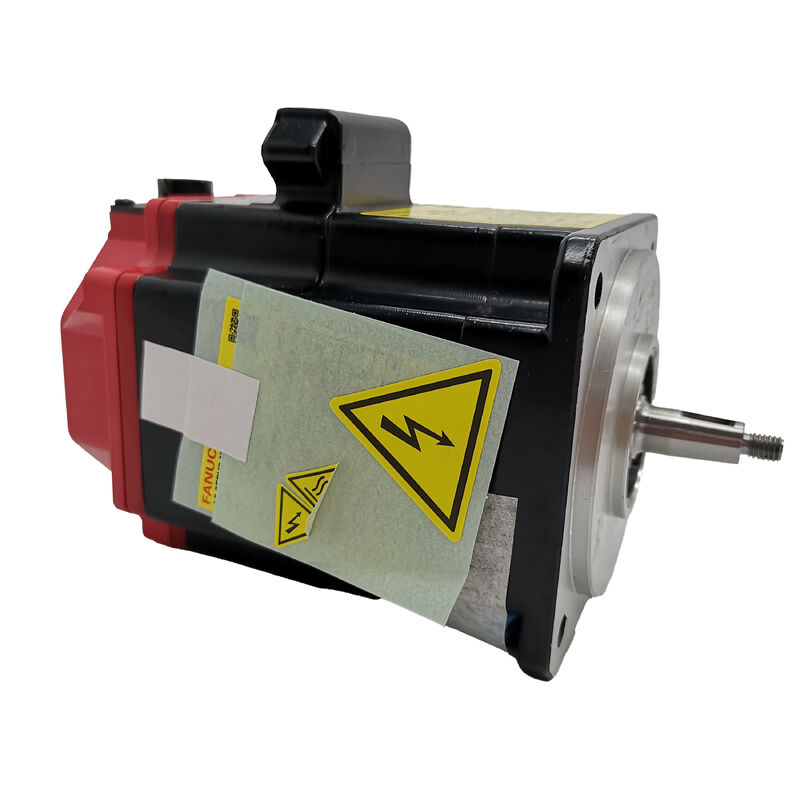
FANUC A06B-0205-B100 AC Servo Motor - Alpha iF 2/5000 Series
Built for the Demands of Modern CNC Motion Control
When a machine tool needs smooth, repeatable axis movement at high cycle rates, the choice of servo motor matters more than most people realize. The FANUC A06B-0205-B100 is an AC servo motor from the Alpha iF series — a line that has earned a quiet reputation on factory floors across automotive, aerospace, and precision machining environments for doing exactly what it's asked, shift after shift.
This motor runs at a rated speed of 4,000 RPM with a maximum speed of 5,000 RPM, delivering a stall torque of 2.0 Nm and a rated output of 0.75 kW (1.0 HP). The peak torque reaches 8.3 Nm, giving it solid punch for acceleration demands in high-speed positioning applications. It weighs in at 4.3 kg — compact enough to fit tight machine tool enclosures without sacrificing performance.
The B100 variant ships with a straight shaft (φ10 mm) and the FANUC Alpha iA1000 pulse coder, enabling high-resolution position feedback that's essential for closed-loop servo control. There is no integrated brake on this configuration, keeping the footprint and inertia lean — rotor inertia is 0.000526 kg*m².
Technical Specifications at a Glance
| Parameter |
Value |
| Rated Output |
0.75 kW / 1.0 HP |
| Rated Speed |
4,000 RPM |
| Maximum Speed |
5,000 RPM |
| Stall Torque |
2.0 Nm |
| Maximum Torque |
8.3 Nm |
| Stall Current |
3.5 A (rms) |
| Torque Constant |
0.57 Nm/A (rms) |
| Rotor Inertia |
0.000526 kg*m² |
| Armature Resistance |
1.1 Ω |
| Thermal Time Constant |
20 min |
| Shaft Type |
Straight, φ10 mm |
| Encoder |
Alpha iA1000 Pulse Coder |
| Weight |
4.3 kg |
Where It Gets Used
The A06B-0205-B100 is a natural fit for CNC machining centers, turning centers, and milling machines where compact axis motors are paired with FANUC servo amplifiers. It also sees use in robotic workcells, automated assembly lines, and multi-axis gantry systems where consistent torque response at varying speeds is non-negotiable.
The Alpha iF series was designed with integration in mind — these motors work within the broader FANUC servo ecosystem, making parameter setup and troubleshooting straightforward for engineers already familiar with FANUC CNC systems. The pulse coder output feeds directly into FANUC servo drives without the need for additional signal conditioning.
Compatibility & Interchangeability
This motor is compatible with FANUC servo amplifier modules from the αi amplifier family. It can replace worn or damaged motors in existing machine installations without requiring changes to drive parameters in most cases. When sourcing a replacement, always verify the shaft configuration and encoder type against the original unit — subtle differences in the suffix codes can mean different connector orientations or shaft dimensions.
Frequently Asked Questions
Q1: What is the difference between the A06B-0205-B100 and the A06B-0205-B000?
A: The primary distinction lies in the shaft and connector configuration. The B100 version features a straight shaft without a keyway, while the B000 is the base configuration — shaft and connector layout details differ between suffix variants. Always cross-check the original motor's suffix before ordering a replacement.
Q2: Which FANUC servo drive is compatible with this motor?
A: This motor is designed to work with FANUC αi series servo amplifiers. The Alpha iA1000 pulse coder on the B100 communicates natively with FANUC CNC systems using FSSB (FANUC Serial Servo Bus). Consult the drive documentation for axis assignment and parameter settings.
Q3: Does the A06B-0205-B100 include a holding brake?
A: No. The B100 configuration does not include an integrated holding brake. If your application requires axis braking — for example, a vertical axis that must hold position when power is cut — you would need a variant with brake, identifiable by a different suffix code.
Q4: What is the expected service life, and what typically causes failure?
A: Under normal operating conditions and regular maintenance, FANUC Alpha iF motors are known for long service life. The most common failure modes include encoder deterioration, bearing wear, and winding insulation degradation caused by overheating or excessive vibration. Keeping the motor within rated load and ambient temperature conditions significantly extends its service life.
Q5: Can this motor be repaired, or should it be replaced outright?
A: Both options are viable depending on the failure type. Encoder failures and bearing replacements are commonly handled by FANUC-authorized repair facilities. For winding or severe mechanical damage, replacement is usually more cost-effective. Rebuilt units are available on the market and can be a practical alternative when original new stock lead times are long.


 Your message must be between 20-3,000 characters!