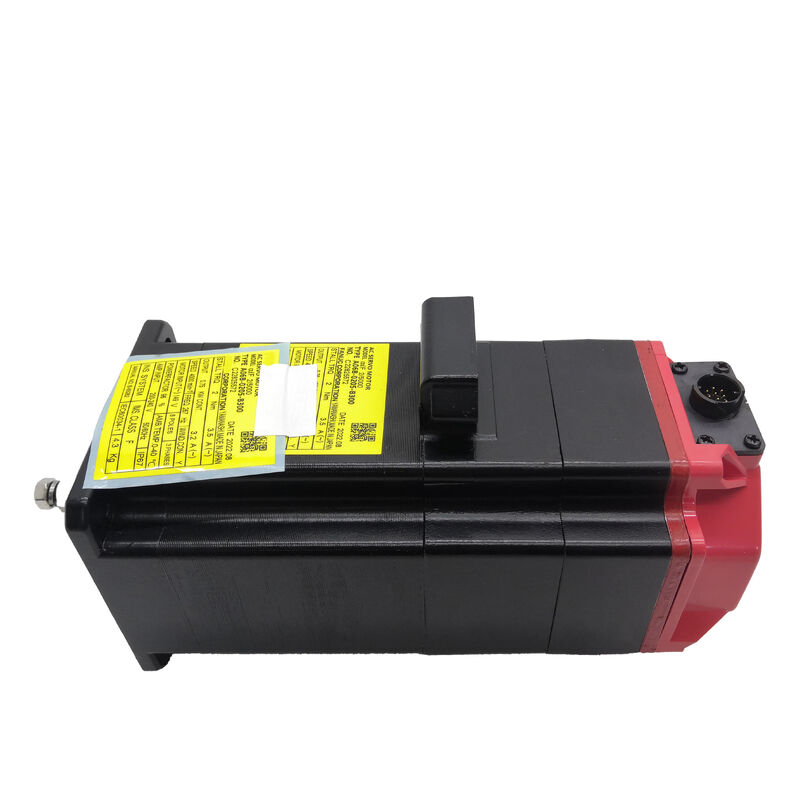
Fanuc A06B-0205-B300 — Compact αiF 2/5000 AC Servo Motor, Taper Shaft, 24V Brake, Absolute A1000 Pulse Coder
Product Overview
Part Number: A06B-0205-B300
Also Searched As: A06B0205B300, Fanuc A06B-0205-B300, FANUC A06B0205B300
Motor Model: αiF 2/5000
Classification: Fanuc Alpha iF Series AC Brushless Servo Motor — 2 Nm Stall Torque, 5,000 rpm Max Speed, Taper Shaft with Key, 24V Spring-Applied Electromagnetic Brake, Absolute A1000 Pulse Coder, IP65
The Motor in a Sentence
The Fanuc A06B-0205-B300 is the smallest braked motor in Fanuc's alpha iF servo family — a compact, high-speed 0.75 kW unit carrying a spring-applied 24V brake and an absolute pulse coder on a taper shaft with key. It belongs on vertical or inclined CNC axes where the load is light, the shaft speed is high, and the axis must hold position mechanically whenever the servo is inactive.
Technical Specifications
| Parameter |
Value |
| Part Number |
A06B-0205-B300 |
| Motor Model |
αiF 2/5000 |
| Rated Output |
0.75 kW |
| Stall Torque |
2 Nm |
| Stall Current |
3.5 A |
| Maximum Torque |
8.3 Nm |
| Rated Speed |
4,000 rpm |
| Maximum Speed |
5,000 rpm |
| Motor Input Voltage |
149V (3-phase) |
| Amplifier Input Voltage |
200–240V AC, 50/60 Hz |
| Poles |
8 |
| Power Factor |
96% |
| Brake Type |
Spring-applied, electrically released |
| Brake Voltage |
24V DC |
| Pulse Coder |
Alpha i A1000 (serial absolute) |
| Encoder Resolution |
1,000,000 pulses/rev |
| Shaft Type |
Taper shaft with key (TPR) |
| Protection Rating |
IP65 |
| Insulation Class |
Class F |
| Ambient Temperature (Operation) |
0°C to +40°C |
| Storage Temperature |
−20°C to +60°C |
| Compatible Amplifiers |
Fanuc αi series (αiSV) servo amplifiers |
| Compatible Controls |
Fanuc Series 0i, 15i, 16i, 18i, 21i, 30i, 31i, 32i |
| Status |
Available — new, refurbished, and repair |
Compact and Fast: The αiF 2/5000 Working Envelope
The αiF 2/5000 is the smallest motor in the Fanuc alpha iF family at 0.75 kW, and it earns its place on machines precisely because of that compact footprint. Small axes — light Z-feeds, subsidiary vertical indexing drives, compact rotary tool magazine lift mechanisms — do not need the bulk of an αiS 8/4000. They need a motor that fits the mechanical space available, delivers enough torque for the load, and moves fast enough to keep cycle times short.
Two Newton-metres of stall torque is the right answer for genuinely light loads. A small spindle head on a compact drill-tap centre, a lightweight indexing head on a multi-axis machine, a secondary Z-axis on a turning centre with a minimal tool post assembly — these axes operate comfortably within the 2 Nm stall torque budget. The 8.3 Nm maximum torque available during acceleration transients provides the dynamic headroom that the rated torque alone does not convey.
At 4,000 rpm rated speed with a 5,000 rpm maximum, this is a high-speed motor. On a 5mm pitch ball screw in direct coupling, 4,000 rpm produces 20 m/min of linear traverse — enough for productive rapid traverse on compact machines without any reduction stage between motor and screw. The 96% power factor means the electrical system is working efficiently, with minimal reactive current demand on the αi amplifier supply.
Taper Shaft with Key: The Machine Tool Standard Interface
The taper shaft on the A06B-0205-B300 — designated TPR in Fanuc's full motor description — is the machine tool standard shaft interface, and the reasons for that are practical and well-established.
A precision-ground taper on the motor shaft mates with a corresponding taper bore in the coupling hub. When the hub is pulled onto the shaft with a draw bolt through the shaft-end thread, the taper geometry centres the hub automatically. The motor and driven shaft axes align to tight geometric tolerance without any manual adjustment or alignment verification. The key, seated in matched keyway slots in both shaft and hub, transmits torque mechanically — independently of the axial clamping force and without depending on friction to carry the load.
For a 2 Nm stall torque motor with 8.3 Nm peak, this is a mechanically robust torque path that handles the cyclic loading of a CNC axis across years of production service without degradation. The key does not loosen under vibration, does not wear with the thermal cycles of machine-on and machine-off, and does not require periodic re-tightening to maintain its torque capacity.
When this motor needs to be replaced — which it will, eventually — the taper shaft makes the process straightforward. The replacement seats identically to the original without shimming or alignment measurement, and the coupling hub returns to exactly the same geometric position relative to the motor flange.
24V Spring-Applied Brake: Compact Safety for Small Vertical Axes
The spring-applied brake is the functional core of the B300 configuration, and understanding how it works is essential for any engineer specifying or servicing this motor.
The spring holds the friction disc engaged at all times. The brake is closed by default. To free the shaft for rotation, the brake coil must be energised with 24V DC — the magnetic force overcomes the spring and lifts the disc away from the braking surface. Remove that 24V for any reason and the spring immediately re-closes the brake. This is true for every type of de-energisation: a commanded E-stop, a power panel fault, an unplanned mains interruption, or a routine servo-off at end of cycle.
On a small vertical axis — which is the primary application for this motor — this fail-safe behaviour is what makes the axis safe. Servo lock holds the axis when the amplifier is powered and functioning normally. The spring-applied brake holds the axis under every other condition: amplifier fault, power loss, E-stop, machine shutdown. The two mechanisms are complementary, covering the full range of operating states the machine will encounter.
The 24V brake circuit needs its own supply in the machine panel, dedicated to the brake coil and separate from the servo amplifier's main supply. A relay switches the coil, with a flyback diode across the coil terminals to suppress the inductive spike when the relay opens. The Fanuc CNC's brake release output coordinates the release and engagement sequences with servo enable — establishing servo lock before the brake opens, and closing the brake before servo enable is removed. Following this sequence protects the brake disc from the wear that engagement on a moving shaft creates.
Alpha i A1000 Pulse Coder: Absolute Position at High Resolution
The encoder on the A06B-0205-B300 is the Alpha i A1000 — Fanuc's standard serial absolute pulse coder at 1,000,000 pulses per revolution.
On a braked vertical axis, the combination of spring-applied brake and absolute encoder produces a specific operational advantage that matters in daily production. When the machine shuts down — planned or not — the brake holds the axis exactly where it stopped. The A1000's multi-turn counter retains the exact shaft angle throughout the outage, maintained by the backup battery in the Fanuc αi servo amplifier. When power returns, the CNC reads the absolute position immediately. Servo lock is established. The brake releases in sequence. The machine resumes from exactly the position where it stopped, without any homing movement.
This matters more than it might first appear. On a compact machine where the vertical axis home position sits close to fixtures or tooling in the work area, the homing movement that an incremental encoder requires after every power event needs careful management — clear the work area, supervise the movement, verify position, then resume. The A1000 eliminates all of that. The axis holds, the encoder remembers, and restart is immediate.
At 1,000,000 counts per revolution, the position resolution on a 5mm pitch ball screw is 5 nanometres per encoder count. The CNC position loop closes at this resolution, enabling the sub-micron positioning repeatability that precision machines require.
Battery reminder. The A1000's backup battery lives in the Fanuc αi servo amplifier, not in the motor. Replace it when the Fanuc CNC issues a battery alarm — a depleted battery resets the absolute counter and forces a reference-return before production can resume.
A06B-0205 Family: Where the B300 Fits
The A06B-0205 series covers the full αiF 2/5000 motor family across shaft configurations, brake voltages, and encoder types:
| Part Number |
Shaft |
Brake |
Encoder |
| A06B-0205-B000 |
Taper with key |
No |
A1000 (absolute) |
| A06B-0205-B001 |
Taper with key |
No |
i1000 (incremental) |
| A06B-0205-B100 |
Straight smooth |
No |
A1000 (absolute) |
| A06B-0205-B300 |
Taper with key |
24V spring-applied |
A1000 (absolute) |
| A06B-0205-B400 |
Straight smooth |
24V spring-applied |
A1000 (absolute) |
| A06B-0205-B605 |
Taper with key |
90V spring-applied |
A1000 (absolute) |
The B300 is the taper shaft, 24V brake, absolute encoder combination — the correct specification for a small vertical CNC axis using a taper-shaft coupling and a 24V DC brake supply. The B400 is mechanically identical except for the straight smooth shaft, for applications using smooth-bore coupling hubs. The B605 carries a 90V brake coil for machines with 90V brake supplies.
Compatible Controls and Amplifiers
The A06B-0205-B300 requires a Fanuc αi series servo amplifier (αiSV) — the αiSV 4 is the typical pairing for the 0.75 kW / 2 Nm αiF 2/5000 motor. Compatible CNC platforms include Fanuc Series 0i-D, 0i-F, 15i, 16i, 18i, 21i, 30i, and 31i. The motor is not compatible with first-generation α or αC series amplifiers, which lack the αi serial encoder interface, or with Fanuc β series drives.
CNC axis parameters must be set to the αiF 2/5000 motor type from Fanuc's servo parameter database, with brake release timing configured appropriately for the vertical axis duty cycle. Fitting the A06B-0205-B300 as a replacement for a failed unit on an existing machine requires verifying the parameter set matches this specific motor rather than any other αiF 2 variant.
Typical Applications
Small vertical Z-axis on compact CNC machining centres. Drill-tap centres, small vertical machining centres, and compact 5-axis machines where the spindle head assembly is lightweight and the Z-axis connects through a taper-shaft coupling. The 2 Nm stall torque handles small spindle head weights; the spring-applied brake holds the head at every stop.
Secondary Z-axis on multi-axis turning centres. Sub-spindle Z-feed axes, live tool vertical feeds, and auxiliary vertical drives on CNC turning centres where a lightweight axis needs both speed and fail-safe braking.
Vertical rotary tool magazine lift drives. Servo-driven vertical lift mechanisms on chain-type or disc-type tool magazines on CNC machining centres, where the magazine carrier or lift arm must hold position mechanically during tool change dwell periods.
Indexed vertical transfer axes on compact automation cells. Small part lift, indexed vertical positioning, and Z-axis shuttle drives on Fanuc-controlled automation cells where the axis load is light and the spring-applied brake is needed for safe operation during servo-off periods.
Fanuc robot wrist and subsidiary joint drives. Fanuc robot joint axes using αi series amplifiers where the αiF 2/5000's compact size, high speed, and absolute encoder suit the joint's mechanical and kinematic requirements.
FAQ
Q1: What is the difference between the A06B-0205-B300 and the A06B-0205-B000?
The functional difference is the electromagnetic brake. The B000 has no brake — at rest, axis position is held by Fanuc servo lock, which requires the servo amplifier to remain powered and active. The B300 has a 24V spring-applied brake that holds the shaft mechanically whenever the brake coil is de-energised, regardless of servo state. Both motors have identical stall torque (2 Nm), rated speed (4,000 rpm), shaft type (taper with key), and encoder (A1000 absolute). Use the B000 on horizontal axes with no gravitational load; use the B300 on vertical axes and any gravity-loaded mechanism.
Q2: Can the A06B-0205-B300 operate at 5,000 rpm, and when is that speed available?
The motor's rated speed is 4,000 rpm — the speed at which continuous rated output of 0.75 kW is guaranteed. The maximum speed of 5,000 rpm is available in the constant-power region above rated speed, where available torque decreases as speed increases. In practical terms, 5,000 rpm is accessible for rapid traverse on light-load axes where the torque demand at that speed is below what the motor can sustain at 5,000 rpm. Verify the torque-speed curve against the axis duty cycle before relying on above-rated-speed operation for sustained machining loads.
Q3: What servo amplifier is compatible with the A06B-0205-B300?
The A06B-0205-B300 requires a Fanuc αi series servo amplifier (αiSV) — the αiSV 4 is the standard pairing for the 0.75 kW αiF 2/5000 motor. Compatible CNC platforms include Fanuc Series 0i-D, 0i-F, 15i, 16i, 18i, 21i, 30i, and 31i. This motor is not compatible with older first-generation α or αC series amplifiers, or with Fanuc β series drives. Axis parameters in the CNC must be configured for the αiF 2/5000 motor type, including correct brake release timing parameters.
Q4: The B300 has a 24V brake — what happens if the machine loses power unexpectedly?
The spring-applied brake closes immediately when 24V is removed from the coil — including on unplanned power loss. The spring is always trying to close the brake; the coil current is what holds it open. When mains power fails, the 24V supply drops, the coil de-energises, and the spring closes the brake within milliseconds. The axis is mechanically held at whatever position it occupied at that moment. No CNC command, no software, and no active system is required to make this happen. The spring acts passively and unconditionally.
Q5: Does the A1000 absolute encoder eliminate the homing cycle on power-up?
Yes — for CNC systems configured to use the absolute position data. The A1000 retains multi-turn absolute shaft position through power-off events via a backup battery in the Fanuc αi servo amplifier. When the CNC powers up, the αi amplifier reads the A1000's absolute position immediately, and the CNC establishes the axis machine coordinate without any movement. On a braked vertical axis, this means the spring brake held the axis in place, the encoder retained the position, and the machine is ready to resume production immediately after power restoration. The backup battery in the servo amplifier must be maintained — replace it at the first Fanuc battery alarm to prevent counter reset and forced homing.



 Your message must be between 20-3,000 characters!