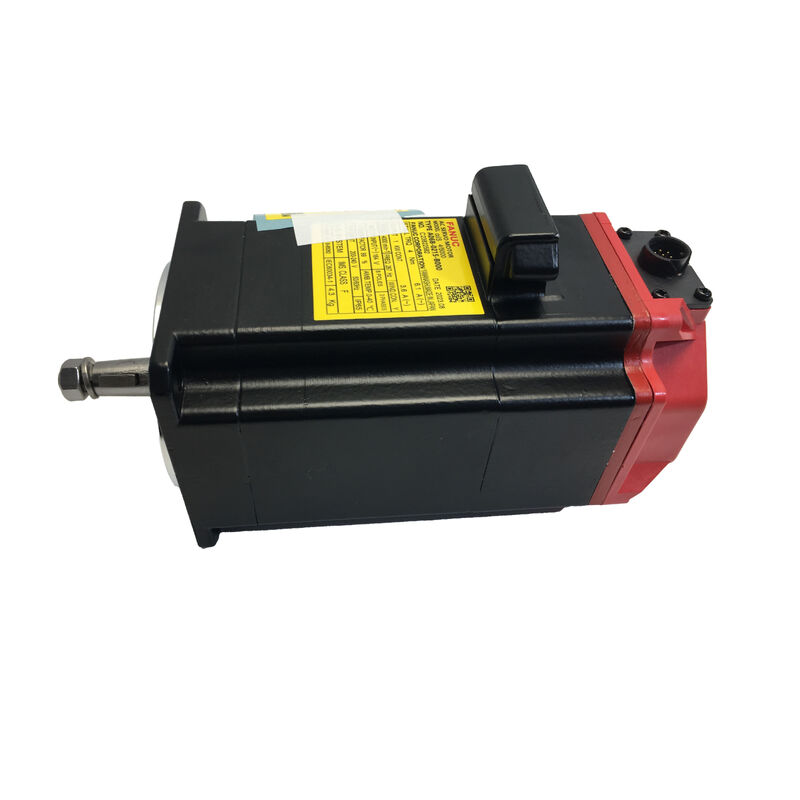
FANUC A06B-0212-B001 | Alpha iS 2/5000 AC Servo Motor — 2 Nm / 0.75 kW / 5000 rpm / Taper Shaft / i1000 / No Brake
αiS 2/5000 — 5000 rpm in a Compact Frame
The A06B-0212-B001 is FANUC's αiS 2/5000 — the Alpha iS 2 Nm motor at 5,000 rpm maximum speed. The 5,000 rpm ceiling is what distinguishes this motor within the 2 Nm class: on a 5mm pitch ball screw in direct coupling, 5,000 rpm produces 25 m/min traverse, which covers rapid positioning requirements on compact CNC lathes and small machining centres without a speed-reduction stage.
At 0.75 kW and 3.8 kg, the motor fits installation spaces where larger Alpha iS motors would require mechanical redesign. The αiS series is the current motor generation matched to FANUC's αi series drive system — Alpha i SVM amplifiers and i-Series CNC controls (16i, 18i, 21i, 0i, 30i/31i/32i).
Key Specifications
| Parameter |
Value |
| Motor Model |
αiS 2/5000 |
| Stall Torque |
2 Nm |
| Rated Output |
0.75 kW |
| Max Speed |
5,000 rpm |
| Motor Voltage |
200V, 3-phase |
| Encoder |
i1000 incremental |
| Shaft |
Taper (TPR) |
| Brake |
None |
| IP Rating |
IP65 (body), IP67 (shaft) |
| Weight |
3.8 kg |
Taper Shaft — Coupling Repeatability
The taper shaft self-centres the coupling hub as it is drawn axially with a draw bolt through the shaft-end thread. The hub seats to the same geometric position every installation — no manual realignment. This repeatability matters in service: a motor swap that requires realignment introduces variables; a taper shaft motor swap that reseats in the original geometry does not. Hub installation: use a draw bolt, never press or hammer. Impact loading travels through the shaft to the i1000 encoder disc and rear bearing.
i1000 Encoder — Incremental, Homing Required
The i1000 pulsecoder is an incremental encoder. A reference-return (homing) cycle is required at each power-up to establish the axis position reference before production starts. The CNC cannot use the axis at a known position until homing is complete. If the application requires absolute position on power-up without a homing cycle, an Alpha iS motor variant with an absolute pulsecoder is the correct specification.
The B001 configuration has no brake. Position at servo-on is maintained by the amplifier's closed loop. Vertical axes or gravity-loaded mechanisms require the brake-equipped variant — the B001 is for horizontal axes and balanced loads where servo lock is sufficient.
FAQ
Q1: What amplifiers and CNC systems are compatible with the A06B-0212-B001?
FANUC αi series servo amplifiers (SVM modules from the A06B-6114 or A06B-6096 FSSB family). Compatible CNC: Series 16i, 18i, 21i, 0i-D/F, 30i/31i/32i. Confirm the amplifier's rated current covers the motor's stall current before pairing. This motor is not compatible with older α series (non-i) amplifiers.
Q2: The i1000 is incremental — can it be replaced with an absolute encoder variant for the same machine?
Physically yes — same flange and shaft. Electrically, the CNC's axis encoder type parameter must be updated to match the new encoder protocol. The absolute encoder variant also requires the backup battery in the servo amplifier to maintain multi-turn position. An axis originally configured for incremental feedback with homing will need parameter changes and recommissioning to use an absolute variant.
Q3: Does the B001 (no brake) work on any axis type?
The B001 is correct for horizontal axes and balanced loads where the servo amplifier's closed loop holds position during normal operation. At servo-off (planned or emergency), servo lock is removed and a braking-free motor on a vertical or gravity-loaded axis will move under gravity. For those axes, the brake variant with its spring-applied 24V brake is required.
Q4: After installing A06B-0212-B001, the axis shows a larger following error than the previous motor. What should be checked?
Confirm the CNC's motor type parameter matches the αiS 2/5000 specification — a parameter set for a different motor type produces a consistent following error. Check the encoder cable seating at the amplifier's feedback connector. Also check the taper shaft hub for correct seating — a hub that is not fully drawn onto the taper creates mechanical misalignment that adds friction and shows as following error before it generates a coupling alarm.
Q5: How does the A06B-0212-B001 differ from the A06B-0212-B000 (no brake, taper)?
The B000 and B001 share the same αiS 2/5000 motor specification — same stall torque, speed, power, and IP rating. The difference is in the encoder type embedded in the suffix system. Confirm the installed motor's exact suffix before ordering — the encoder specification must match the CNC's axis parameter configuration for the motor to operate correctly after replacement.


 Your message must be between 20-3,000 characters!