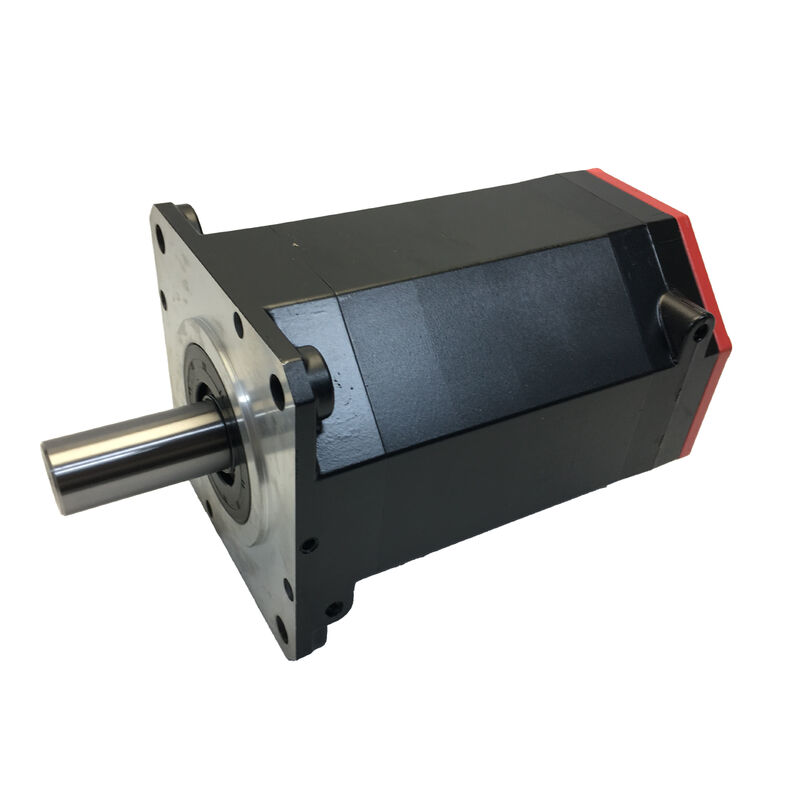
Fanuc A06B-0212-B100 — High-Speed αiS 2/5000 AC Servo Motor, Straight Shaft, No Brake, Alpha i A1000 Pulse Coder
Product Overview
Part Number: A06B-0212-B100
Also Searched As: A06B0212B100, Fanuc A06B-0212-B100, FANUC A06B0212B100
Motor Model: αiS 2/5000
Classification: Fanuc Alpha iS Series AC Brushless Servo Motor — 5,000 rpm, Straight Smooth Shaft, No Brake, Absolute A1000 Pulse Coder, IP65
What This Motor Does
Speed is the defining characteristic of the Fanuc A06B-0212-B100. At 5,000 rpm rated speed, this αiS 2/5000 sits at the high-velocity end of the Fanuc alpha iS servo motor family — operating faster than the 4,000 rpm motors that cover the majority of machining centre feed axes, and well above the 3,000 rpm motors used for heavy-duty slow drives. At 2 Nm stall torque, it is not a high-torque motor. But for axes where traversal speed and dynamic responsiveness are the design drivers — and where the load torque demand stays within the 2 Nm envelope — the αiS 2/5000 delivers what those applications need.
The A06B-0212-B100 comes in the simplest configuration in the αiS 2 family: straight smooth shaft, no electromagnetic brake, Alpha i A1000 absolute pulse coder. The B100 suffix encodes that no-brake configuration. For horizontal axes where servo lock holds position adequately at rest and rapid high-speed traversal is the performance requirement, this is the correct and complete specification.
Technical Specifications
| Parameter |
Value |
| Part Number |
A06B-0212-B100 |
| Motor Model |
αiS 2/5000 |
| Rated Speed |
5,000 rpm |
| Stall Torque |
2 Nm |
| Supply Voltage |
3-phase 200V AC |
| Pulse Coder |
Alpha i A1000 (serial absolute) |
| Encoder Resolution |
1,000,000 pulses/rev |
| Shaft Type |
Straight, smooth (ST, SLK — no keyway) |
| Electromagnetic Brake |
None |
| Protection Rating |
IP65 |
| Insulation Class |
Class F |
| Ambient Temperature (Operation) |
0°C to +40°C |
| Storage Temperature |
−20°C to +60°C |
| Compatible Amplifiers |
Fanuc αi series (αiSV) servo amplifiers |
| Compatible Controls |
Fanuc Series 0i, 15i, 16i, 18i, 21i, 30i, 31i, 32i |
| Status |
Available — new, refurbished, and repair |
5,000 rpm: The Case for Speed Over Torque
Every servo motor design involves a trade-off between speed and torque at a given physical size and power level. The αiS 2/5000 makes its trade-off explicitly: the "2" stall torque figure is modest for a Fanuc alpha iS motor, but "5000" rpm rated speed is at the ceiling of the standard α iS family's speed range.
That trade-off makes sense for specific machine axis types. Small-format CNC machining centres with lightweight table assemblies — where the table mass is low, the cutting forces are modest, and rapid traverse speed is what shortens cycle time — use high-speed small-torque motors efficiently. A 5,000 rpm motor driving a 4mm pitch ball screw produces 20 m/min linear traverse speed directly, without any intermediate reduction. For small machining centres competing on cycle time, that direct-drive rapid traverse capability is exactly what the axis design requires.
The same logic applies to drilling machines, engravers, and small specialty CNC equipment where compact axes with light loads need to move quickly and position accurately. The αiS 2/5000 covers that working envelope without the weight and volume penalty of a larger-torque motor.
Straight Smooth Shaft: Installation and Coupling
The shaft on the A06B-0212-B100 is straight and smooth — no keyway, no taper. Fanuc designates this ST (straight) and SLK (slick/smooth) in the full motor description. For the coupling designs used on this class of motor — precision split-hub bellows couplings, flexible disc couplings, and direct ball-screw coupling assemblies — this is the standard interface.
At 2 Nm stall torque, the friction clamping force from a properly specified split-hub coupling is entirely adequate. The coupling should be selected at or above the peak torque demand of the axis, which for a 5,000 rpm motor with 2 Nm stall will typically fall in the 4–6 Nm range once acceleration torque is included. Standard servo coupling catalogues have products directly suited to this specification at the shaft diameter of the A06B-0212-B100.
Replacement is straightforward: the smooth shaft allows the coupling hub to be slid off after loosening the clamp bolts, and the replacement motor hub fitted without keyway alignment. For machines where servo motor replacement is a planned maintenance procedure, this simplicity is an operational advantage.
Variants of the αiS 2/5000 with a keyway (KEY designation) are available under different part numbers within the A06B-0212 series. For the B100, the smooth shaft is confirmed by the SLK designation.
No Brake: The Right Configuration for Most Applications
The B100 suffix specifies no electromagnetic brake. Position at rest is maintained by the Fanuc αi servo amplifier's servo lock — the position loop remains closed, the A1000 pulse coder monitors shaft angle continuously at 1,000,000 counts per revolution, and the amplifier supplies corrective current to hold zero following error.
For horizontal axes with no gravitational load acting in the direction of shaft rotation, this is entirely reliable. The servo lock hold on a well-tuned Fanuc axis at rest is extremely tight — the shaft does not move measurably, and the CNC position register stays exactly where the last commanded position placed it. There is no mechanical wear, no relay to sequence, no 24V brake circuit in the panel, and no brake inspection requirement on the maintenance schedule.
The αiS 2/5000's natural application domain — high-speed light-load axes on small machining centres, drilling machines, and engraving equipment — consists primarily of horizontal axes where this no-brake configuration is both correct and preferred.
For any axis with a gravitational load component (vertical axes, inclined drives), the appropriate variant carries a brake suffix. The A06B-0212-B500 or B700-series part numbers within the A06B-0212 family include electromagnetic brake options for those applications.
Alpha i A1000 Pulse Coder: Absolute Position at One Million Counts
The Alpha i A1000 pulse coder fitted to the A06B-0212-B100 is a serial absolute encoder at 1,000,000 pulses per revolution. This is the same encoder class fitted to the αiS 8/4000 (A06B-0235-B000) and the broader Fanuc αi motor family — Fanuc's standard absolute position feedback device for the αi amplifier platform.
Why absolute matters. An absolute encoder retains position through power-off events. When the Fanuc CNC is switched on — after a planned shutdown, after an alarm stop, after a weekend — the αi servo amplifier reads the A1000's absolute position immediately. The CNC knows the exact machine coordinate of every axis before anything moves. No reference-return (homing) cycle is required. For a machining centre with multiple axes all fitted with absolute encoder motors, this means the machine is ready to run within seconds of power-up rather than after a potentially lengthy and carefully managed homing sequence.
Resolution at 5,000 rpm. One million counts per revolution at 5,000 rpm means the velocity feedback loop receives extraordinarily fine position updates per unit time. At rated speed, this translates to smooth torque output with essentially no quantisation noise in the velocity signal, which is what allows the Fanuc servo to run at maximum speed without speed ripple — a characteristic that matters on high-speed traversal axes where vibration from velocity ripple would affect surface finish or machine dynamics.
Battery backup. The A1000's multi-turn absolute counter is maintained through power-off by a backup battery in the Fanuc αi servo amplifier or the CNC cabinet battery unit. Replace the battery when the CNC issues a battery alarm. A fully discharged battery resets the counter and requires a reference-return before production can resume.
Where the αiS 2/5000 Fits in the Fanuc Alpha iS Family
The Fanuc αiS family covers a wide torque and speed range. The αiS 2/5000 sits at the high-speed, low-torque end:
| Model |
Stall Torque |
Rated Speed |
Typical Application |
| αiS 2/5000 |
2 Nm |
5,000 rpm |
Small CNC, light high-speed axes |
| αiS 4/4000 |
4 Nm |
4,000 rpm |
Compact machining centre axes |
| αiS 8/4000 |
8 Nm |
4,000 rpm |
Medium machining centre feed axes |
| αiS 12/4000 |
12 Nm |
4,000 rpm |
Heavy feed and vertical Z-axes |
| αiS 22/4000 |
22 Nm |
4,000 rpm |
Large machining centre primary axes |
The A06B-0212-B100 operates at the top of this family's speed range. Stepping up to the αiS 4/4000 or αiS 8/4000 means accepting lower speed in exchange for higher torque — the right trade-off when the axis load demands more than 2 Nm, and a step too far when the axis genuinely needs 5,000 rpm traversal capability.
Compatible Amplifiers and Controls
The A06B-0212-B100 operates with Fanuc αi series servo amplifiers (αiSV) — specifically the αiSV 4 or αiSV 8 at this power level, depending on the machine's axis configuration. The A1000 pulse coder communicates over the Fanuc serial encoder protocol supported by all αi-generation amplifiers.
Compatible Fanuc CNC platforms include Series 0i-D, 0i-F, 15i, 16i, 18i, 21i, 30i-A, 30i-B, 31i-A, 31i-B, and 32i. The motor is not compatible with earlier α-series amplifiers predating the αi generation, or with Fanuc β-series amplifiers, which use a different encoder protocol.
When fitting the A06B-0212-B100 as a replacement, verify the axis parameters in the CNC match the αiS 2/5000 motor type entry in Fanuc's motor parameter database. Incorrect motor type parameters can cause incorrect current limiting, unstable servo performance, or amplifier faults on startup.
Typical Applications
High-speed small machining centres. X and Y feed axes on small-format CNC vertical machining centres where table mass is light and rapid traverse speed is the cycle time driver. The 5,000 rpm motor drives the ball-screw at high linear speed on short-pitch screws without requiring a reduction stage.
CNC drilling and tapping machines. X-Y positioning axes on CNC drilling centres, tapping machines, and gang-drill units where rapid positioning between hole locations dominates the cycle. The αiS 2/5000's high speed minimises inter-hole positioning time; the A1000 absolute encoder provides immediate position knowledge on startup.
CNC engraving and routing machines. Primary axis drives on CNC engravers, sign-making routers, and small-format milling machines where lightweight gantry or table structure enables high traverse speeds and the cutting loads fall within the 2 Nm torque envelope.
Semiconductor and electronics equipment positioning axes. Precision positioning axes on PCB drilling equipment, semiconductor handling stations, and electronic component assembly machinery where high-speed short-stroke positioning cycles are the primary performance requirement.
Laser positioning and cutting machine axes. Lightweight cutting head positioning axes on small-format laser cutting and marking systems where the head mass is minimal and the axis must traverse rapidly between cut features.
Frequently Asked Questions
Q1: Does the A06B-0212-B100 have an absolute or incremental encoder?
The A06B-0212-B100 is fitted with the Alpha i A1000 serial absolute encoder at 1,000,000 pulses per revolution. Absolute means the motor retains multi-turn shaft position through power-off events via a backup battery in the Fanuc αi servo amplifier. When the CNC powers up, the axis position is known immediately — no reference-return homing cycle required. This is distinct from incremental encoder variants (designated "i" in the encoder suffix), which require homing on every power-up.
Q2: What is the difference between the A06B-0212-B100 and the A06B-0212-B500 or B705?
The key difference is the electromagnetic brake. The B100 has no brake — axis position at rest is held by Fanuc servo lock. The B500 and B705 variants include an electromagnetic brake (spring-applied, electrically released) for vertical axes and mechanisms where mechanical holding is required at servo-off. Additionally, the B705 uses a different pulse coder (a64ia — an incremental encoder with 64,000 ppr). All variants share the same αiS 2/5000 stall torque and rated speed. Choose B100 for horizontal axes with no gravitational load component; choose a braked variant for vertical axes.
Q3: Which Fanuc servo amplifier does the A06B-0212-B100 require?
The A06B-0212-B100 requires a Fanuc αi series servo amplifier (αiSV) — typically the αiSV 4 or αiSV 8 depending on the machine configuration. Compatible CNC platforms include Fanuc Series 0i-D/F, 15i, 16i, 18i, 21i, 30i, and 31i. This motor is not compatible with older first-generation α or αC series amplifiers, or with Fanuc β-series drives, which cannot decode the A1000 serial absolute pulse coder protocol.
Q4: What does the IP65 rating cover, and is there a higher-rated version?
The standard A06B-0212-B100 carries IP65 — complete protection against dust ingress and against directed water jets from any direction. This covers most indoor industrial environments including machines with coolant splash. The #0100 suffix variant (A06B-0212-B100#0100) upgrades the sealing to IP67, providing protection against temporary immersion up to 1 metre depth. For machines with heavy coolant flooding or wash-down requirements, the #0100 version should be specified.
Q5: What should be verified when installing an A06B-0212-B100 as a replacement?
Three checks are essential before commissioning. First, confirm the axis parameters in the CNC are set to the αiS 2/5000 motor type number from Fanuc's servo parameter guide — incorrect motor type settings cause servo instability or amplifier faults. Second, verify the coupling hub fit on the smooth straight shaft — ensure the split-hub clamp torque meets the coupling manufacturer's specification and provides adequate friction to resist the axis peak torque. Third, confirm the backup battery in the αi servo amplifier is in good condition; a depleted battery resets the absolute position counter and requires a reference-return cycle before production can resume.


 Your message must be between 20-3,000 characters!