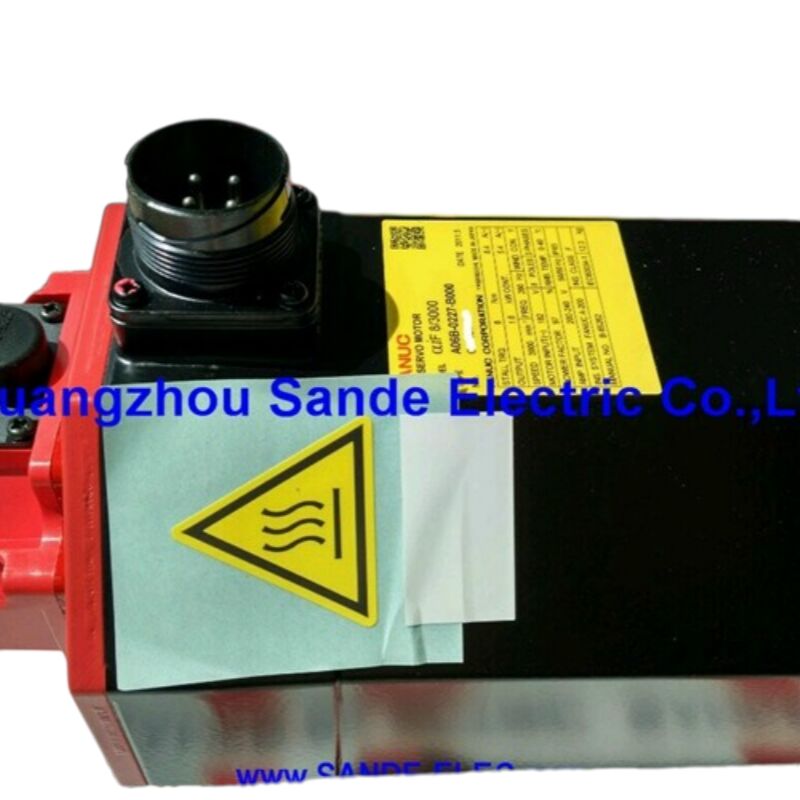
Fanuc A06B-0212-B101 — 5,000 rpm αiS 2/5000 AC Servo Motor, Straight Shaft, i1000 Incremental Pulse Coder, No Brake
Product Overview
Part Number: A06B-0212-B101
Also Searched As: A06B0212B101, Fanuc A06B-0212-B101, FANUC A06B0212B101
Motor Model: αiS 2/5000
Classification: Fanuc Alpha iS Series AC Brushless Servo Motor — 5,000 rpm, 2 Nm Stall Torque, Straight Smooth Shaft, No Brake, Alpha i i1000 Incremental Pulse Coder, IP65
The Motor in Brief
The Fanuc A06B-0212-B101 is a compact, high-speed servo motor from the αiS series — the smallest and fastest motor in Fanuc's standard alpha iS feed axis family. Rated at 5,000 rpm with a 2 Nm stall torque, it is built around a specific application profile: axes that need maximum shaft speed and rapid dynamic response over light loads, rather than sustained high-force operation.
What separates this part number from the otherwise identical A06B-0212-B100 is a single encoder difference. The B101 carries the Alpha i i1000 incremental pulse coder — 1,000,000 pulses per revolution, serial protocol, but incremental rather than absolute. That distinction has real operational consequences, covered in detail below, and knowing it is essential for both initial installation and field replacement.
Straight smooth shaft, no brake, IP65 — these are the base configuration choices of the B101.
Technical Specifications
| Parameter |
Value |
| Part Number |
A06B-0212-B101 |
| Motor Model |
αiS 2/5000 |
| Rated Speed |
5,000 rpm |
| Stall Torque |
2 Nm |
| Supply Voltage |
3-phase 200V AC |
| Pulse Coder |
Alpha i i1000 (serial incremental) |
| Encoder Resolution |
1,000,000 pulses/rev |
| Shaft Type |
Straight, smooth (ST, SLK — no keyway) |
| Electromagnetic Brake |
None |
| Protection Rating |
IP65 |
| Insulation Class |
Class F |
| Ambient Temperature (Operation) |
0°C to +40°C |
| Storage Temperature |
−20°C to +60°C |
| Compatible Amplifiers |
Fanuc αi series (αiSV) servo amplifiers |
| Compatible Controls |
Fanuc Series 0i, 15i, 16i, 18i, 21i, 30i, 31i, 32i |
| Status |
Available — new, refurbished, and repair |
i1000 vs A1000: The Encoder Distinction That Changes Operation
This is the most important technical point about the A06B-0212-B101, and it is easy to miss when cross-referencing part numbers.
The Fanuc αiS 2/5000 motor is available with two different pulse coder types at 1,000,000 ppr:
Alpha i A1000 — Absolute (B100 suffix) The A1000 retains multi-turn shaft position through power-off events via a backup battery in the servo amplifier. Power up the CNC, and every axis knows exactly where it is before anything moves. No homing required.
Alpha i i1000 — Incremental (B101 suffix) The i1000 tracks position accurately during operation but does not retain position through power-off. Every time the CNC powers up — or recovers from a power loss, E-stop, or alarm — the axis position is unknown until a reference-return cycle moves the axis to its home position marker. Only then does the CNC establish the coordinate.
Both encoders provide 1,000,000 ppr resolution and communicate over the same Fanuc serial protocol. The velocity feedback quality and positional accuracy during continuous operation are equivalent. The difference is entirely in the power-down behaviour.
For machine tools where a homing cycle is a normal and accepted part of startup, the i1000 is perfectly workable — and machines installed with the B101 from new will have their reference-return sequences already programmed and validated. The issue arises during field replacement: if the failed motor on a machine was a B100 (absolute), the B101 (incremental) is not a drop-in functional substitute without updating the CNC parameters to expect an incremental encoder and programming a reference-return procedure that did not previously exist.
5,000 rpm at 2 Nm: The Working Envelope
Speed and torque are always traded against each other at a given physical motor size. The αiS 2/5000 sits at the high-speed, compact-torque end of the alpha iS family.
What 5,000 rpm delivers on a machine axis. On a 4mm pitch ball screw, 5,000 rpm produces 20 m/min linear traverse speed in direct coupling — no gear or belt reduction needed. For small CNC machining centres and drilling machines where rapid traverse between holes or features is a major contributor to total cycle time, this traversal speed is genuinely useful.
What 2 Nm stall torque means in practice. Stall torque defines the maximum sustained force at zero speed. Two Newton-metres is modest — suitable for lightweight table and slide assemblies, not for heavy cutting operations on large CNC machines. On a 4mm pitch screw with typical efficiency, 2 Nm sustains roughly 2.8 kN of axial force. That budget covers small machining centre axes, engravers, PCB drilling heads, and compact automation positioning stages with confidence.
The αiS 2/5000's natural domain is small, fast, light-load axes — the opposite end of the application spectrum from the αiS 22/4000 motors found on heavy-duty horizontal machining centres.
Straight Smooth Shaft: Service-Friendly Interface
The shaft on the A06B-0212-B101 is straight and smooth — designated ST (straight) and SLK (slick, no keyway) in the full Fanuc motor description. This is the standard interface for precision servo couplings: split-hub bellows couplings, disc couplings, and taper-lock-style coupling hubs that clamp to the shaft OD.
At 2 Nm stall torque with peak torque during acceleration somewhat higher, correctly specified friction-clamp couplings handle the full operating range without slip. The coupling should be selected to the peak torque demand of the axis duty cycle, not just the stall figure.
The smooth shaft makes motor replacement straightforward. Loosen the coupling clamp, slide the hub off, install on the replacement motor, re-clamp. No keyway alignment, no keyway dimension verification. For sites where the A06B-0212-B101 is used across several axes — common in small machining centre and drilling centre applications — this simplicity accumulates across every service event.
No Brake: When Servo Lock Is Sufficient
Position at rest is maintained by the Fanuc αi servo amplifier's servo lock function. With the position loop active and the i1000 reporting 1,000,000 counts per revolution, the amplifier supplies corrective current to hold the commanded position against any small disturbance. For horizontal axes on machines where no gravitational load acts along the axis direction at servo-off, this is entirely reliable and accurate.
The αiS 2/5000's application territory — small machining centres, PCB equipment, engravers, and general positioning automation — consists almost entirely of horizontal axes where servo lock is the appropriate and sufficient solution. A brake on these axes would add panel complexity, a 24V circuit, relay maintenance, and brake disc inspection to the maintenance schedule, providing no functional benefit in return.
Where vertical axes or inclined mechanisms exist on the same machine, those axes should use a braked motor variant — the A06B-0212-B500 or B705 variants within the αiS 2/5000 family carry brake options. The A06B-0212-B101 is correctly specified for the horizontal axes on those machines.
Compatible Amplifiers and CNC Controls
The A06B-0212-B101 operates with Fanuc αi series servo amplifiers (αiSV) — typically the αiSV 4 at this power level. The i1000 pulse coder uses the same Fanuc serial encoder protocol as the A1000, so no special cabling or interface hardware is required. The CNC parameter set must specify the i1000 encoder type for the axis; fitting a B101 on an axis previously set up for a B100 (absolute) requires the relevant encoder-type parameters to be updated.
Compatible CNC controllers include Fanuc Series 0i-D, 0i-F, 15i, 16i, 18i, 21i, 30i-A, 30i-B, 31i-A, 31i-B, and 32i. The motor is not compatible with earlier α-series or αC-series amplifiers, or with Fanuc β-series drives, which use different encoder interface circuitry.
αiS 2/5000 Family: Where the B101 Fits Among Its Siblings
The A06B-0212 product series covers multiple configurations of the same αiS 2/5000 motor body:
| Part Number |
Shaft |
Brake |
Encoder |
| A06B-0212-B000 |
Taper |
No |
A1000 (absolute) |
| A06B-0212-B001 |
Taper |
No |
i1000 (incremental) |
| A06B-0212-B100 |
Straight smooth |
No |
A1000 (absolute) |
| A06B-0212-B101 |
Straight smooth |
No |
i1000 (incremental) |
| A06B-0212-B705 |
Straight smooth |
Yes (90V) |
a64ia (incremental) |
The B101 is the straight-shaft, no-brake motor with incremental encoder — appropriate for horizontal axes on machines where the startup homing sequence is already established.
Typical Applications
Small CNC vertical machining centre X/Y axes. Lightweight table and saddle drives on compact machining centres where 5,000 rpm traversal speed reduces inter-feature positioning time and the 2 Nm torque budget covers the modest table mass and cutting loads.
CNC PCB drilling and routing machines. X-Y positioning axes on PCB drilling centres, routing machines, and electronic assembly equipment. These machines execute thousands of short positioning moves per shift; the αiS 2/5000's high-speed, low-inertia profile keeps positioning time as short as the amplifier bandwidth allows.
CNC engraving and small-format routing. Primary axis drives on sign-engraving machines, jewellery CNC, and small-format milling equipment. The 5,000 rpm motor drives these typically lightweight gantry structures at maximum traverse speed without any intermediate reduction mechanism.
High-speed drilling and tapping machines. X-Y axis drives on gang drill and CNC tapping machines where the axis must traverse between hole locations at maximum speed and position quickly enough that the drill-retract-traverse-approach cycle time is not axis-motion-limited.
General automation positioning axes. Any Fanuc αi-amplifier-based automation system requiring 5,000 rpm, 2 Nm servo performance with a straight shaft, no brake, and incremental position feedback.
FAQ
Q1: What is the difference between the A06B-0212-B101 and the A06B-0212-B100?
The only difference is the pulse coder type. The B100 carries an A1000 absolute encoder — the motor retains multi-turn position through power-off, and the CNC knows the axis coordinate immediately on startup without any homing movement. The B101 carries an i1000 incremental encoder — position is lost at power-down, and a reference-return cycle is required every time the CNC is powered up or recovers from a stop. All other specifications — stall torque, rated speed, shaft type, brake configuration, and physical dimensions — are identical. Always confirm which encoder type the machine's CNC expects before ordering a replacement.
Q2: Does the A06B-0212-B101 require a reference-return cycle on every power-up?
Yes. The i1000 is an incremental encoder and does not retain absolute position through power-off events. Every CNC startup — whether planned or following an alarm stop or power interruption — requires the axis to execute its reference-return sequence before the CNC can establish a valid machine coordinate. This is normal behaviour for incremental encoder motors and is supported across all compatible Fanuc CNC platforms. The machine's reference-return program must be in place and validated before the motor is put into service.
Q3: Which Fanuc servo amplifier is compatible with the A06B-0212-B101?
The A06B-0212-B101 requires a Fanuc αi series servo amplifier (αiSV) — the αiSV 4 is the typical match at this power level. Compatible CNC systems include Fanuc Series 0i-D/F, 15i, 16i, 18i, 21i, 30i, and 31i. This motor is not compatible with older first-generation α or αC series amplifiers, or with Fanuc β-series drives. The axis parameter set in the CNC must be configured for the αiS 2/5000 motor type with i1000 encoder specification.
Q4: Can the A06B-0212-B101 replace an A06B-0212-B100 already installed on a machine?
Mechanically yes — both have the same straight smooth shaft, physical dimensions, and mounting interface. Functionally, the swap requires CNC parameter changes to update the encoder type from absolute to incremental, and the machine's startup sequence must be updated to include a reference-return cycle that was not previously required. In most production environments, replacing an absolute-encoder motor with an incremental one is not advisable unless the machine's startup sequences can be safely modified and revalidated. The preferred replacement for a B100 is another B100.
Q5: What is the IP65 rating on this motor, and is there a higher-protection version?
The standard A06B-0212-B101 carries IP65 — complete dust protection and resistance to directed water jets from any direction, suitable for most CNC machine environments. A sealed IP67 variant (designated with the #0100 suffix, A06B-0212-B101#0100) provides protection against temporary submersion up to one metre depth. The IP67 version is appropriate for machines with heavy coolant flooding or where motors are routinely exposed to directed coolant streams. Both variants share identical electrical and mechanical specifications.


 Your message must be between 20-3,000 characters!