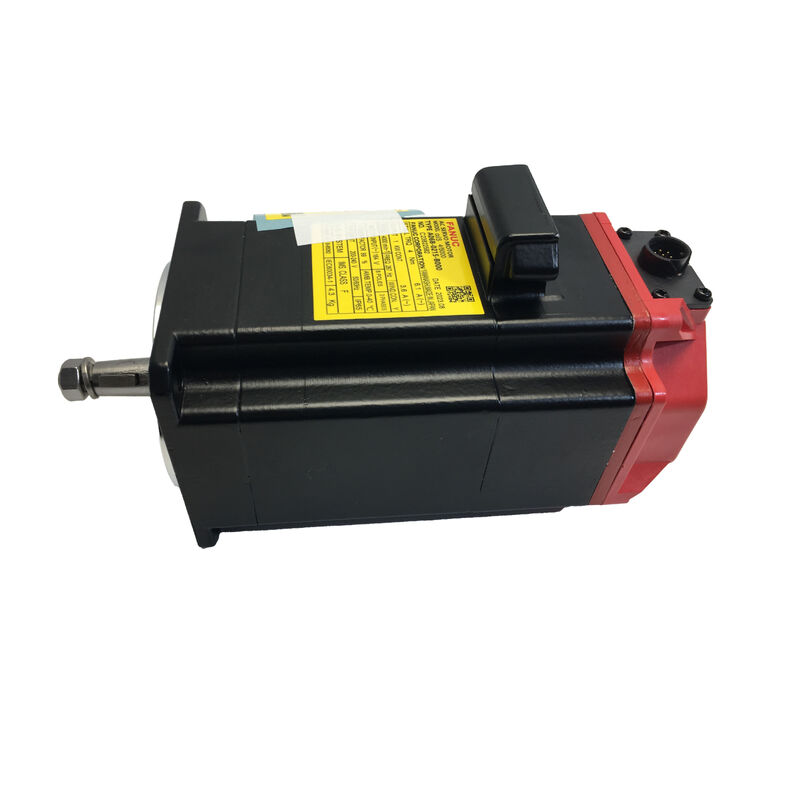
Fanuc AC Servo Motor A06B-0212-B605 — βis Series with Integrated Brake for Vertical CNC Axis Control
βis Series · With Integrated Brake · Compact AC Servo Motor for CNC Vertical Axis Control
When the Axis Runs Vertical, the Motor Spec Changes
Horizontal axis motors and vertical axis motors look similar on a spec sheet. In practice, they have one critical difference: what happens when the machine loses power.
On a horizontal axis, the load stays where it is. Gravity isn't pulling it anywhere. On a vertical axis — a Z-axis on a machining center, a drilling head, a tool changer arm — gravity is always working against the load. The moment power drops, without something actively holding the axis in place, the load moves. Sometimes slowly. Sometimes fast enough to damage the workpiece, the tooling, or the spindle itself.
That's what the integrated brake on the Fanuc A06B-0212-B605 is for. It's not a convenience feature or an optional upgrade — it's the component that keeps the axis stationary the instant the machine de-energizes, whether through a planned shutdown, an emergency stop, or an unexpected power cut. For any CNC application where an axis works against gravity, this motor belongs in the specification. A no-brake variant does not.
Specifications
| Parameter |
Detail |
| Series |
βis — AC Servo Motor |
| Brake |
Integrated electromagnetic brake |
| Encoder |
Absolute high-resolution serial encoder |
| Body Protection |
IP65 |
| Shaft End Protection |
IP67 |
| Cooling |
Self-cooled, natural convection |
| Drive Compatibility |
FANUC βi SVU / βi SVM series |
| CNC Compatibility |
FANUC 0i-D, 0i-F, 30i, 31i, 32i |
The Brake — What It Does and How It Works
The electromagnetic brake in the A06B-0212-B605 is a spring-set, power-release design. That means the brake is mechanically engaged by default and releases only when energized. Flip that logic around and the safety implication becomes clear: if the power supply fails, the brake engages automatically. No control signal needed, no active command from the CNC — the axis holds its position because the brake's default state is locked.
Under normal operation, the brake releases when the servo system energizes and re-engages when the axis comes to a commanded stop or when the machine powers down. The transition is fast enough to be transparent to the machine cycle.
This design is standard practice for vertical axis servo applications and is specifically what separates this motor from the no-brake variants in the βis lineup. The physical envelope is similar; the internal behavior under power loss is fundamentally different.
Performance Characteristics That Hold Up in Production
Absolute encoder — position retained across shutdowns. The serial encoder stores axis position data continuously without needing a homing battery or a reference cycle on startup. After a planned stop or an emergency, the controller resumes from the exact last known position. On a vertical axis, that means no creep, no lost reference, and no re-zeroing routine before the next cycle begins.
IP67 shaft seal — built for coolant exposure. In machining environments, cutting fluid migrates. The shaft-end seal on this motor carries an IP67 rating — sufficient for direct coolant spray and immersion exposure — without requiring special maintenance intervals to sustain it.
Smooth torque delivery across the speed range. The βis winding geometry minimizes torque ripple, which matters most at slow feed rates where motor irregularities transfer directly into the surface of the part. Consistent low-speed torque output is not a marginal performance detail; it's what makes the difference between a finishing pass that holds tolerance and one that doesn't.
Thermal equilibrium through continuous operation. The insulation class and bearing specification on this motor are selected for sustained duty — not for short bursts between idle periods. A motor that drifts thermally mid-shift introduces a variable that's hard to diagnose and harder to compensate. This one doesn't.
Machine Applications
Vertical Machining Centers — Z Axis The most direct application. The Z-axis on a VMC works against gravity on every upward move and needs reliable power-off braking to prevent spindle drop during E-stop conditions or power interruptions. The A06B-0212-B605 handles this as its primary use case.
CNC Drilling and Boring Machines Vertical feed axes on drilling centers that cycle repeatedly through the Z-axis. High reversal frequency combined with gravity-loaded downward moves makes brake-equipped servo motors the standard specification for this equipment type.
Automatic Tool Changers The arm or carousel mechanism on tool changers often involves a vertical or angular movement that needs to hold position precisely between cycles. The integrated brake provides that hold without relying on the servo drive to maintain torque in a static state.
Pallet and Fixture Positioning Systems Vertical lift axes on pallet changers and workholding systems that index between stations. These axes need to hold a fixed position under load while other machine operations complete — exactly the condition the spring-set brake is designed for.
Rotary Table Clamping and Tilt Axes On multi-axis machines with tilt or compound rotary tables, axes that work against gravity under load need the same brake-on-power-loss behavior for safe operation.
Motor Condition and What the Market Looks Like
The secondary market for FANUC servo motors includes new stock, refurbished units, and — more commonly than buyers tend to expect — units with no disclosed service history sold alongside legitimate new inventory. The brake adds a complication here that doesn't exist with no-brake motors: the brake mechanism itself wears.
A refurbished unit may have a brake that has cycled thousands of times. The spring preload may have weakened. The friction surfaces may be partially worn. None of that is detectable without disassembly, and it won't be visible on arrival regardless of how clean the motor looks externally.
A new A06B-0212-B605 has a brake that has never operated — factory spring preload, unworn friction surfaces, full design-life remaining. For a component that is specifically chosen for its safety function on a vertical axis, the condition of the brake mechanism is not a secondary consideration.
Installation and Service Notes
Confirm amplifier module capacity against motor specifications before wiring. The βi SVU and βi SVM series both support this motor, but the module rating must match the motor's current draw — mismatched ratings are among the more frequent installation errors on βis-series replacements.
At initial power-up, verify brake release and engage function through the CNC diagnostic screen before running the axis under load. This confirms the brake wiring is correct and the brake is responding to the drive signal as expected.
During operation, monitor axis following error through the CNC diagnostic interface. A gradually increasing trend — as opposed to a sudden alarm — is typically the early indicator of encoder cable seal wear in coolant-exposed installations and is best addressed before it escalates.
For units in storage: 0–40 °C, below 75% relative humidity, no condensation. Rotate the shaft manually every six months to prevent bearing brinelling. Do not release the brake manually during storage. Keep the unit in original sealed packaging until installation.
Frequently Asked Questions
Q1: What type of brake does the A06B-0212-B605 use? It uses a spring-set, power-release electromagnetic brake — meaning the brake is engaged by default and releases only when the servo system is energized. If power is lost unexpectedly, the brake automatically holds the axis without any signal from the controller. This is the standard design for vertical axis servo applications.
Q2: Can this motor be used on a horizontal axis? Technically yes, but the integrated brake adds weight and wiring complexity that provides no benefit on a horizontal axis where gravity holding isn't required. For horizontal applications, a no-brake variant within the βis series is a more appropriate specification.
Q3: What amplifier does this motor require? The A06B-0212-B605 is compatible with FANUC βi SVU and βi SVM series servo amplifiers. The amplifier module must be rated to match the motor's current specification. Verify the correct pairing before ordering — the brake wiring circuit also needs to be confirmed in the amplifier connection drawing.
Q4: Is this motor compatible with FANUC 0i-F and 30i controllers? Yes. It is compatible with FANUC 0i-D, 0i-F, 30i, 31i, and 32i series controllers when used with the appropriate βi-series amplifier. For controller generations outside this list, compatibility should be confirmed before specifying this motor.
Q5: How many brake cycles is the integrated brake rated for? The brake is rated for approximately 2 million operating cycles under normal load conditions. Actual service life varies depending on braking frequency and the load applied at each cycle. Machines with frequent emergency stops or high-cycle vertical axis operation should include brake condition in their planned maintenance schedule.


 Your message must be between 20-3,000 characters!