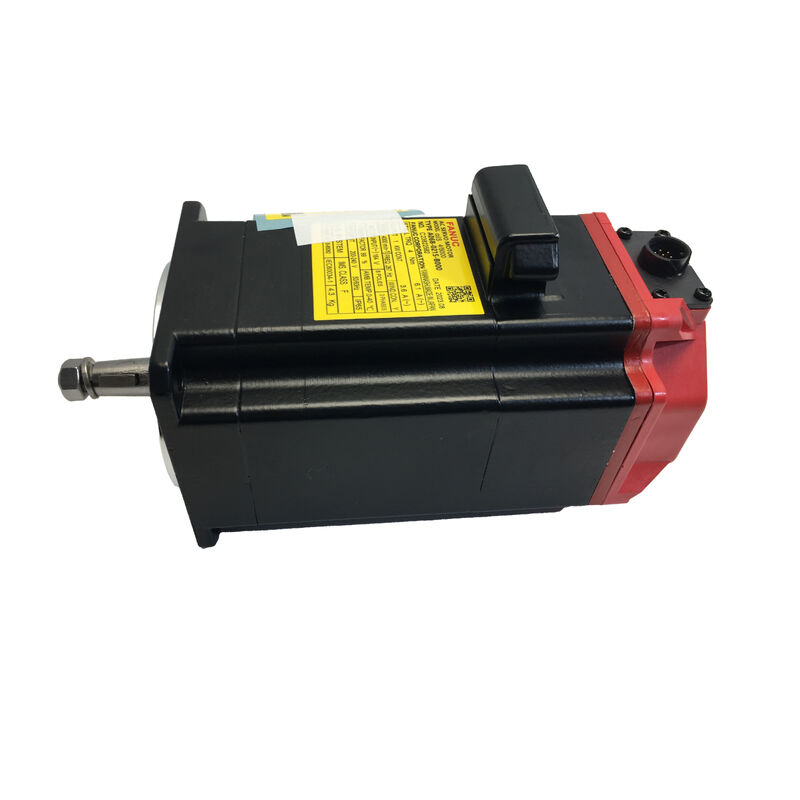
Fanuc AC Servo Motor A06B-0215-B000
βis Series · No Brake · Compact High-Precision Servo Motor for CNC Axis Feed Control
The Motor That Doesn't Call Attention to Itself
The best servo motor in a machine is the one you stop thinking about after installation. It runs. The axis holds tolerance. The surface finish is consistent. The following error stays flat through the whole shift. Nobody opens the electrical cabinet to investigate, because there's nothing to investigate.
That's the standard the Fanuc A06B-0215-B000 is built to meet. It's a compact βis-series AC servo motor without an integrated brake — configured for horizontal axis applications where the drive system handles motion and the motor's job is to execute it accurately, repeatedly, and without introducing variables the controller has to compensate for.
Small-frame motor. High-cycle workload. Long service intervals. That combination defines where this motor ends up, and it's what the βis design is optimized around.
Specifications
| Parameter |
Detail |
| Series |
βis — AC Servo Motor |
| Brake |
None (B000 configuration) |
| Encoder |
Absolute high-resolution serial encoder |
| Body Protection |
IP65 |
| Shaft End Protection |
IP67 |
| Cooling Method |
Self-cooled, natural convection |
| Drive Compatibility |
FANUC βi SVU / βi SVM series |
| CNC Compatibility |
FANUC 0i-D, 0i-F, 30i, 31i, 32i |
What Gets Built Into This Motor That Actually Matters
The encoder holds position without help. The absolute serial encoder on the A06B-0215-B000 retains axis position through power cycles, E-stops, and unplanned shutdowns — no homing battery, no reference sequence on startup. The controller wakes up already knowing where the axis is. On a high-cycle machine running three shifts, eliminating the homing sequence every time the machine restarts is a real time saving.
The shaft seal is rated for what machining environments actually do. IP67 at the shaft end means the most vulnerable point on the motor — where the rotating shaft exits the housing — is sealed against coolant immersion, not just splash. In an active machining environment where cutting fluid migrates into every gap it can find, that rating is the one that prevents encoder contamination and premature bearing failure.
Torque ripple is controlled, not just specified. This shows up most clearly in slow finishing passes. A motor with inconsistent low-speed torque output produces surface irregularities that can't be tuned out by the CNC — they come from the physics of the motor itself. The βis winding geometry keeps torque delivery smooth at the speeds where it matters for surface finish.
The thermal behavior is stable across a shift, not just at startup. Insulation class and bearing selection on the βis series are both chosen for continuous duty operation. A motor that runs at thermal equilibrium all shift produces consistent axis behavior. One that gradually heats and drifts introduces positioning errors that are genuinely difficult to distinguish from other machine variables.
No brake means a lighter, simpler installation. On horizontal axes, the brake adds weight and wiring without serving a function. The B000 configuration removes it. The motor is easier to handle during installation, the drive cabinet wiring is cleaner, and nothing about the configuration is there without a reason.
Where This Motor Gets Installed
The A06B-0215-B000 is a small-frame motor. Its footprint fits where larger servo units won't, and the βis series encoder and drive architecture mean it integrates into FANUC-controlled machines without the compatibility questions that come with non-OEM alternatives.
In practice, it shows up most consistently in four types of equipment. Compact CNC lathes, where X and Z axis feed control needs to be consistent across thousands of parts per shift and the motor's absolute encoder prevents reference drift between batches. Small vertical machining centers, where limited installation space makes the compact frame a practical requirement rather than just a preference. Tapping and drilling centers, which reverse axis direction at high frequency and need fast torque response without accumulated positional error between cycles. And auxiliary axes on multi-process machines — rotary tables, tool changers, pallet indexers — where FANUC protocol compatibility is required but the application doesn't justify the size or cost of an αi-series unit.
The common thread across all of them is a machine that cycles continuously, in an environment that isn't gentle, with tolerances that don't have room for the motor to be a variable.
A Different Way to Think About Purchase Decisions
Most buying decisions for servo motors come down to price first. That's understandable. It's also where the calculation tends to go wrong.
A refurbished unit at a lower price point isn't the same product as a new one. The encoder has operating hours. The bearing preload may have shifted. The winding insulation has gone through thermal cycles that shorten the remaining service life — not to zero, but somewhere into that life, invisibly. None of this is detectable on receipt. The unit looks clean, the shaft turns freely, and the packaging may look close enough to original to be convincing.
Where it shows up is later: a slow increase in axis following error over months, a bearing that starts generating noise, an encoder alarm that appears and disappears intermittently before it becomes permanent. All of it traceable back to starting condition, none of it apparent on the day of purchase.
A new A06B-0215-B000 has zero accumulated wear. Bearings in factory condition. An encoder that has never run. Full OEM warranty from day one. For a motor expected to run unattended inside a production machine for several years, those aren't abstract benefits.
Notes on Installation and Long-Term Care
Before the motor goes anywhere near the machine, confirm that the βi amplifier module capacity matches the motor's rated current. This check takes minutes and prevents mismatched ratings that generate alarms from the first power-on. Also verify physical dimensions and connector positions against the machine mounting drawing before uncrating the unit — discovering a mismatch at the machine costs more time than discovering it at the drawing stage.
Once installed, the diagnostic to monitor is axis following error through the CNC screen. A slow upward trend over weeks — not a sudden alarm, but a gradual drift — is the early signature of encoder cable seal wear in coolant-exposed installations. Addressing it at that stage means a cable replacement. Waiting for the hard alarm means an unplanned production stop.
For stored units, the rules are straightforward: 0–40 °C, below 75% relative humidity, no condensation. Rotate the shaft manually every six months to prevent bearing brinelling from static contact load. Don't unpack until the day of installation.
Frequently Asked Questions
Q1: Is there a version of this motor that includes an integrated brake? Yes. Within the βis series, brake-equipped variants share the same base motor but include an integrated electromagnetic brake for vertical axis applications. The A06B-0215-B000 does not include a brake and is the correct choice for horizontal axis use. If your application involves a vertical axis or any load that needs to be held when power is removed, a brake-equipped variant should be specified instead.
Q2: What drive hardware is required for the A06B-0215-B000? This motor is designed for use with FANUC βi SVU or βi SVM series servo amplifiers. The amplifier module must be rated to match the motor's current specification — this isn't a detail to approximate. Confirm the correct pairing before ordering either component.
Q3: Can this replace an earlier β-series motor without changing anything else? Not without some verification work. The βis series uses an updated serial encoder protocol compared to the original β-series, which typically requires parameter changes in the CNC controller after installation. Physical connector locations may also differ between motor generations. Treat it as a guided replacement rather than a direct swap, and plan for a parameter check before the first axis run.
Q4: Which CNC systems is this motor compatible with? The A06B-0215-B000 is compatible with FANUC 0i-D, 0i-F, 30i, 31i, and 32i series controllers when paired with an appropriate βi-series amplifier. Compatibility with controller generations outside this range should be confirmed before committing to the motor as a replacement.
Q5: What should be checked when buying to verify the unit is genuinely new? Look for sealed FANUC packaging with intact authenticity labels, a shaft with no wear or fretting at the keyway, and a serial number with no prior service or repair record in FANUC's system. A seller who can provide clear documentation of new stock origin is a reasonable baseline. If the packaging has already been opened or sourcing information isn't available on request, ask for clarification before accepting the unit.



 Your message must be between 20-3,000 characters!