Home
>
Products
>
Industrial Servo Motor
>
Part Number: A06B-0223-B000
Also Searched As: A06B0223B000, Fanuc A06B-0223-B000, FANUC A06B0223B000
Motor Model: αiF 4/5000
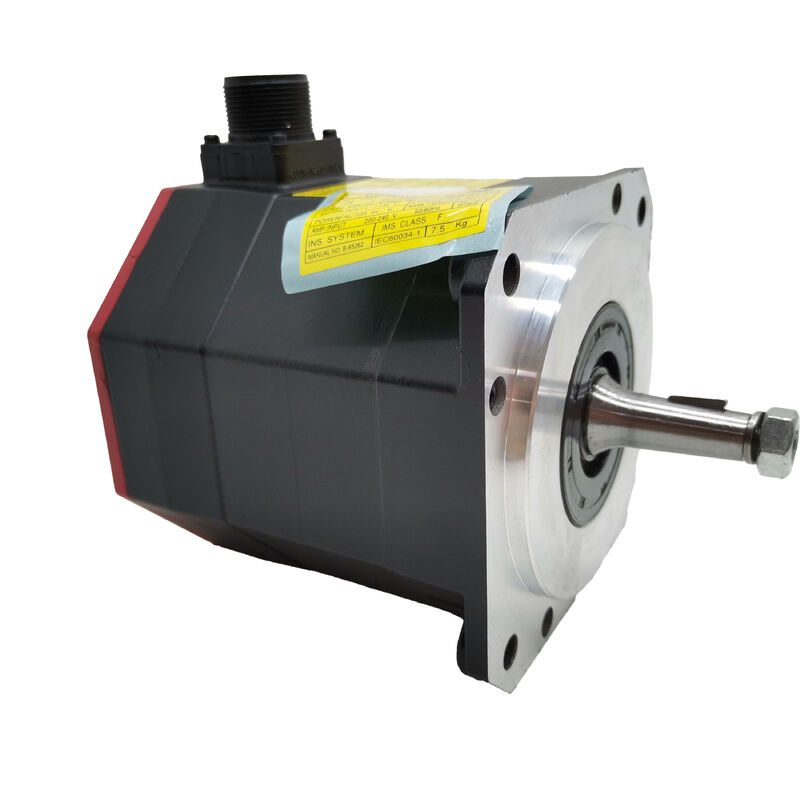
Classification: Fanuc Alpha iF Series AC Brushless Servo Motor — 4 Nm Stall Torque, 5,000 rpm, Taper Shaft with Key, No Brake, Absolute A1000 Pulse Coder, IP65
The Fanuc A06B-0223-B000 is an αiF 4/5000 AC servo motor — a capable mid-range motor from Fanuc's alpha iF series that shows up on a remarkably wide variety of Fanuc-controlled machine tools. With 4 Nm stall torque, a 5,000 rpm rated speed, and a taper shaft with key as standard, this motor covers the performance requirements of light-to-medium CNC feed axes across small and medium-format machining centres, turning centres, and drilling machines.
Three things define its configuration. The taper shaft delivers the precise, self-centring interface that machine tool servo coupling requires. The Alpha i A1000 absolute pulse coder at 1,000,000 pulses per revolution means the machine knows exactly where it is the instant power comes on — no homing cycle needed. And the B000 suffix confirms no electromagnetic brake, which is the correct choice for horizontal axes that hold position through Fanuc servo lock at rest.
| Parameter | Value |
|---|---|
| Part Number | A06B-0223-B000 |
| Motor Model | αiF 4/5000 |
| Rated Output | 1.4 kW |
| Stall Torque | 4 Nm |
| Rated Speed | 5,000 rpm |
| Supply Voltage | 3-phase 200V AC |
| Pulse Coder | Alpha i A1000 (serial absolute) |
| Encoder Resolution | 1,000,000 pulses/rev |
| Shaft Type | Taper shaft with key (TPR) |
| Electromagnetic Brake | None |
| Protection Rating | IP65 |
| Insulation Class | Class F |
| Ambient Temperature (Operation) | 0°C to +40°C |
| Storage Temperature | −20°C to +60°C |
| Compatible Amplifiers | Fanuc αi series (αiSV) servo amplifiers |
| Compatible Controls | Fanuc Series 0i, 15i, 16i, 18i, 21i, 30i, 31i, 32i |
| Status | Available — new, refurbished, and repair |
The αiF designation places this motor in a specific category within Fanuc's servo motor lineup. The "4" in the model name is the stall torque in Newton-metres — the maximum torque the motor sustains at zero speed before reaching thermal limits. The "5000" is the rated speed in rpm. Together, they define the motor's working envelope.
Four Newton-metres of stall torque handles the low-speed, high-load phases of a machining cycle — deep drilling passes, heavy facing cuts, sustained feed under cutting load. On a 4mm pitch ball screw at 90% efficiency, 4 Nm sustains approximately 5.6 kN of axial force at low speeds. That's a realistic budget for small-to-medium machining centre feed axes carrying moderate table and workpiece mass.
The 5,000 rpm rated speed is where this motor distinguishes itself from the 4,000 rpm motors that dominate the mid-range αiS family. At 5,000 rpm on a 4mm pitch ball screw, the axis moves at 20 m/min in direct coupling — fast enough to make rapid traverse genuinely rapid on a compact machine. For smaller machines where cycle time is a competitive concern and axis travel is short, that traversal speed has production value.
This combination — 4 Nm sustained force capability, 5,000 rpm traversal speed, 1.4 kW rated output — fits the performance requirements of a broad population of CNC machine tool feed axes. It is not a coincidence that the A06B-0223 series appears on such a wide variety of equipment.
The taper shaft on the A06B-0223-B000 is the standard Fanuc shaft configuration for machine tool servo axes, and understanding what it delivers helps explain why it is specified as the default rather than a straight shaft.
A taper shaft is a precisely ground cone, matched to a corresponding bore in the coupling hub or ball-screw coupling assembly. When the hub is pulled onto the taper with a draw bolt through the shaft-end thread, the taper geometry centres the hub automatically — the motor and driven shaft axes align to a tight geometric tolerance without adjustment. The key in the shaft keyway then transmits torque mechanically, independently of the axial clamping force.
This matters for two practical reasons. First, accurate shaft alignment at installation reduces radial load on the motor's front bearing and avoids introducing backlash into the axis. Second, when the motor is removed for service and reinstalled — or replaced with a fresh unit — the taper ensures the replacement seats identically to the original without shimming or alignment verification. For a machine tool manufacturer designing a motor mount, taper shaft standardisation means the same coupling hub works across all motors in the αiS/αiF family at a given frame size.
The included key is essential. Without it, all torque transmission would depend on taper clamping friction alone, which is not adequate under the cyclic reversal and shock loads a machining axis experiences. The key-and-taper combination is mechanically robust across the full operating life of the motor.
The B000 designation means this motor carries no electromagnetic brake. Position at rest is maintained by the Fanuc αi servo amplifier's servo lock — the position loop remains active, the A1000 pulse coder continuously monitors shaft angle at 1,000,000 counts per revolution, and the amplifier delivers corrective current to hold zero following error.
On horizontal axes — the X and Y table drives, saddle feeds, and carriage axes that make up the majority of machine tool servo applications — this is entirely adequate. The servo lock hold is tight, the axis does not drift, and the machine coordinate remains valid across any rest period while power is on.
The no-brake configuration also keeps installation cleaner. There is no 24V DC brake circuit to wire in the panel, no brake relay to specify and mount, no brake release timing to programme into the CNC startup sequence, and no brake disc wear to monitor over the motor's service life. On a machine with eight or ten servo axes, those simplifications add up.
When a machine axis has a gravitational load component — a vertical Z-axis carrying spindle head mass, an inclined feed with a weight component along the axis direction — servo lock is not adequate at servo-off. Those applications require a braked motor variant. Within the A06B-0223 series, the B400 (straight smooth shaft, 24V brake) and B500 (straight keyed shaft, 24V brake) carry electromagnetic brakes for vertical axis applications. The B000 is the correct and preferred specification for horizontal axes.
The encoder fitted to the A06B-0223-B000 is the Alpha i A1000 — Fanuc's serial absolute encoder at 1,000,000 pulses per revolution. The "A" prefix is what matters: this is an absolute encoder, not an incremental one.
| Part Number | Shaft | Brake | Encoder |
|---|---|---|---|
| A06B-0223-B000 | Taper with key | No | A1000 (absolute) |
| A06B-0223-B001 | Taper with key | No | i1000 (incremental) |
| A06B-0223-B400 | Straight smooth | 24V brake | A1000 (absolute) |
| A06B-0223-B500 | Straight keyed | 24V brake | A1000 (absolute) |
The B000 is the clean baseline — taper shaft, no brake, absolute encoder. It is the right motor for the horizontal axis applications that most Fanuc machine tools have in the majority of their axes.
The A06B-0223-B000 operates with Fanuc αi series servo amplifiers (αiSV) — the αiSV 4 or αiSV 8 depending on the machine's axis configuration and peak current requirements. The A1000 pulse coder communicates over Fanuc's standard αi serial encoder protocol, supported by all αi-generation amplifiers.
Compatible CNC platforms: Fanuc Series 0i-D, 0i-F, 15i, 16i, 18i, 21i, 30i-A, 30i-B, 31i-A, 31i-B, and 32i.
The motor is not compatible with older first-generation α or αC series amplifiers that use a different encoder interface, nor with Fanuc β series drives.
When fitting the A06B-0223-B000 as a replacement, verify the CNC axis parameters are set to the αiF 4/5000 motor type from Fanuc's servo parameter database. Incorrect motor type parameters produce unstable servo performance or amplifier faults on startup.
It is compatible with all Fanuc CNC systems that use the αi series servo amplifiers (αiSV) — which covers Fanuc Series 0i-D, 0i-F, 15i, 16i, 18i, 21i, 30i, and 31i platforms. It is not compatible with older first-generation α or αC series amplifiers, or with β series drives. Always confirm that the machine's amplifier is an αi-generation unit before ordering a replacement.
No. The Alpha i A1000 is an absolute encoder — it retains multi-turn position through power-off events via a backup battery in the servo amplifier. When the CNC powers up, axis coordinates are established immediately without any reference-return movement. This is one of the most operationally significant differences between the B000 (absolute A1000) and the B001 (incremental i1000). If the machine currently uses a B001 and a B000 is being considered as a replacement, the CNC must be set up to recognise the absolute encoder type, which may require parameter changes.
The taper shaft provides a self-centring interface between the motor and the coupling hub — the cone geometry centres the hub automatically when it is pulled onto the shaft with a draw bolt, giving accurate shaft alignment without adjustment. The key occupies matched slots in both shaft and hub, transmitting torque mechanically rather than through taper friction alone. The key is typically included with the motor. Always verify that the coupling hub on the machine has a matching taper bore and keyway before installing.
The B000 has no electromagnetic brake, so servo lock is the only mechanism holding position when the servo is active. If the servo is disabled or power is cut, a vertical axis will move under gravity. For vertical axes, gravity-loaded mechanisms, or any drive where uncontrolled movement at servo-off creates risk, a braked variant is required — the A06B-0223-B400 (straight smooth shaft, 24V brake) or B500 (straight keyed shaft, 24V brake) are the appropriate choices within the αiF 4/5000 family. The B000 is correctly specified for horizontal axes with no gravitational load component.
The Alpha i A1000's multi-turn counter is maintained by a backup battery in the Fanuc αi servo amplifier. The battery requires periodic replacement — typically every few years depending on power-on hours. The Fanuc CNC will issue a battery alarm when the voltage drops below the threshold. Replace the battery promptly at the first alarm; allowing full battery depletion resets the absolute counter and requires a reference-return cycle before the machine can resume production.
Contact Us at Any Time