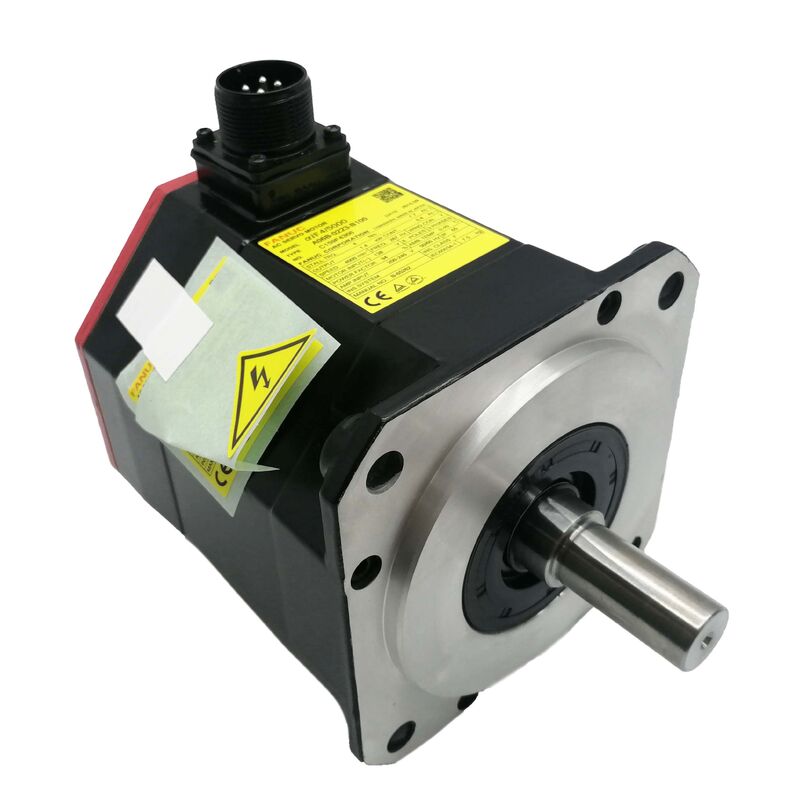
Fanuc AC Servo Motor A06B-0223-B100
βis Series · No Brake · Compact CNC Servo Motor
The Case for Getting the Motor Right
In CNC machining, the servo motor is the point where electronic commands become physical movement. Get that conversion wrong — through a mismatched replacement, a worn encoder, or an incompatible drive pairing — and the problems show up in the parts: chatter marks, positional drift, cycle time inconsistency.
The Fanuc A06B-0223-B100 is a βis-series AC servo motor designed for the feed axis demands of compact and mid-range CNC machine tools. It runs without an integrated brake — a deliberate choice for horizontal axis configurations — and connects directly to FANUC's βi amplifier ecosystem without adaptation hardware or custom parameter mapping. For machine builders and maintenance teams who need a motor that simply works within an existing FANUC setup, that native compatibility is the starting point for everything else.
Specifications
| Parameter |
Detail |
| Motor Series |
βis Series — AC Servo |
| Brake |
Not included (B100 configuration) |
| Encoder |
High-resolution absolute serial encoder |
| Body Protection |
IP65 |
| Shaft Seal |
IP67 |
| Cooling |
Self-cooled, natural convection |
| Drive Compatibility |
FANUC βi SVU / βi SVM amplifier series |
| CNC Compatibility |
FANUC 0i-D, 0i-F, 30i, 31i, 32i |
What This Motor Is Actually Good At
There's a tendency to over-specify servo motors — to assume that more power means better performance. In practice, the A06B-0223-B100 is optimized for something different: consistency at the axis level in machines where cycle counts are high and part tolerances don't have much room for variation.
A few specific things that hold up under working conditions:
Absolute position memory. The serial encoder holds position data without a battery or mechanical reference. After a power cut or E-stop, the axis resumes from its exact last known position — no homing cycle, no lost parts.
Shaft-end sealing that actually lasts. The IP67 shaft seal is built for environments where coolant mist is a constant. It doesn't require special maintenance intervals; it just handles what production floors throw at it.
Torque delivery without cogging. The winding design keeps torque ripple low across the speed range. That matters most in slow finishing passes, where any motor irregularity shows up directly on the machined surface.
Thermal stability across shifts. The insulation class and bearing selection are sized for continuous operation, not just short bursts. A motor that drifts thermally mid-shift is a real problem; this one doesn't.
Where It Fits in a Machine
The βis series fills the compact end of FANUC's servo motor range. The A06B-0223-B100 is a strong fit for:
CNC Lathes (compact platforms) X and Z axis feed control on smaller turning centers. The motor's responsiveness at low feed rates keeps surface finish consistent across long production runs.
Small and Mid-Size Vertical Machining Centers X and Y axis drives where the machine footprint is limited and the motor needs to operate reliably in close quarters with coolant systems nearby.
Drilling and Tapping Centers High-cycle applications with frequent direction reversals. The motor's low inertia and fast torque response reduce cycle time without sacrificing positioning accuracy.
Secondary and Auxiliary Axes Rotary tables, tool changers, and pallet systems on multi-process machines that need full FANUC protocol compatibility without the size and cost of an αi-series unit.
New Unit vs. The Market Alternative
FANUC servo motors circulate in a secondary market that mixes new stock, refurbished units, and — more often than buyers expect — remarked motors with no clear service history. The A06B-0223-B100 is no exception.
A refurbished unit might look identical on arrival. The encoder has hours on it. The bearings may have microscopic fatigue. The winding insulation has gone through thermal cycles. None of that is visible until the motor is running in a machine, often months after installation.
A new unit brings zero run hours, bearings and encoder in factory condition, and full OEM warranty. For a component that operates inside a machine unattended and is expected to last years, the starting condition matters — independent of the purchase price difference.
Installation and Storage Notes
Before fitting: Cross-reference the motor's frame dimensions and connector type against your machine drawings. Confirm the βi amplifier module rating matches the motor's current specification. The FANUC βis Connection Manual is the authoritative source for verified pairings.
In operation: The most common early-warning sign of encoder cable wear is a slow increase in axis following error — detectable through the CNC diagnostic screen before any hard alarm appears. Check connector seals annually in coolant-exposed installations.
In storage: 0–40 °C, below 75% relative humidity, no condensation. Rotate the shaft manually every six months if the unit is held in long-term storage. Keep it sealed in original packaging until installation day.
Frequently Asked Questions
Q1: Is there a version of this motor that includes a brake? Yes. A brake-equipped variant exists within the βis series for vertical axis applications. The B100 configuration does not include a brake and is suited to horizontal axes where power-off holding is not needed. If your application requires gravity load holding, a different suffix variant should be specified.
Q2: What amplifier does this motor require? The A06B-0223-B100 is designed for use with FANUC βi SVU or βi SVM series servo amplifier units. The amplifier module must be rated to match the motor's current draw. Confirm the specific pairing using FANUC's motor-amplifier selection documentation before purchasing.
Q3: Can this replace an older β-series motor directly? Not as a plug-and-play swap. The βis series uses an updated serial encoder protocol compared to earlier β-series motors, which means CNC parameters will need to be reviewed and adjusted after installation. A physical fit check is also recommended, as connector locations may differ between generations.
Q4: Which FANUC controllers work with this motor? Compatible controllers include the FANUC 0i-D, 0i-F, 30i, 31i, and 32i series when paired with the correct βi-series amplifier. Compatibility with other controller generations should be confirmed against FANUC's published pairing documentation before committing to the hardware.
Q5: How do I confirm a unit is genuinely new before purchasing? New units arrive in sealed FANUC packaging with intact authenticity labels, a clean shaft showing no contact wear at the keyway, and a serial number with no prior service history. If a seller cannot provide clear sourcing documentation or the unit arrives without original packaging, treat that as a red flag and request clarification before accepting delivery.



 Your message must be between 20-3,000 characters!