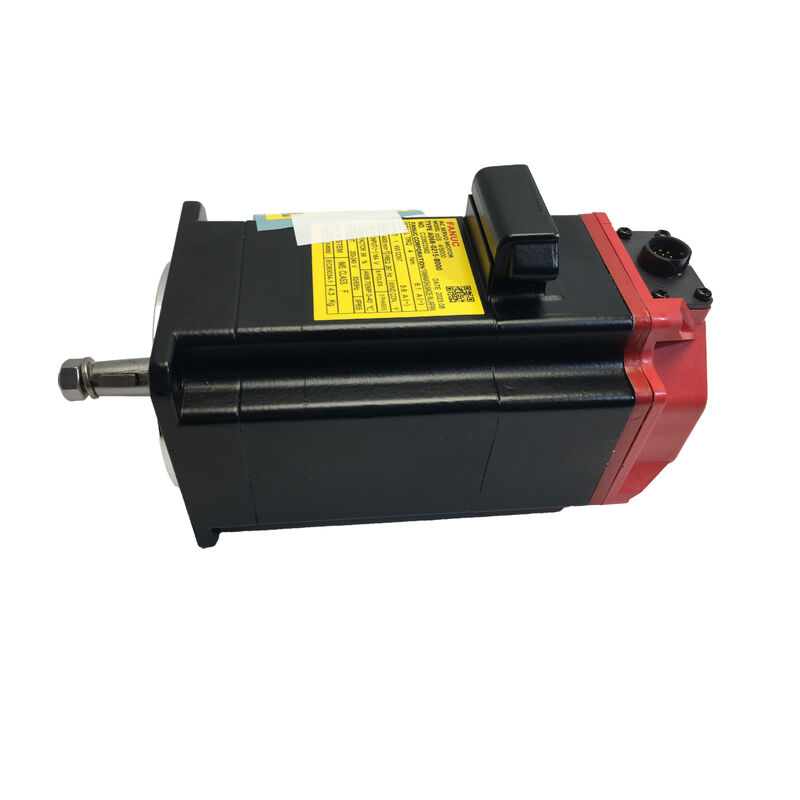
FANUC A06B-0232-B100 AC Servo Motor — αiS 8/6000 | 2.2 kW | 8 Nm | 6,000 rpm | αiA 1000 Pulsecoder | IP65 | 200V
Specifications at a Glance
| Parameter |
Value |
| Part Number |
A06B-0232-B100 |
| Alternate Code |
A06B0232B100 |
| Manufacturer |
FANUC Corporation |
| Motor Model |
αiS 8/6000 (Alpha iS 8/6000) |
| Series |
FANUC αiS (Alpha iS) |
| Rated Output |
2.2 kW |
| Supply Voltage |
200 V |
| Rated Torque (Stall) |
8 Nm |
| Rated Speed |
6,000 rpm |
| Peak Current |
80 A |
| Back-EMF Constant |
16 V |
| Resistance |
0.13 Ω |
| Feedback Device |
Pulsecoder αiA 1000 |
| Shaft Type |
Straight (Standard, No Brake) |
| Protection Rating |
IP65 |
| Weight |
10 kg |
| Ambient Temperature |
0 °C to +40 °C |
| Condition |
In Stock |
What the αiS 8/6000 Is Designed to Do
Speed is the defining characteristic of the αiS 8/6000. While FANUC's medium-speed αiS motors in the 8 Nm class top out at 3,000 or 4,000 rpm, the A06B-0232-B100 is rated to 6,000 rpm continuous — twice the speed of a conventional servo at equivalent torque output. That combination puts this motor in a specific and demanding application zone: high-speed feed axes on CNC machining centers where rapid traverses need to be both fast and precisely controlled, and where the servo must transition smoothly from rapid traverse at full speed into a precise feed cut without losing position accuracy.
The αiS designation signals where this motor sits in FANUC's product hierarchy. The Alpha iS series is FANUC's industrial-standard servo motor line, built for integration with FANUC CNC systems (Series 16i, 18i, 21i, 30i, 31i, 32i and 0i) and designed around FANUC's αi servo amplifier modules. Every specification — the pulsecoder interface, the motor parameter set, the drive matching — is tuned within the FANUC closed ecosystem where the CNC, amplifier, and motor are engineered as a system, not assembled from separate vendors.
8 Nm at 6,000 rpm — The Performance Triangle
Servo motor selection involves a three-way trade-off between torque, speed, and frame size. A motor that delivers high torque at high speed in a compact body is doing something mechanically demanding, and the αiS 8/6000 does it without moving to a larger frame.
8 Nm stall torque defines what the axis can push — the continuous force available through the full speed range. This is the value that determines whether the motor can drive the load through a cutting operation without thermal overload.
6,000 rpm is the rated continuous speed. At that speed, the motor delivers 2.2 kW of continuous mechanical power — enough for high-speed machining center feed axes, rapid traverse drives, and any axis where traverse speed is a direct machine productivity parameter.
Peak current at 80 A — the instantaneous current ceiling the amplifier can supply — determines the motor's acceleration authority. High peak current means sharp velocity profile execution: the motor reaches target speed quickly, settles without overshoot, and recovers from load disturbance within a tight following error window. This is what makes the difference between a servo that holds position at high feedrate and one that accumulates tracking error under load.
αiA 1000 Pulsecoder: The Feedback Foundation
Every A06B-0232-B100 ships with FANUC's αiA 1000 pulsecoder built into the motor body. This is the standard incremental serial pulsecoder used across the FANUC αiS motor line — 1,000,000 position pulses per revolution transmitted over FANUC's high-speed serial feedback interface to the αi servo amplifier.
The pulsecoder communicates not just position, but also motor temperature and internal fault status over the same serial link. Thermal alarms, encoder errors, and overspeed events are all reported back through the pulsecoder interface to the CNC — the machine does not need separate sensor wiring to detect motor fault conditions. That integration is not incidental; it is a core design principle of the FANUC αi system, where diagnostic visibility into every component is built in rather than added on.
For machines with multiple axes, the standardized αiA 1000 interface across all motors in the αiS series means the same encoder cable family (FANUC A66L-0001 series) and the same parameter set apply regardless of motor size — simplifying spares management and reducing the number of configuration variables in multi-axis systems.
IP65 Housing — Sealed for CNC Environments
The A06B-0232-B100 carries an IP65-rated enclosure: fully dust-tight and resistant to water jets from any direction. High-speed servo motors generate heat at their bearings and windings. In a machine tool environment where coolant is actively sprayed, metallic particles are airborne, and lubricant mist is present throughout the work zone, the sealing quality of the motor housing is not a secondary specification — it determines service life.
At 10 kg, the motor is compact for its output class. The straight shaft allows direct coupling to ballscrews and belt pulleys using FANUC-standard couplings without adapter elements. No keyway on the B100 shaft specification means the coupling relies on clamp-type connection — which is correct for servo applications where the high reversal frequency of CNC feed axes makes mechanical fretting a concern with keyed interfaces.
System Integration: FANUC αi Servo Amplifiers
The A06B-0232-B100 operates within FANUC's αi servo amplifier system — the A06B-6096, A06B-6114, and A06B-6117 series servo modules (SVM — Servo Module) used in FANUC's power supply/amplifier cabinet architecture with PSM (Power Supply Module) and SVM combinations.
At 2.2 kW continuous with 80 A peak current demand, the motor drives at a level that sits within the range of FANUC's SVM single-axis and dual-axis 20i and 40i servo modules. The specific amplifier selection depends on the CNC system generation, the total number of axes, and the PSM capacity in the cabinet — parameters determined by the machine tool builder's original design rather than the motor alone.
FANUC's αiS motors are engineered for direct parameter recognition: the CNC reads the motor model from the pulsecoder and automatically loads the correct gain parameters. On a properly configured system, swapping a failed A06B-0232-B100 with a new unit requires no manual parameter entry — the system re-identifies the motor at startup and loads the drive parameters automatically.
Where This Motor Is Found
CNC machining center X/Y/Z feed axes — high-speed vertical and horizontal machining centers where rapid traverse at 6,000 rpm enables fast positioning between cuts, and where the 8 Nm continuous torque sustains feedrates through aggressive machining passes.
High-speed drilling and tapping machines — cycle-optimized machines where the ratio of rapid traverse time to cutting time is critical to part throughput, and where 6,000 rpm feed axis capability directly reduces non-cutting time per part.
Precision grinding machine axes — both the table drive and wheel head infeed on precision surface and cylindrical grinders, where the combination of high speed for positioning and stable low-speed torque for fine infeed increments is the defining requirement.
Turning center turret indexing and axis drives — the Z and X axes on high-speed CNC lathes where fast repositioning between tool changes and cutting passes is a direct productivity parameter.
Wire EDM and die-sinking EDM machine axes — precision axes where the 6,000 rpm high-speed capability allows fast rough-cut traverse while the 8 Nm torque sustains the constant-speed, constant-force requirement of precision EDM feed control.
A06B-0232-B100 Variant Context
The B100 designation within FANUC's part number system identifies this as the straight shaft, standard, no-brake, αiA 1000 pulsecoder configuration of the αiS 8/6000 motor body. Other suffix variants of the same motor include:
- A06B-0232-B400 — with 24V DC electromagnetic brake
- A06B-0232-B200 — tapered shaft, no brake
- A06B-0233-B100 — αiS 8/6000HV (400V-class system, 400/480V supply)
The A06B-0232-B100 is the standard 200V, no-brake, straight-shaft configuration — the most commonly specified variant for horizontal and standard-orientation CNC feed axes where gravity holding is not required and the 200V amplifier system is in use.
FAQ
Q1: What is the difference between A06B-0232-B100 and A06B-0233-B100?
Both are FANUC αiS 8/6000 motors with the same mechanical and torque specifications. The distinction is voltage class: the A06B-0232-B100 is the 200V version, used with 200V-class FANUC αi amplifier systems. The A06B-0233-B100 is the HV (High Voltage) version, designed for 400V-class power supply systems. The two are not electrically interchangeable. Always verify the voltage class of your machine's servo amplifier system before ordering.
Q2: Which FANUC servo amplifier is compatible with the A06B-0232-B100?
The A06B-0232-B100 is compatible with FANUC's αi series servo amplifier modules (SVM) — including the A06B-6096, A06B-6114, and A06B-6117 series, depending on the CNC generation and cabinet configuration. The specific module depends on the machine's original PSM/SVM architecture and the number of axes controlled. For exact amplifier matching, refer to the machine's electrical documentation or the FANUC αi servo amplifier description manual for your CNC series.
Q3: Does the A06B-0232-B100 require homing after a power cycle?
Yes. The αiA 1000 pulsecoder on the A06B-0232-B100 is an incremental device, not absolute. Position data is not retained through a power-down. At each machine startup, each axis must execute a reference return (home) sequence before the CNC can accept axis motion commands. This is standard operating procedure for FANUC machines using αiA-series pulsecoders. FANUC's absolute pulsecoder variants (αiA 64, αiA 128) retain position without homing but are a separate part number configuration.
Q4: Can the A06B-0232-B100 be used to replace an older FANUC α-series (non-i) servo motor?
Not as a direct electrical replacement. The αiS series uses different amplifiers, different pulsecoder interface protocol, and different motor parameter sets from the earlier α (non-i) series. Substituting an αiS motor in a system designed for the older α series requires replacing the servo amplifier module and updating the CNC parameter set. It is possible as a planned upgrade but is not a plug-compatible swap. When replacing a failed αiS motor with another αiS motor of the same part number, the replacement is direct with no system changes required.
Q5: What does the B100 suffix indicate, and is a brake-equipped version available?
In FANUC's servo motor part number structure, B100 identifies the standard straight shaft, no-brake configuration with the αiA 1000 pulsecoder. For applications requiring mechanical shaft holding at power-down — vertical axes, gravity-loaded mechanisms — the brake-equipped variant is A06B-0232-B400, which adds a 24V DC power-off electromagnetic brake to the same motor body. The brake supply must be wired separately from the amplifier system.


 Your message must be between 20-3,000 characters!