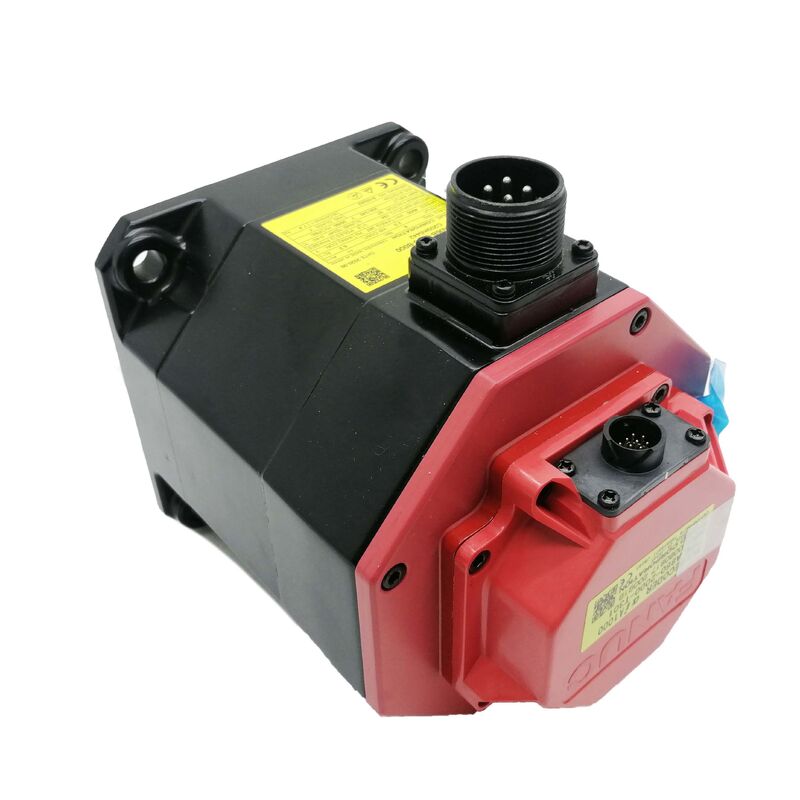
Fanuc A06B-0235-B000 — αiS 8/4000 AC Servo Motor, Taper Shaft, No Brake, Alpha i A1000 Pulse Coder
Product Overview
Part Number: A06B-0235-B000
Also Searched As: A06B0235B000, A06B-0235-B000 Fanuc, FANUC A06B0235B000 Series: Fanuc MELSERVO Alpha iS (αiS) Series Classification: AC Brushless Servo Motor — 2.5 kW, 4,000 rpm, Taper Shaft with Key, No Brake, Alpha i A1000 Pulse Coder
Overview
The Fanuc A06B-0235-B000 is a factory-standard αiS 8/4000 AC servo motor — one of the most widely deployed feed axis motors in Fanuc-controlled CNC machine tools globally. Rated at 2.5 kW with a 4,000 rpm rated speed and an 8 Nm stall torque, it sits in the productive middle range of the Fanuc αiS family: enough torque for medium-to-heavy machining centre feed axes, enough speed for brisk rapid traverse, and a taper shaft interface that has been standard on machine tool feed axes since the platform was introduced.
The "B000" designation in the part number encodes a specific mechanical configuration: no electromagnetic brake, standard taper shaft with key. This is the motor Fanuc engineers specify by default for horizontal feed axes on machining centres, turning centre Z-axes, and a wide range of machine tool feed mechanisms where servo lock holds position at rest and no gravitational load acts along the axis direction at servo-off.
Fitted with the Alpha i A1000 pulse coder — a serial absolute encoder at 1,000,000 pulses per revolution — this motor delivers the position resolution and absolute position capability that Fanuc CNC systems use for sub-micron positioning accuracy, direct axis homing, and zero-speed ripple at low feed rates. It is the complete unit that ships as standard with Fanuc's αiS 8/4000 motor designation: motor body, taper shaft, and the A1000 pulse coder mounted and aligned at the factory.
Technical Specifications
| Parameter |
Value |
| Part Number |
A06B-0235-B000 |
| Motor Model |
αiS 8/4000 |
| Rated Output |
2.5 kW (3.4 HP) |
| Supply Voltage |
3-phase 200–240V AC |
| Input Frequency Range |
0–267 Hz |
| Rated Current |
8.3 A |
| Rated Speed |
4,000 rpm |
| Stall Torque |
8 Nm |
| Rated Torque |
~5.97 Nm |
| Poles |
8 |
| Power Factor |
97% |
| Pulse Coder |
Alpha i A1000 (A860-2000-T301) |
| Encoder Resolution |
1,000,000 pulses/rev (serial absolute) |
| Shaft Type |
Taper shaft with key |
| Electromagnetic Brake |
None |
| Protection Rating |
IP65 |
| Insulation Class |
Class F |
| Ambient Temperature (Operation) |
0°C to +40°C |
| Storage Temperature |
−20°C to +60°C |
| Weight |
~9.6 kg (21.2 lbs) |
| Compatible Controls |
Fanuc Series 0i, 15i, 16i, 18i, 21i, 30i, 31i, 32i |
| Compatible Amplifiers |
Fanuc αi series servo amplifiers (αiSV) |
| Status |
Current production — also available as refurbished/surplus stock |
αiS 8/4000: Reading the Performance Numbers
The model designation αiS 8/4000 encodes the two most important operating parameters in a compact form that Fanuc service engineers read directly off the motor nameplate. The "8" is the stall torque in Newton-metres — the maximum torque the motor can sustain at zero speed without exceeding the thermal limit. The "4000" is the rated speed in rpm. Together they define the motor's working envelope before any specification table is consulted.
At 8 Nm stall torque and 4,000 rpm, the αiS 8/4000 puts this motor at a productive operating point for machine tool axes. The stall torque determines the motor's peak sustained force capability at low speeds — the heavy cutting phase of a deep milling operation, the constant-force phase of a facing cut across a large workpiece, or the sustained feed force during a long drilling cycle. Eight Newton-metres of stall torque drives a 10mm pitch ball screw against approximately 4.5 kN of sustained axial force — enough for medium-duty machining centre table axes and most turning centre carriage axes under realistic production cutting loads.
The 5.97 Nm rated torque at 4,000 rpm — derived from the 2.5 kW power rating — is the continuous figure for high-speed operation. In the flat region of the torque-speed curve up to 4,000 rpm, the motor operates at or below this figure during rapid traverse and constant-velocity cutting phases. Above 4,000 rpm (where the motor enters the field-weakening range), available torque decreases while the motor continues to deliver power up to the maximum speed limit.
The Alpha i A1000 pulse coder at 1,000,000 ppr provides position feedback resolution that is roughly 64 times finer than a 14-bit encoder and approximately 8 times finer than a 17-bit encoder. At 4,000 rpm, this resolves shaft angle to a fraction of an arc-minute per update cycle — fine enough that the velocity loop has essentially no quantisation error at any practical feed rate, and the position loop can command repeatable sub-micron increments on the machine axis.
The Taper Shaft: CNC Machine Tool Standard
The taper shaft with key on the A06B-0235-B000 is the defining mechanical interface for CNC machine tool servo motor installations and the reason this motor slots directly into machining centres, turning centres, and grinding machines without any coupling hardware modification.
In machine tool servo motor mounting, the taper shaft serves two functions simultaneously. The taper geometry — a defined cone angle matching a corresponding bore in the ball-screw coupling hub or gear coupling — provides a self-centring interface that achieves precise geometric alignment of the motor and driven shaft axes without the tolerance stack-up that a cylindrical bore interface introduces. The key in the shaft keyway transmits the torque mechanically through the key's shear cross-section, independent of the axial clamping load that holds the hub on the taper.
The practical consequence is a motor-to-mechanism connection that is both geometrically accurate and mechanically positive. The hub seats on the taper to a defined axial depth, the key prevents rotation, and a draw bolt through the shaft end pulls the hub firmly onto the taper. Disassembly and reassembly — for bearing replacement, motor swap, or coupling service — returns the hub to exactly the same geometric position without any alignment procedure.
For machine tool manufacturers, this interface is standard across the αiS range because it allows the same ball-screw coupling hub design to be used on any motor in the αiS family. When the machine tool engineer sizes up from an αiS 4/4000 to an αiS 8/4000 for a heavier axis, the coupling hub is unchanged. When the service engineer swaps a failed motor for a replacement unit, the taper-shaft interface ensures the replacement seats identically to the original without shimming or alignment verification.
The B000 suffix confirms no electromagnetic brake on this unit. For the horizontal feed axes and symmetrically loaded turning centre axes that constitute the majority of αiS motor applications, servo lock through the Fanuc αi amplifier holds position reliably at rest without mechanical holding. Brake variants carry a B100 or B605 suffix depending on configuration.
Alpha i A1000 Pulse Coder: The Feedback System
The Alpha i A1000 pulse coder (Fanuc part number A860-2000-T301) is the feedback device fitted as standard to the A06B-0235-B000. It is a serial absolute encoder — not a simple incremental pulse generator — and its characteristics affect how the Fanuc CNC system manages position at every step from startup to high-speed interpolation.
Serial absolute protocol. The A1000 communicates with the Fanuc αi servo amplifier over a serial link rather than producing differential A/B/Z pulse trains. This serial protocol transmits both position data and encoder status information in each communication cycle. The serial format is more noise-immune than differential pulse signals over long cable runs and more compact in cable size — only a few signal conductors needed rather than a full differential pair set.
Absolute position on power-up. The A1000 retains multi-turn absolute shaft position through power-off events. When the Fanuc CNC is switched on, the servo amplifier reads the absolute position from each axis pulse coder immediately. The CNC knows the machine coordinate of every axis before any movement occurs. This eliminates the reference-return (homing) cycle that incremental encoders require on every startup — a significant operational benefit on production machines that cycle power between shifts or following any alarm stop.
One million pulses per revolution. At 1,000,000 counts per revolution, the A1000 provides the angular resolution that Fanuc's high-accuracy interpolation algorithms require for sub-micron linear positioning on ball-screw axes. On a 4mm pitch ball screw, one encoder count corresponds to 4 nanometres of linear displacement. The CNC's position commands can specify moves in increments far smaller than any mechanical compliance allows in practice — which is exactly the condition needed for stable, non-hunting position loops at high gain.
Battery backup. The absolute position counter in the A1000 is maintained through power-off events by a backup battery, typically housed in the Fanuc αi servo amplifier or in the CNC cabinet battery unit depending on the machine configuration. Replace the backup battery when the CNC displays an encoder battery alarm. Allowing full battery depletion resets the absolute counter — requiring a reference-return cycle and potentially a manual axis clear-out procedure before production resumes. This is straightforward to prevent by treating the battery alarm as an immediate maintenance item.
Compatible Controls and Amplifiers
The A06B-0235-B000 is designed for Fanuc αi series servo amplifiers — the αiSV (Alpha i Servo) amplifier family that drives the αiS series motors across all current and recent Fanuc CNC platforms.
CNC controllers confirmed compatible: Fanuc Series 0i-D, 0i-F, 15i-MB, 16i, 18i, 21i-MB, 30i-A, 30i-B, 31i-A, 31i-B, 32i. All of these use the αi amplifier series with the same serial encoder protocol the A1000 pulse coder implements.
The αiSV amplifier for an αiS 8/4000 motor is typically the αiSV 20 or αiSV 40 depending on the machine's axis configuration and bus capacity. The motor's 8.3A rated current and 2.5 kW output fall within the αiSV 20's capacity for single-axis applications, and the αiSV 40 provides headroom for higher peak current demand during aggressive acceleration cycles.
Parameter setup. When fitting a replacement A06B-0235-B000, the Fanuc CNC parameter set for the axis must match the motor model. The relevant parameters — motor type number, number of pole pairs, encoder type, current limits — are confirmed in the Fanuc servo parameter guide for the specific CNC series. Fanuc's automatic motor detection (available on more recent CNC versions) can read the motor type from the pulse coder serial data and set parameters automatically. On older CNC versions, manual parameter entry is required.
The A06B-0235-B000 is not compatible with Fanuc αC, β, or original α series amplifiers that predate the αi generation. It requires an αi-generation servo amplifier matching both the motor's electrical characteristics and the A1000 pulse coder's serial protocol.
Fanuc αiS Series: Context and Positioning
The αiS (Alpha iS) series represents Fanuc's standard machine tool servo motor platform — the motors that ship as standard on Fanuc-controlled machining centres, turning centres, and grinding machines worldwide. The "iS" designation distinguishes this series from the earlier αi series, with improvements including higher torque density, lower rotor inertia for improved dynamic response, and enhanced thermal performance.
Within the αiS range, the 8/4000 sits at the mid-capacity point of the 4,000 rpm subfamily:
| Model |
Stall Torque |
Rated Speed |
Output |
| αiS 2/4000 |
2 Nm |
4,000 rpm |
~0.8 kW |
| αiS 4/4000 |
4 Nm |
4,000 rpm |
~1.7 kW |
| αiS 8/4000 |
8 Nm |
4,000 rpm |
2.5 kW |
| αiS 12/4000 |
12 Nm |
4,000 rpm |
~5.0 kW |
| αiS 22/4000 |
22 Nm |
4,000 rpm |
~9.0 kW |
The αiS 8/4000 is the standard motor for medium-duty machining centre X and Y axes on machines with table masses in the 300–600 kg range, and for Z-axes on machines where the spindle head assembly mass and counterbalance arrangement places the net downward torque demand within the motor's stall torque rating.
Typical Applications
Horizontal machining centre X, Y, and Z feed axes. The primary design application for the A06B-0235-B000. Horizontal and vertical machining centres with Fanuc 0i, 30i, or 31i CNC systems use αiS 8/4000 motors on feed axes handling medium-weight tables and saddles. The 8 Nm stall torque sustains cutting loads during heavy milling and boring operations; the 4,000 rpm rated speed enables rapid traverse rates that minimise non-cutting time.
CNC turning centre carriage and cross-slide axes. Z-axis carriage and X-axis cross-slide drives on CNC turning centres under Fanuc 0i-T or 0i-TF control. The taper shaft interface suits the direct-coupling designs common on turning centre ball-screw axis drives; the 4,000 rpm rating provides rapid traverse capability across the full length of travel.
CNC grinding machine axes. Table and wheel head feed axes on CNC external and surface grinding machines requiring precise low-velocity feed control combined with adequate torque for dressing and grinding load cycles. The A1000 pulse coder's 1,000,000 ppr resolution supports the fine infeed increments characteristic of precision grinding cycles.
Wire EDM and EDM sink machine axes. Primary and secondary positioning axes on EDM equipment where the absolute encoder provides immediate axis position knowledge on power-up, and the motor's smooth low-speed torque characteristics support the slow controlled feeds used during the machining process.
Custom automation and multi-axis systems. Any automation system running a Fanuc αi-series servo amplifier and requiring 2.5 kW / 4,000 rpm servo capability with a taper-shaft output, absolute position feedback, and the fully documented Fanuc servo parameter set that the αiS series motor database supports.
Frequently Asked Questions
Q1: What pulse coder is fitted to the A06B-0235-B000, and what encoder resolution does it provide?
The A06B-0235-B000 is fitted with the Fanuc Alpha i A1000 pulse coder (reference A860-2000-T301) as standard. This is a serial absolute encoder providing 1,000,000 pulses per revolution of position data. It transmits absolute shaft angle and multi-turn position data over a serial link to the αi servo amplifier. The absolute capability means the Fanuc CNC system knows the exact machine coordinate of every axis immediately on power-up — no reference-return homing cycle required after planned or unplanned shutdowns.
Q2: What servo amplifier is compatible with the A06B-0235-B000?
The A06B-0235-B000 requires a Fanuc αi series servo amplifier (αiSV) — typically an αiSV 20 or αiSV 40 depending on axis configuration. Compatible CNC controllers include Fanuc Series 0i-D/F, 15i, 16i, 18i, 21i, 30i, 31i, and 32i. This motor is not compatible with older α series or αC series amplifiers that predate the αi generation, nor with Fanuc β series or any non-Fanuc servo drive, which lack the A1000 pulse coder serial protocol decoder.
Q3: Does the A06B-0235-B000 have a brake, and how is position held at rest?
The B000 suffix confirms no electromagnetic brake. At rest, axis position is maintained by the Fanuc αi servo amplifier's servo lock — the position loop stays active and the amplifier supplies corrective current to hold the commanded position. For horizontal axes and any axis without a gravitational load component along the direction of travel, this is reliable and accurate. For vertical axes or axes with an unbalanced gravitational load, a braked motor variant — carrying a B100 or similar suffix — should be specified instead.
Q4: What does the taper shaft design offer compared to a straight shaft?
The taper shaft with key provides two advantages specific to machine tool servo motor applications. First, the taper geometry self-centres the coupling hub on the shaft, achieving precise geometric alignment of motor and driven shaft axes. Second, the key transmits torque mechanically through the keyway rather than relying on friction clamping alone. This makes installation and removal straightforward for service, returns the hub to exactly the same position every time, and ensures the torque path is mechanically positive rather than friction-dependent. Taper shaft design is standard across the Fanuc αiS family to allow common coupling hub designs across motor capacity variants.
Q5: What should be checked before installing a replacement A06B-0235-B000?
Three items are critical. First, confirm the replacement carries the correct suffix — B000 means no brake, taper shaft, standard configuration. Other suffixes indicate brake, shaft, or sealing differences. Second, verify the Fanuc CNC axis parameters match the αiS 8/4000 motor type. Parameter mismatches cause control errors or reduced performance. Third, check the pulse coder backup battery condition in the servo amplifier or CNC battery unit. A low or discharged battery must be replaced before commissioning the replacement motor, as the absolute position reference must be valid for the machine to resume production without a full reference-return cycle.



 Your message must be between 20-3,000 characters!