logo
Guangzhou Sande Electric Co.,Ltd.
Email Sales01@sande-elec.com TEL: 86--18620505228
Home > Products > Industrial Servo Motor >
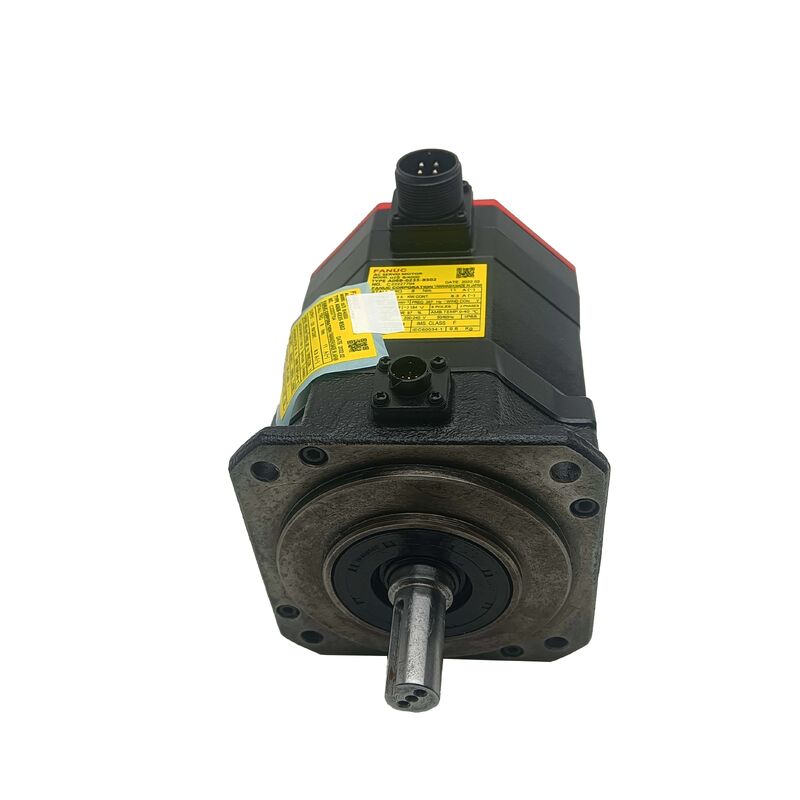
Fanuc AC Servo Motor A06B-0235-B300 A06B0235B300 AO6B-O235-B3OO
  • Fanuc AC Servo Motor  A06B-0235-B300  A06B0235B300  AO6B-O235-B3OO

Fanuc AC Servo Motor A06B-0235-B300 A06B0235B300 AO6B-O235-B3OO

Place of Origin JAPAN
Brand Name FANUC
Certification CE ROHS
Model Number A06B-0235-B300
Product Details
Condition:
NEW / USED
Item No.:
A06B-0235-B300
Origin:
JAPAN
Certificate:
CE
Highlight: 

a06b ac servo motor fanuc

,

a06b fanuc ac servo motor

,

fanuc ac ac servo motor fanuc

Payment & Shipping Terms
Minimum Order Quantity
1 pcs
Packaging Details
original packing
Delivery Time
0-3 days
Payment Terms
T/T, PayPal, Western Union
Supply Ability
100 pcs/day
Product Description

Fanuc A06B-0235-B300 — αiS 8/4000 AC Servo Motor with 24V Brake, Taper Shaft, Absolute A1000 Pulse Coder

Product Overview

Part Number: A06B-0235-B300

Also Searched As: A06B0235B300, Fanuc A06B-0235-B300, FANUC A06B0235B300

Motor Model: αiS 8/4000

Classification: Fanuc Alpha iS Series AC Brushless Servo Motor — 8 Nm Stall Torque, 4,000 rpm, Taper Shaft with Key, 24V Spring-Applied Electromagnetic Brake, Absolute A1000 Pulse Coder, IP65


Three Specifications That Define This Motor

The Fanuc A06B-0235-B300 is built around three defining characteristics that appear directly in its part number suffix and together describe exactly which axes and applications it serves.

8 Nm stall torque at 4,000 rpm. The αiS 8/4000 is a proven mid-capacity machine tool servo motor — enough stall torque to sustain heavy cutting forces on medium-format CNC axes, and enough speed to make rapid traverse genuinely productive. At 2.5 kW rated output, it is one of the most widely deployed motors in Fanuc's alpha iS family.

Taper shaft with key. The TPR designation is Fanuc's standard CNC machine tool shaft interface — a precision-ground taper that self-centres the coupling hub and a key that transmits torque mechanically through the shaft-hub joint. The B000 (no brake) variant of this same motor has identical performance; the taper shaft with key is shared across the family.

24V spring-applied electromagnetic brake. This is what the B300 suffix adds over the base B000 configuration. The brake coil must be energised with 24V DC to keep the shaft free. Remove that voltage — for any reason — and the spring closes the brake disc immediately. Planned servo-off, E-stop, power interruption: the axis holds mechanically, without depending on any active system remaining functional.

Together, these three characteristics describe a motor built specifically for vertical axes and gravity-loaded mechanisms on Fanuc-controlled CNC machine tools.


Technical Specifications

Parameter Value
Part Number A06B-0235-B300
Motor Model αiS 8/4000
Rated Output 2.5 kW
Stall Torque 8 Nm
Rated Speed 4,000 rpm
Supply Voltage 3-phase 200V AC
Brake Voltage 24V DC (spring-applied, electrically released)
Pulse Coder Alpha i A1000 (serial absolute)
Encoder Resolution 1,000,000 pulses/rev
Shaft Type Taper shaft with key (TPR)
Electromagnetic Brake Yes — 24V spring-applied
Protection Rating IP65
Insulation Class Class F
Ambient Temperature (Operation) 0°C to +40°C
Storage Temperature −20°C to +60°C
Compatible Amplifiers Fanuc αi series (αiSV) servo amplifiers
Compatible Controls Fanuc Series 0i, 15i, 16i, 18i, 21i, 30i, 31i, 32i
Status Available — new, refurbished, and repair

8 Nm, 4,000 rpm: What This Motor Delivers on a Machine Axis

The αiS 8/4000 sits in the productive mid-range of Fanuc's alpha iS servo motor family — above the 4 Nm motors suited for light axes, below the 12 Nm and 22 Nm motors serving the heaviest machining centre drives.

Eight Newton-metres of stall torque translates directly to mechanical force on ball-screw axes. At 90% screw efficiency on a 10mm pitch screw, 8 Nm sustains approximately 4.5 kN of axial force at near-zero speed — the load condition during deep drilling, facing under heavy chip load, or a Z-axis holding a heavy spindle head against gravity without drift. This is the torque budget that medium-format vertical machining centres, turning centre Z-axes, and similar Fanuc-controlled equipment are typically designed around.

At 4,000 rpm rated speed, the motor moves a 10mm pitch ball screw at 40 m/min in direct coupling — enough for practical rapid traverse on most machine tool axes without requiring a speed-reduction stage between motor and screw. The combination of 8 Nm stall torque and 4,000 rpm traversal speed in a single motor makes the αiS 8/4000 the natural choice for axes that spend their working cycle doing both: slow, high-force cutting phases and fast traversal between positions.


The 24V Brake: What "Spring-Applied" Actually Means in Production

The electromagnetic brake on the A06B-0235-B300 is not simply a convenience feature. Understanding exactly how it works — and how it behaves under every operating condition — is the starting point for specifying the right motor for a vertical axis.

The brake is spring-applied and electrically released. The spring holds the friction disc engaged at all times. Energising the brake coil with 24V DC creates a magnetic force that overcomes the spring and lifts the disc away from the braking surface, releasing the shaft for motion. The coil must remain energised throughout every period of shaft rotation.

The consequence is straightforward: the shaft is held mechanically by default. Any event that removes 24V from the brake coil — an E-stop command, a panel power fault, a mains interruption, or a planned servo-off at the end of a cycle — immediately releases the coil and closes the brake. The axis holds at whatever position it occupied when power was removed. No software. No CNC. No amplifier. The spring closes the brake passively and unconditionally.

This is precisely why vertical axes require spring-applied brakes. When a Z-axis carries the full weight of a spindle head assembly, any loss of servo lock — whether planned or unexpected — without a mechanical brake causes the axis to fall. The A06B-0235-B300's spring-applied brake prevents that. The spindle head holds position through every stop event, every power cycle, and every emergency condition that the machine encounters.

Brake circuit requirements. The brake coil needs a dedicated 24V DC supply in the machine panel, separate from the servo amplifier's power. A relay switches the coil, and surge suppression (a flyback diode across a DC coil) is mandatory to protect the relay contacts from the inductive voltage spike when the coil de-energises. The Fanuc CNC's brake release output coordinates the release timing with servo enable to prevent releasing the brake before servo lock is established.

Brake sequencing. The correct sequence when enabling a braked axis: establish servo lock first, then release the brake. The correct sequence when disabling: decelerate to rest under servo control, engage the brake, then remove servo enable. Applying the brake to a moving shaft generates heat and accelerates brake disc wear. Following this sequence extends brake service life across the motor's operating lifetime.


Taper Shaft: Machine Tool Standard for a Reason

The taper shaft interface on the A06B-0235-B300 is Fanuc's standard for CNC machine tool servo axes, and it earns that status through two mechanical properties that matter across thousands of installation and service events.

Self-centring on installation. The taper geometry centres the coupling hub automatically as it is drawn onto the shaft with a draw bolt through the shaft-end thread. The motor and driven shaft axes align to tight geometric tolerance without any manual adjustment, without shims, and without laser alignment tools. The hub seats to the same position every time — whether fitted at the machine builder's factory or reinstalled by a field service engineer replacing a failed motor years later.

Positive torque transmission through the key. The key occupies matched keyway slots in both shaft and hub, transmitting torque through the key's shear cross-section rather than through taper friction alone. Eight Newton-metres stall torque and the higher peak torques during aggressive axis acceleration cycles are all transmitted through the key — a mechanically robust path that does not degrade with service hours, does not loosen under vibration, and does not depend on maintaining a specific clamping force over time.

For machine tool manufacturers standardising on a single servo coupling hub design across their axis configurations, the taper shaft means the same hub fits every motor in the αiS family at the same frame size. When the engineer selects an αiS 8/4000 over an αiS 4/4000 for a heavier axis, the coupling hardware is unchanged.


Alpha i A1000 Pulse Coder: Absolute Position Through Every Stop

The Alpha i A1000 — the "a1000" in the motor's full description — is Fanuc's serial absolute encoder at 1,000,000 pulses per revolution. On a braked vertical axis specifically, the absolute encoder's value goes beyond position resolution.

When a vertical Z-axis shuts down — planned or not — the spring-applied brake holds the spindle head in position. Simultaneously, the A1000's multi-turn absolute counter retains the exact shaft angle in memory, maintained by the backup battery in the Fanuc αi servo amplifier. When the machine powers back up, the amplifier reads the absolute position immediately. The CNC knows exactly where the Z-axis is. Servo lock is established. The brake release sequence executes. The axis is ready — from whatever position it stopped, without any homing movement.

On a machine where the Z-axis homing movement would require manual clearance of fixtures or tooling from the work area, this matters operationally. A power interruption mid-cycle does not require manual intervention before the machine can resume. The brake held the axis safely; the encoder remembered the position; startup is immediate and automated.

At 1,000,000 counts per revolution, the encoder resolution on a 10mm pitch ball screw resolves to 10 nanometres per count — far finer than any mechanical compliance in the axis allows. The position loop closes at this resolution, which is what enables the sub-micron repeatability that precision machining centres deliver in production.

Battery maintenance. The A1000's absolute counter needs its backup battery replaced periodically. The Fanuc CNC issues a battery alarm before the battery is fully discharged. Replace the battery promptly at the first alarm — a depleted battery resets the counter and requires a reference-return cycle, which on a vertical axis means a managed, supervised homing movement before production can resume.


A06B-0235 Series: Where the B300 Sits

The A06B-0235 product series covers the full αiS 8/4000 motor family across shaft configurations, brake voltages, and encoder types:

Part Number Shaft Brake Encoder
A06B-0235-B000 Taper with key No A1000 (absolute)
A06B-0235-B001 Taper with key No i1000 (incremental)
A06B-0235-B300 Taper with key 24V spring-applied A1000 (absolute)
A06B-0235-B605 Taper with key 90V spring-applied A1000 (absolute)
A06B-0235-B702K Straight keyed No A1000 (absolute)

The B300 is the taper shaft, 24V brake, absolute encoder combination — the standard specification for vertical αiS 8/4000 axes on machines with 24V brake supply circuits. The B605 carries a 90V brake coil for machines with different brake supply specifications; the performance is otherwise identical.


Typical Applications

Vertical Z-axis on CNC vertical machining centres. The primary application for the A06B-0235-B300. Spindle head Z-axes on vertical machining centres where the spindle assembly mass requires 8 Nm stall torque during low-speed Z-feed operations, and the spring-applied brake holds the spindle head mechanically at every stop — tool changes, machine-off, E-stops, and power interruptions.

Z-axis on CNC turning centres. Carriage Z-axis drives on CNC turning centres where the carriage and tool post assembly has a gravitational component along the Z direction on inclined or vertical machine configurations, requiring mechanical brake holding at rest.

Pallet changer and rotary table drives with vertical elements. Servo-driven pallet lift mechanisms, vertical indexing stations, and tilting rotary table drives on machining cells where the loaded mechanism must hold position mechanically when the servo is inactive.

Vertical press and forming machine feed axes. Servo-actuated press feed axes, die approach drives, and vertical ram drives on specialty machining equipment where the vertical axis mass and load require both the torque capacity of the αiS 8/4000 and the fail-safe braking the B300 provides.

Tool magazine vertical lift and indexing axes. Vertical tool magazine lift mechanisms and servo-driven tool change arm vertical travel axes on CNC machining centres where the tool magazine or changer must hold a defined position under gravity when the servo is off.


FAQ


Q1: What is the difference between the A06B-0235-B300 and the A06B-0235-B000?

The single functional difference is the electromagnetic brake. The B000 has no brake — axis position at rest is maintained by Fanuc servo lock, which requires the servo amplifier to remain powered and active. The B300 has a spring-applied 24V brake that holds the shaft mechanically whenever the brake coil is de-energised, regardless of servo state. Both motors share identical stall torque (8 Nm), rated speed (4,000 rpm), shaft type (taper with key), and encoder (A1000 absolute). Use the B000 on horizontal axes with no gravitational load; use the B300 on vertical axes, inclined feeds, and any mechanism where uncontrolled axis movement at servo-off would be hazardous.


Q2: Does the 24V brake engage automatically during an E-stop or power loss?

Yes — that is precisely the point of the spring-applied design. The spring holds the brake closed by default. The coil must be continuously energised with 24V DC to keep the shaft free. Any event that removes 24V — E-stop, power interruption, amplifier fault, or planned servo-off — immediately releases the coil and the spring closes the brake. This behaviour requires no software, no CNC, and no active system to execute. It is unconditional and instantaneous. The axis holds at whatever position it occupied when the brake coil was de-energised.


Q3: What servo amplifier and CNC are compatible with the A06B-0235-B300?

The A06B-0235-B300 requires a Fanuc αi series servo amplifier (αiSV) — the αiSV 20 or αiSV 40 is typical for the αiS 8/4000 power level, depending on machine configuration and peak current requirements. Compatible CNC platforms include Fanuc Series 0i-D, 0i-F, 15i, 16i, 18i, 21i, 30i, and 31i. The motor is not compatible with older first-generation α or αC series amplifiers, or with Fanuc β series drives. The CNC axis parameters must be set to the αiS 8/4000 motor type, and brake release timing parameters must be configured for the vertical axis application.


Q4: Does the A1000 absolute encoder eliminate the need for a reference-return after power loss?

Yes. The A1000 is a serial absolute encoder that retains multi-turn position through power-off events via a backup battery in the servo amplifier. When the machine powers back up after any stop — planned or not — the CNC reads the absolute position immediately. The spring-applied brake held the axis in place; the encoder remembered the exact position. No homing movement is required. This is a significant operational advantage on vertical axes, where a homing movement after power loss requires careful sequencing and may need manual clearance of the work area before it is safe to execute.


Q5: What is the difference between the B300 (24V brake) and the B605 (90V brake) variant?

Both are αiS 8/4000 motors with spring-applied electromagnetic brakes, taper shafts with key, and A1000 absolute encoders. The only difference is the brake coil voltage: the B300 operates on a 24V DC brake supply, while the B605 operates on a 90V DC brake supply. The mechanical performance, torque specification, encoder, and amplifier compatibility are identical. The brake voltage must match the machine's panel brake supply circuit. Most modern Fanuc CNC machine tools use 24V DC brake circuits, making the B300 the more common variant, but older or specialised machines may use 90V. Confirm the machine's brake supply voltage before ordering.

Contact Us at Any Time

+86 18620505228
10/F,Jia Yue Building, Chebei Road,Tianhe district,Guangzhou,China
Send your inquiry directly to us