logo

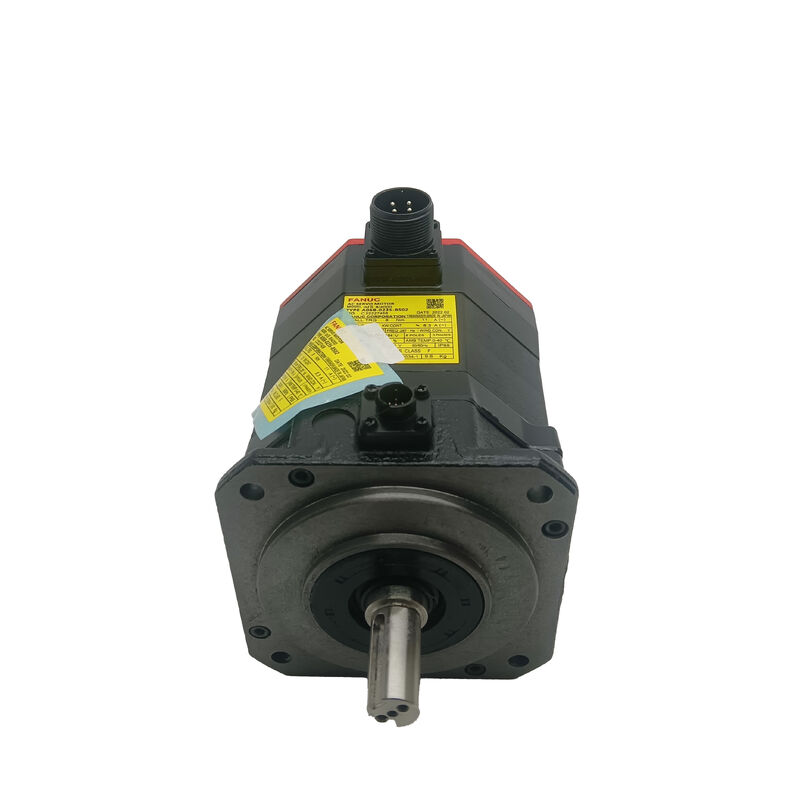
Fanuc AC Servo Motor A06B-0235-B400 A06B0235B400 AO6B-O235-B4OO

1 pcs
MOQ
Fanuc AC Servo Motor  A06B-0235-B400  A06B0235B400   AO6B-O235-B4OO
Features Gallery Product Description Request A Quote
Features
Specifications
Condition: NEW / USED
Item No.: A06B-0235-B400
Origin: JAPAN
Certificate: CE
Highlight:

a06b ac servo motor fanuc

,

a06b fanuc ac servo motor

,

fanuc ac ac servo motor fanuc

Basic Infomation
Place of Origin: JAPAN
Brand Name: FANUC
Certification: CE ROHS
Model Number: A06B-0235-B400
Payment & Shipping Terms
Packaging Details: original packing
Delivery Time: 0-3 days
Payment Terms: T/T,PayPal,Western Union
Supply Ability: 100 pcs/day
Product Description

Fanuc A06B-0235-B400 — αiS 8/4000 AC Servo Motor, Straight Shaft, 24V Brake, Absolute A1000 Pulse Coder

Product Overview

Part Number: A06B-0235-B400 Also Searched As: A06B0235B400, Fanuc A06B-0235-B400, FANUC A06B0235B400 Motor Model: αiS 8/4000 Classification: Fanuc Alpha iS Series AC Brushless Servo Motor — 8 Nm Stall Torque, 4,000 rpm, Straight Smooth Shaft, 24V Spring-Applied Electromagnetic Brake, Absolute A1000 Pulse Coder, IP65


What Sets the B400 Apart

The αiS 8/4000 is one of Fanuc's most widely deployed machine tool servo motors. The A06B-0235-B400 is the straight smooth shaft, 24V braked configuration of that motor — a combination that shows up on vertical CNC axes where the machine tool design uses flexible disc or split-hub couplings rather than the taper-shaft standard, and where a spring-applied brake is a functional safety requirement.

Most of what you need to know about this motor can be read from its suffix and model designation. AiS 8/4000 gives you the torque-speed operating point: 8 Nm stall torque, 4,000 rpm rated speed, 2.5 kW output. ST, SLK confirms a straight, smooth shaft with no keyway — the coupling interface for precision servo couplings. 24v BRK is the spring-applied electromagnetic brake: coil energised to release, spring-closed by default. A1000 is the serial absolute pulse coder at 1,000,000 pulses per revolution.

Put it together and the application picture is clear: a braked vertical servo axis on a Fanuc-controlled machine tool, connected through a smooth-shaft servo coupling, with absolute position retained through every stop event.


Technical Specifications

Parameter Value
Part Number A06B-0235-B400
Motor Model αiS 8/4000
Rated Output 2.5 kW
Stall Torque 8 Nm
Rated Speed 4,000 rpm
Supply Voltage 3-phase 200V AC
Brake Type Spring-applied, electrically released
Brake Voltage 24V DC
Pulse Coder Alpha i A1000 (serial absolute)
Encoder Resolution 1,000,000 pulses/rev
Shaft Type Straight, smooth (ST, SLK — no keyway)
Electromagnetic Brake Yes — 24V spring-applied
Protection Rating IP65
Insulation Class Class F
Ambient Temperature (Operation) 0°C to +40°C
Storage Temperature −20°C to +60°C
Compatible Amplifiers Fanuc αi series (αiSV) servo amplifiers
Compatible Controls Fanuc Series 0i, 15i, 16i, 18i, 21i, 30i, 31i, 32i
Status Available — new, refurbished, and repair

Performance at 8 Nm and 4,000 rpm

Eight Newton-metres of stall torque at zero speed. That is the defining capability of the αiS 8/4000 for the phases of a machining cycle that put the most demand on a servo axis — the slow-speed, high-load phases where the motor is fighting friction, gravitational load, and cutting force simultaneously.

On a 10mm pitch ball screw with 90% efficiency, 8 Nm sustains approximately 4.5 kN of axial force. On a vertical Z-axis carrying a typical machining centre spindle head assembly — spindle motor, housing, and tool — that stall torque covers the full gravitational load component during vertical feed operations with meaningful margin remaining for cutting load.

The 4,000 rpm rated speed drives a 10mm pitch screw at 40 m/min in direct coupling — fast enough for productive rapid traverse on most mid-format CNC machine axes. The motor does not need a gearbox between it and the ball screw to achieve practical rapid traverse speeds, which keeps the axis mechanically simple and eliminates backlash from the traverse path.

At 2.5 kW continuous rated output, the motor handles the typical duty cycles of CNC machining centre Z-axes and turning centre carriage axes without thermal overload under production cutting conditions.


Straight Smooth Shaft: Coupling Choices and Service Implications

The straight smooth shaft on the A06B-0235-B400 — designated ST (straight) and SLK (slick, no keyway) — is the coupling interface for split-hub precision servo couplings. This includes bellows couplings, disc couplings, and jaw couplings that transmit torque through friction clamping on the smooth shaft OD.

For many machine tool designers, the choice between taper shaft and straight shaft comes down to the coupling hardware already designed into the axis. Machines specified around flexible servo couplings — particularly where the coupling must accommodate some misalignment between the motor shaft and ball screw — typically use a straight-shaft motor. The B400's smooth shaft accepts these couplings directly.

At 8 Nm stall torque with higher peak torques during acceleration, the coupling selection matters. The hub must be sized to the peak torque demand of the axis, not just the stall figure. A coupling sized to the 8 Nm stall torque will be marginal during aggressive acceleration cycles that may demand 2× or more of that figure momentarily. Standard servo coupling catalogues at this shaft diameter offer products rated to 20–30 Nm and above, which provides adequate margin for this motor's full operating range.

Motor replacement is straightforward. Loosen the coupling clamp, slide the hub off the smooth shaft, install on the replacement motor, re-clamp to the specified torque. No keyway alignment, no taper seating, no draw bolt torque procedure. For sites where the A06B-0235-B400 is fitted across multiple axes, this service simplicity accumulates over the machine's lifetime.


24V Spring-Applied Brake: The Fail-Safe Architecture

The electromagnetic brake on the A06B-0235-B400 is spring-applied and electrically released — a design architecture that is fundamentally different from a "normally open" or service brake, and the difference is what makes it appropriate for vertical axis applications.

The spring holds the friction disc engaged at all times. The only way to free the shaft for rotation is to energise the brake coil with 24V DC, which creates a magnetic force strong enough to overcome the spring and lift the disc away from the braking surface. As long as 24V is applied to the coil, the shaft is free. The moment that voltage disappears — for any reason at all — the spring immediately closes the brake.

This means:

  • E-stop removes panel power → brake closes
  • Amplifier fault trips the main contactor → brake closes
  • Mains power interruption → brake closes
  • Planned servo-off at end of cycle → brake closes
  • Emergency stop mid-machining → brake closes

Every stop event, planned or otherwise, results in the axis being mechanically held by the spring. No CNC instruction, no PLC logic, no software sequence is needed to make this happen. The spring does it passively and unconditionally.

For a vertical Z-axis on a machining centre, this is not optional safety functionality — it is the engineering requirement that keeps the spindle head stationary when servo power is absent. Servo lock holds the axis when the amplifier is active and functioning normally, but it provides no protection at servo-off or under any failure mode that removes amplifier power. The spring-applied brake does.

The 24V brake circuit in the panel needs its own dedicated supply, a relay to switch the coil current, and a flyback diode across the coil terminals to absorb the inductive voltage spike when the relay opens. The Fanuc CNC's brake release output coordinates the release sequence with servo enable — releasing the brake after servo lock is confirmed, and engaging the brake before servo enable is removed. Following this sequence is what extends brake disc service life and prevents position errors from releasing a moving axis.


Alpha i A1000 Pulse Coder: Absolute Position on a Braked Axis

The Alpha i A1000 at 1,000,000 pulses per revolution is Fanuc's standard serial absolute encoder for the αi motor family. The absolute position capability it provides is particularly valuable when paired with a spring-applied brake.

When a vertical axis shuts down — for any reason — the spring-applied brake holds the axis mechanically in place. The A1000's multi-turn absolute counter, maintained by the backup battery in the Fanuc αi servo amplifier, retains the exact shaft angle throughout the outage. When the machine restores power, the CNC reads the absolute position immediately. Servo lock is established in sequence. The brake releases. The machine is ready to continue from exactly the position where it stopped.

The operational advantage is real: no reference-return required. On vertical axes where a homing cycle means moving the spindle head toward the table under controlled conditions — potentially with a fixture or workpiece still in the working volume — eliminating the homing requirement after every stop event is not just convenient. It is a meaningful reduction in the number of situations where human intervention is needed before production can resume.

At 1,000,000 counts per revolution on a 10mm pitch ball screw, each encoder count corresponds to 10 nanometres of linear displacement. The position loop closes at this resolution — finer than any mechanical compliance in the axis structure — which is what allows the CNC to command sub-micron positioning increments and maintain the repeatability that precision machining operations depend on.

Battery replacement. The A1000's backup battery requires periodic replacement. The Fanuc CNC will issue a battery alarm before depletion. Replace the battery promptly: a fully discharged battery resets the absolute counter and requires a reference-return cycle before the axis can resume production.


A06B-0235 Family: Placing the B400 in Context

The A06B-0235 series covers the full αiS 8/4000 motor family across shaft styles, brake configurations, and encoder options:

Part Number Shaft Brake Encoder
A06B-0235-B000 Taper with key No A1000 (absolute)
A06B-0235-B100 Straight smooth No A1000 (absolute)
A06B-0235-B300 Taper with key 24V spring-applied A1000 (absolute)
A06B-0235-B400 Straight smooth 24V spring-applied A1000 (absolute)
A06B-0235-B605 Taper with key 90V spring-applied A1000 (absolute)

The B400 is the straight smooth shaft + 24V brake + absolute encoder combination. It is the correct motor when the axis coupling design uses a smooth-shaft interface and the axis has a gravitational load component requiring mechanical holding at servo-off.


Typical Applications

Vertical Z-axis on CNC vertical machining centres with flexible couplings. Spindle head drives on vertical machining centres where the axis coupling uses a bellows or disc coupling on a smooth shaft, and the spring-applied brake holds the spindle head at every stop event — tool changes, E-stops, power cycles, and planned machine shutdowns.

CNC turning centre vertical or inclined feed axes. Axes on CNC turning centres with inclined or vertical bed configurations where the axis carries a gravitational load and the machine's servo coupling design uses a straight-shaft interface.

Automated cell vertical transfer and lift axes. Servo-driven vertical transfer stages, part lift mechanisms, and Z-axis positioning systems on Fanuc-amplifier-based automation cells where the straight smooth shaft suits the coupling geometry and the spring-applied brake is a safety requirement for personnel and equipment protection.

Z-axis on Fanuc robot work positioners and tilt tables. Vertical travel axes on servo-driven Fanuc robot work positioners and programmable tilt tables where the axis load has a gravitational component requiring mechanical holding when the servo is inactive.

Replacement for worn B400 units on existing machines. Field replacement of a failed A06B-0235-B400 on any machine where this part number was fitted originally — the straight smooth shaft ensures the replacement seats identically in the existing coupling hub without any alignment procedure.


FAQ


Q1: What is the difference between the A06B-0235-B400 and the A06B-0235-B300?

Both are αiS 8/4000 motors with 8 Nm stall torque, 24V spring-applied brake, and A1000 absolute encoder — the motor performance and brake behaviour are identical. The only difference is the shaft type. The B300 has a taper shaft with key — the self-centring taper interface standard on CNC machine tool ball-screw couplings. The B400 has a straight smooth shaft — no taper, no keyway — for use with split-hub flexible servo couplings. The shaft type must match the existing coupling hub in the machine; they are not interchangeable without replacing the coupling hardware.


Q2: How does the spring-applied brake protect a vertical axis during a power failure?

The spring holds the brake disc engaged by default. The 24V coil must be continuously energised to keep the shaft free. A power failure — or any event that cuts the 24V supply — removes coil current and the spring immediately closes the brake. The axis is mechanically held without depending on any active system, software, or electronic component to make it happen. This is the fundamental safety advantage of the spring-applied design: it provides mechanical axis restraint under any failure mode that removes electrical power, including unexpected mains interruptions.


Q3: Which Fanuc servo amplifier is required for the A06B-0235-B400?

The A06B-0235-B400 requires a Fanuc αi series servo amplifier (αiSV) — the αiSV 20 or αiSV 40 is typical for the 2.5 kW / 8 Nm motor capacity. Compatible CNC platforms include Fanuc Series 0i-D, 0i-F, 15i, 16i, 18i, 21i, 30i, and 31i. The motor is not compatible with first-generation α or αC series amplifiers, or with β series drives. CNC axis parameters must be configured for the αiS 8/4000 motor type, and brake release timing must be set appropriately for the vertical axis application.


Q4: Does the A1000 encoder retain position through a power failure?

Yes. The Alpha i A1000 is a serial absolute encoder that retains multi-turn shaft position through power-off events via a backup battery in the Fanuc αi servo amplifier. When the machine powers back up after any stop — including an unplanned power failure — the spring-applied brake will have held the axis in place, and the CNC reads the absolute position immediately without any homing movement. This combination of spring brake and absolute encoder is what allows a vertical axis to resume production after a power event without manual intervention or a reference-return cycle.


Q5: Is there an IP67-rated version of the A06B-0235-B400 for machines with heavy coolant exposure?

Yes. The standard A06B-0235-B400 is rated IP65 — dust-tight and protected against directed water jets from any direction. For machines where the motor is directly exposed to coolant flooding or submersion risk, the #0100 suffix variant (A06B-0235-B400#0100) provides IP67 protection — sealed against temporary submersion up to 1 metre depth. Both variants are electrically and mechanically identical; the only difference is the sealing specification. Confirm the protection level required against the machine's actual coolant environment before ordering.

Recommended Products
Get in touch with us
Contact Person : Ms. Amy
Tel : +86 18620505228
Characters Remaining(20/3000)