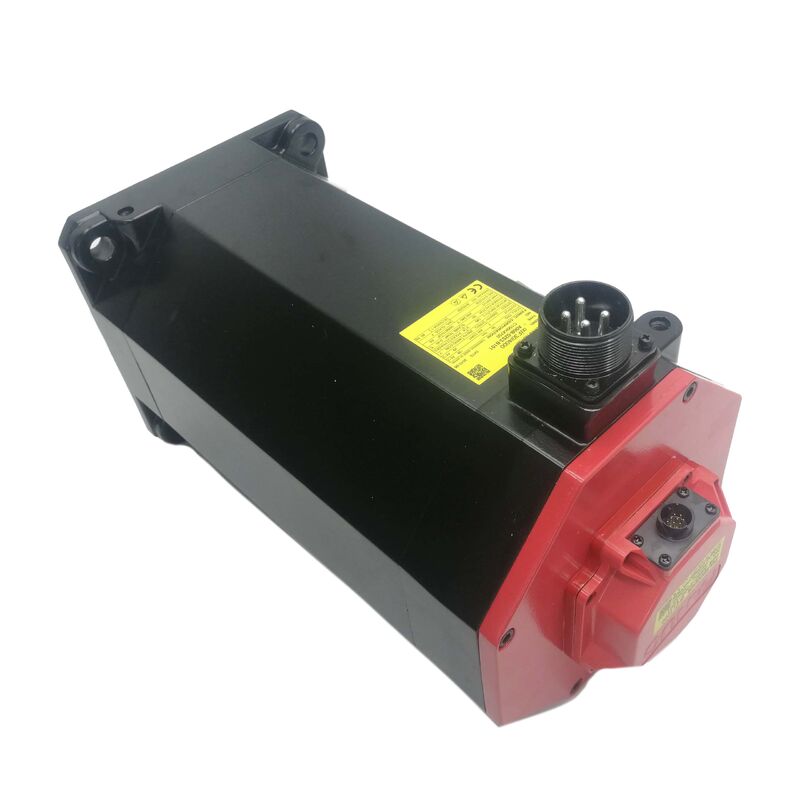
Fanuc A06B-0241-B101 | Alpha i AC Servo Motor AC12/2000i — 12Nm Stall Torque, 2000rpm, i1000 Encoder, Straight Shaft, CNC 30i / 31i / 0i-C / 0i-D
Overview
The Fanuc A06B-0241-B101 belongs to the alpha i C series — a motor line built around one design priority: sustained high torque at moderate speed.
The 12 Nm stall torque is the number that defines this motor's working identity. It is not the motor to select if rapid, light-load axis travel is the main requirement; it is the motor to select when the axis must push against a real mechanical load through the entire cutting cycle without the amplifier tripping on over-current.
The 2000rpm rated speed creates the natural pairing: with 12Nm available and a 2000rpm ceiling, the motor delivers roughly 2.5kW of continuous mechanical power. More importantly, it delivers that torque at speeds well below 2000rpm — down into the range where axes are actually cutting, where heavy drilling operations subject the Z-axis to sustained thrust loads, or where a pallet shuttle mechanism must hold its position under gravity.
The C series design geometry prioritises exactly this low-speed torque density, and the alpha i amplifier's current vector control maintains accuracy in the torque output across the motor's entire speed range.
The i1000 encoder uses 1000 sine-period lines per revolution as its base disc resolution.
The amplifier's interpolation and quadrature processing derives position data at resolution well above the 1000 raw line count, providing adequate positional feedback for the 30i/31i/0i-C/D controls this motor is designed to serve.
Because the i1000 is an incremental type, the CNC requires a reference return cycle on startup to establish the axis position datum. For applications where position retention through power cycles is needed, the B100 and B400 variants of the same motor body carry absolute encoders.
Key Specifications
| Parameter |
Value |
| Motor Designation |
AC12/2000i (Alpha i C series) |
| Stall Torque |
12 Nm |
| Rated Speed |
2000 rpm |
| Peak Power |
~2.5 kW |
| Encoder |
i1000 (incremental) |
| Shaft |
Straight, slick (no keyway) |
| Brake |
None |
| Supply |
3-phase 200V AC series |
| IP Rating |
IP65 |
| Manual |
B-65262 |
| CNC Compatibility |
30i-B, 31i-B, 0i-C, 0i-D |
Alpha i C Series — High Torque by Design
Within the alpha i servo motor family, Fanuc uses the "C" designation to indicate a motor type that trades speed range for torque density at lower speeds. A standard alpha iS or iF motor at a similar frame size would reach higher peak speeds but with a different torque-speed curve.
The C series motor uses a geometry — larger air gap diameter relative to stack length, higher pole count — that produces higher flux density in the rotor and therefore higher continuous torque per ampere of stator current.
The practical result is a motor that fits a 130mm flange envelope (similar to medium-frame alpha iS motors) while delivering torque characteristics suited to heavy-duty axes. Machine builders use C series motors on axes where the mechanical advantage is insufficient to hide a modest motor — vertical axes without counterbalance, large rotary tables, or transfer line mechanisms that must cycle reliably under full load across millions of machine cycles.
IP65 Sealing in Production Environments
IP65 provides complete exclusion of dust and protection against directed water jets from any angle — adequate for the coolant mist and chip-laden air of standard CNC machining. Machines with aggressive flood coolant or periodic high-pressure wash-down are better served by the #7076 sealing upgrade (IP67), but for the majority of enclosed machining centres and turning centres, IP65 delivers comfortable protection across normal machine lifetimes.
When mounting the motor on vertical axes where coolant may run along the motor housing toward the shaft seal, pay attention to the seal lip at the shaft bore.
The oil seal on alpha i motors handles standard coolant mist well; sustained coolant flow pooling against the seal lip represents a more demanding condition that IP67 is better equipped for.
Repair and Exchange
The A06B-0241-B101 is fully repairable. Bearing replacement (typically the most common maintenance intervention), encoder replacement, and full winding rewind services are available from Fanuc specialist service providers.
For minimum downtime, managed exchange pools allow faulty motors to be swapped for tested replacements immediately, with the faulty motor being rebuilt into the exchange stock pool afterward.
FAQ
Q1: What is the key difference between the A06B-0241-B101 (i1000) and the A06B-0241-B100 (absolute encoder)?
The B101 uses an incremental i1000 encoder and requires a reference return at startup.
The B100 uses an αiA absolute encoder that retains multi-turn position through power-off via the amplifier battery, enabling no-homing startup. Both motors share the same body and torque-speed characteristics.
For machines where operators require the convenience of immediate axis readiness after any shutdown, the B100 absolute variant is the preferred specification.
Q2: Can the i1000 encoder on the B101 be upgraded to an absolute type in the field?
Yes, the encoder assembly can be changed from the i1000 to the αiA type. The physical installation involves replacing the encoder assembly on the motor's rear end cap and adjusting the CNC's servo parameter (specifically the pulse coder type parameter) to match.
After the encoder swap, a reference return and position write cycle establishes the new encoder's absolute datum on the machine. Confirm the installed amplifier supports the target encoder type before proceeding.
Q3: Which SVM amplifier module is appropriate for the AC12/2000i motor?
The SVM selection depends on the motor's stall current and the peak current required during the application's worst-case acceleration. The AC12 designation at 12Nm stall torque places the rated current in the range that an SVM1-80 handles comfortably for single-axis installation.
If the axis profile requires rapid acceleration demanding current above the SVM1-80's continuous rating, the SVM1-130 is the next step. Use the Fanuc servo selection guide with the specific torque-speed-time profile to determine the correct amplifier class.
Q4: When specifying a replacement, is the B101 shaft compatible with the machine's coupling without modification?
Verify the specific shaft suffix of the motor currently in the machine before ordering.
The A06B-0241-B101 is a straight slick shaft (no keyway). If the machine uses a coupling that requires a keyed shaft, the A06B-0241 series in the keyed variant must be ordered instead.
The suffix code appended after the hyphen (#7008 for keyed, #7000 for slick) determines the shaft configuration. Ordering the wrong shaft type results in a motor that physically fits the machine but cannot reliably transmit torque through the original coupling.
Q5: The motor is rated IP65 — is additional protection needed for spindle axis applications in turning centres with live tooling?
Standard IP65 is adequate for the enclosure and chip guard arrangement of most CNC lathes.
The critical consideration is the shaft orientation relative to coolant flow — if the motor is mounted with the shaft pointing upward and coolant can run down along the shaft, ensure the routing prevents sustained coolant contact at the shaft seal.
Fanuc's IP67 upgrade (#7076 suffix) adds an additional lip seal stage and improved shaft bore sealing, appropriate for high-pressure coolant environments.


 Your message must be between 20-3,000 characters!