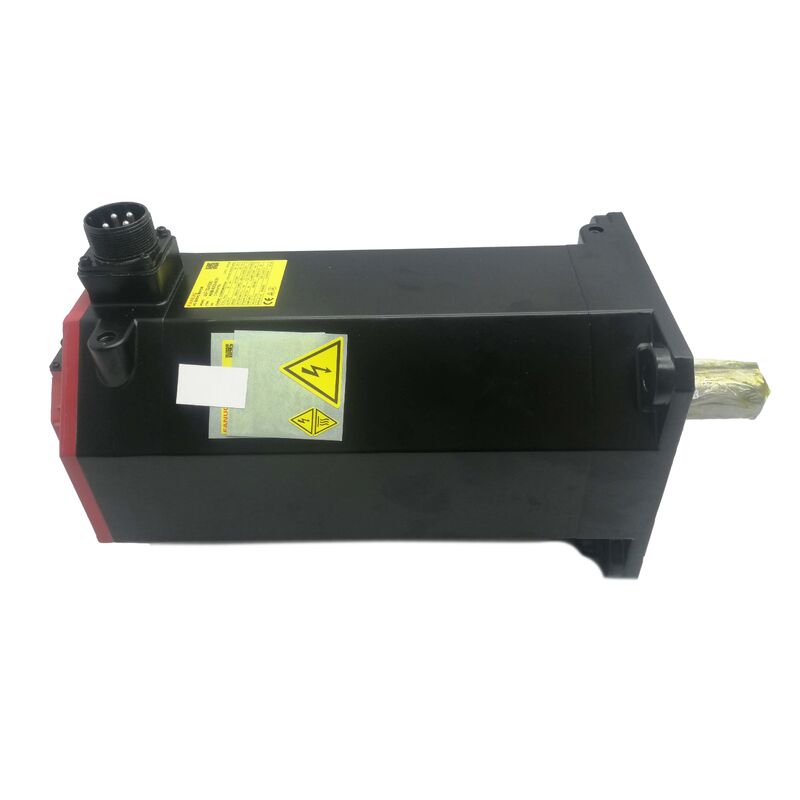
New FANUC A06B-0253-B101 AC Servo Motor for High-Precision CNC Motion Systems
The FANUC A06B-0253-B101 AC Servo Motor is built for industrial motion environments where stable torque, accurate feedback, and repeatable servo control are essential. In CNC equipment and automated production systems, a motor of this class is expected to deliver more than raw output. It needs to respond cleanly to command changes, remain predictable under changing loads, and help the control system maintain positioning quality throughout long operating cycles. That is exactly the kind of role this model is associated with.
Key Technical Data
| Specification |
Details |
| Product Type |
AC Servo Motor |
| Part Number |
A06B-0253-B101 |
| Motor Model |
αiF30/3000 |
| Rated Output |
7.0 kW |
| Rated Speed |
3000 min⁻¹ |
| Maximum Speed |
3000 min⁻¹ |
| Stall Torque |
30 Nm |
| Maximum Torque |
83 Nm |
| Stall Current |
39.0 A (rms) |
| Rotor Inertia |
0.0170 kg·m² |
| Phase |
3-Phase |
| Shaft Type |
Straight Shaft |
| Feedback Type |
i1000 Incremental Encoder |
| Typical Application |
CNC / Industrial Motion Control |
These core specifications position the motor in a performance range suited to demanding servo applications. The 30 Nm stall torque supports controlled low-speed behavior and dependable acceleration, while the 83 Nm maximum torque gives the system useful reserve during short-duration peak demand. With 7.0 kW output and 3000 min⁻¹ speed capability, the motor fits equipment that needs substantial axis performance without compromising servo stability.
Designed for Real Production Demands
In many industrial settings, the difference between acceptable motion and excellent motion comes down to consistency. A servo motor may have enough power on paper, but what matters in daily use is how smoothly it starts, how predictably it handles changing loads, and how accurately it works with the control system. The A06B-0253-B101 is better understood through that lens. It belongs in applications where motion quality is not optional, especially when machine uptime, axis repeatability, and process stability all matter at the same time.
Its straight shaft layout also makes it relevant for buyers focused on practical replacement work. Mechanical fit is one of the first issues that affects installation success, and a shaft configuration that aligns with the original machine design helps reduce unnecessary modification. In service and rebuild work, that often means a faster return to operation and fewer compatibility surprises during assembly.
Reliable Feedback for Controlled Servo Performance
A servo motor is only as useful as the feedback it can provide to the drive and control system. This model is commonly described with an i1000 incremental encoder, which supports accurate monitoring of motor position and speed. In practical machine operation, that matters because better feedback allows cleaner correction, more repeatable movement, and steadier axis behavior across a wide range of operating conditions.
For CNC users, that translates into more dependable motion control where the smallest deviations can influence part quality, cycle consistency, or surface finish. In automation environments, it helps preserve smooth operation when fast and accurate response is needed repeatedly through long production runs. Rather than being just a replacement component, this motor is better seen as a core motion element in systems where precision and reliability are expected every day.
Suitable for CNC and Industrial Automation Applications
The FANUC A06B-0253-B101 is well suited for a wide range of industrial uses, especially where precise servo response and robust motion capability need to work together. Typical application environments include:
-
CNC machine tools
-
Automated manufacturing systems
-
Precision axis drive assemblies
-
Industrial motion control equipment
-
Compatible FANUC servo motor replacement projects
Because of its output class, torque profile, shaft style, and encoder configuration, this motor is especially practical for users who need a replacement solution that supports both mechanical compatibility and stable long-term motion performance.
FAQ
Q1: What is the rated output of the FANUC A06B-0253-B101?
A1: The FANUC A06B-0253-B101 is associated with a rated output of 7.0 kW. This places it in a performance range suitable for CNC and industrial automation systems that require substantially more servo capacity than smaller motor classes can offer. In real applications, that output level helps support stronger axis motion, improved load handling, and more stable performance in demanding production environments.
Q2: What torque performance is commonly listed for this motor?
A2: Available specification data associates this model with 30 Nm stall torque and 83 Nm maximum torque. Those values indicate a servo motor designed for applications where acceleration control, load changes, and precise axis behavior all matter. For buyers evaluating replacement options, torque capability is one of the most important indicators of whether the motor can support the intended motion demands of the machine.
Q3: What shaft and encoder configuration is associated with the A06B-0253-B101?
A3: Distributor listings commonly describe this motor with a straight shaft and an i1000 incremental encoder. These details are important because they affect both mechanical installation and control-side compatibility. Confirming shaft style and encoder type is especially useful in maintenance work, where the goal is to restore original machine behavior with as little adjustment as possible.
Q4: What speed is the FANUC A06B-0253-B101 designed for?
A4: This motor is associated with a rated speed of 3000 min⁻¹, and the same specification data lists a maximum speed of 3000 min⁻¹ for the αiF30/3000 model. That speed class makes it suitable for industrial systems where stable torque and controlled servo motion are more important than extreme rotational speed. In practice, it supports reliable axis response in machine tools and other precision motion equipment.
Q5: What kinds of applications is this servo motor suitable for?
A5: The A06B-0253-B101 is suitable for CNC machinery, industrial automation equipment, precision axis systems, and compatible FANUC replacement applications. Its combination of 7.0 kW output, 30 Nm stall torque, straight shaft, and i1000 encoder feedback makes it particularly useful in equipment where accurate motion, stable servo correction, and dependable day-to-day operation are critical to performance.



 Your message must be between 20-3,000 characters!