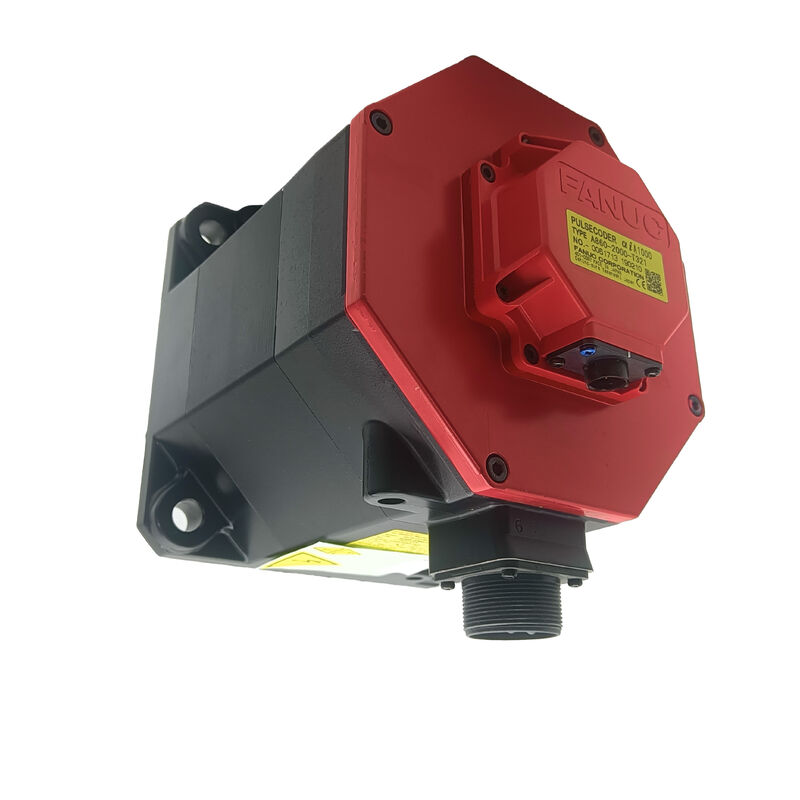
New FANUC A06B-0269-B101 AC Servo Motor for CNC and Industrial Motion Control
The FANUC A06B-0269-B101 AC Servo Motor is built for CNC equipment and industrial automation systems that depend on stable torque output, fast servo response, and reliable positioning accuracy under continuous-duty conditions. Designed for precision motion control, this motor is a practical choice for machine tools, automated production lines, and replacement projects where repeatable axis performance and long-term operating stability are essential. It is commonly listed as part of the αiS 30/4000HV series and is described in distributor listings with a straight shaft and i1000 incremental encoder configuration.
Key Technical Data
| Specification |
Details |
| Product Type |
AC Servo Motor |
| Part Number |
A06B-0269-B101 |
| Motor Series |
FANUC αiS Series |
| Motor Model |
αiS 30/4000HV |
| Rated Output |
5.5 kW |
| Rated Speed |
3000 min⁻¹ |
| Maximum Speed |
4000 min⁻¹ |
| Stall Torque |
30 Nm |
| Maximum Torque |
100 Nm |
| Stall Current |
15.9 A (rms) |
| Rotor Inertia |
0.00759 kg·m² |
| Torque Constant |
1.90 Nm/A (rms) |
| Back EMF Constant |
66 V (rms) / 1000 min⁻¹ |
| Armature Resistance (1 phase) |
0.25 Ω |
| Mechanical Time Constant |
0.002 s |
| Thermal Time Constant |
35 min |
| Weight |
23 kg |
| Shaft Type |
Straight Shaft |
| Feedback Type |
i1000 Incremental Encoder |
The specification profile of this motor makes it especially suitable for applications where strong servo behavior and controlled high-speed operation need to work together. With 5.5 kW rated output, 30 Nm stall torque, and 4000 min⁻¹ maximum speed, the A06B-0269-B101 supports responsive acceleration, dependable load handling, and accurate command tracking in demanding industrial systems.
Stable Performance for High-Precision Motion
A servo motor used in a CNC environment has to deliver more than power alone. It must respond smoothly to control commands, remain stable through load variation, and maintain repeatable motion quality across long production cycles. The A06B-0269-B101 is suited to that role because its output class and torque characteristics are matched to applications where both motion strength and positional control matter.
Its 30 Nm stall torque helps the motor maintain steady servo behavior at low speed and during acceleration, while the 100 Nm maximum torque gives additional reserve for short-duration peak demand. In practical machine operation, that kind of performance can help improve axis consistency, reduce unstable response under changing load, and support better overall process control.
High-Speed Capability with Reliable Servo Control
The 3000 min⁻¹ rated speed and 4000 min⁻¹ maximum speed allow this motor to fit applications that require both precise positioning and fast motion response. In automated manufacturing and CNC systems, that balance is important because higher speed is only valuable when it remains controllable. This motor is designed to provide that balance, giving users a motion solution that can support productivity without sacrificing servo stability.
The 0.00759 kg·m² rotor inertia also contributes to the motor’s motion profile, helping it deliver a controlled response that suits precision-driven applications. For buyers comparing replacement options, this matters because inertia characteristics influence how the motor behaves during acceleration, deceleration, and servo correction.
Practical for Replacement and Maintenance Work
In real maintenance work, choosing the right servo motor is about more than part number matching. Output level, speed range, shaft structure, encoder type, and overall motor behavior all affect how well the replacement will perform after installation. The A06B-0269-B101 is commonly described with a straight shaft and i1000 incremental encoder, which makes it particularly relevant for buyers who need to maintain compatibility within established FANUC-based systems.
For service teams, rebuilders, and industrial buyers, this motor can be a practical solution when the goal is to restore smooth axis motion, preserve control accuracy, and keep equipment running with dependable daily performance.
Typical Applications
This servo motor is commonly considered for:
-
CNC machine tools
-
Industrial automation systems
-
Precision axis control assemblies
-
High-performance motion-control equipment
-
Compatible FANUC servo motor replacement projects
FAQ
Q1: What is the rated output of the FANUC A06B-0269-B101?
A1: The FANUC A06B-0269-B101 is rated at 5.5 kW. This output level places it in a performance class suitable for CNC and industrial automation applications that need stronger servo capability than compact motor models can provide. In practical use, that helps support demanding axis movement while maintaining controlled and repeatable motion behavior.
Q2: What speed range is associated with this servo motor?
A2: This motor is specified with a rated speed of 3000 min⁻¹ and a maximum speed of 4000 min⁻¹. That combination makes it suitable for systems where responsive motion and stable servo control are both important. In many machine applications, this helps balance throughput, positioning accuracy, and motion smoothness during continuous operation.
Q3: What torque performance does the A06B-0269-B101 offer?
A3: The motor is specified with 30 Nm stall torque and 100 Nm maximum torque. These values indicate that it is designed for serious motion-control applications where the motor must handle changing loads, support acceleration, and maintain stable axis behavior. For many buyers, torque capability is one of the main reasons to choose this model for industrial servo applications.
Q4: What shaft and feedback configuration is commonly listed for this model?
A4: Distributor listings commonly describe the A06B-0269-B101 with a straight shaft and an i1000 incremental encoder. These details are important because they affect both mechanical fit and control-side compatibility. When sourcing a replacement motor, confirming shaft style and encoder type can reduce installation problems and help preserve original machine performance.
Q5: What types of applications is the FANUC A06B-0269-B101 suitable for?
A5: This servo motor is suitable for CNC machinery, industrial automation equipment, precision axis systems, and compatible FANUC replacement applications. Its combination of output class, speed capability, torque profile, and feedback configuration makes it especially useful in systems where accurate motion and dependable long-term operation are essential.


 Your message must be between 20-3,000 characters!