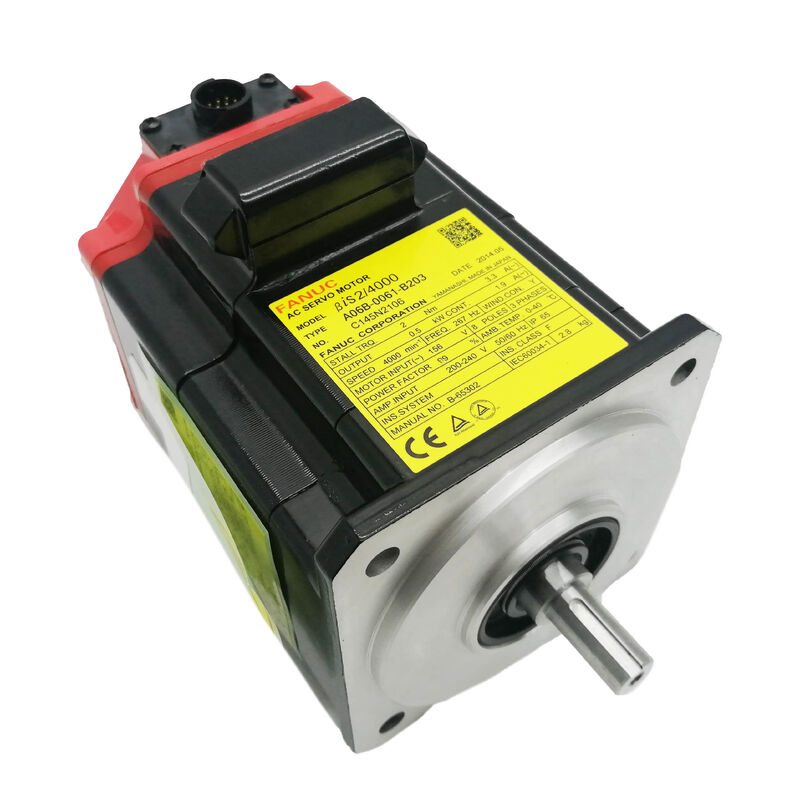
FANUC A06B-0061-B203 | Beta iS 2/4000 AC Servo Motor — 2 Nm / 4000 rpm / Straight Keyed Shaft / b128iA Encoder
A Mid-Range Beta iS for Compact CNC Axes
The A06B-0061-B203 is FANUC's βiS 2/4000 — the 2 Nm class, 4,000 rpm motor from the Beta iS series. At 0.5 kW with 2 Nm stall torque, it covers the type of CNC axis that doesn't need heavy cutting force but does need precise, responsive positioning: tool carousel indexers, sub-axis drives on compact turning centres, feed axes on small machining centres, and auxiliary servo positions on multi-function machines.
The B203 configuration specifies the straight keyed shaft without a brake. The straight keyed shaft provides positive torque transmission at the coupling — the key takes the load rather than relying on friction clamping force alone, which is more reliable across repeated direction reversals and vibration loading over service life.
The β128iA encoder gives 128 signal periods per revolution, processed by the servo amplifier to a higher effective resolution for position control. This is an incremental encoder — the machine must complete a reference-return (homing) cycle after each power-up before production can start. If the application requires absolute position without homing, a Beta iS variant with an absolute encoder is the correct specification.
No brake is the right choice for horizontal axes and mechanisms where the servo amplifier's closed position loop holds the axis at rest during normal machine operation. Vertical axes and gravity-loaded slides require the corresponding brake variant (B503 suffix) with spring-applied 24V holding brake.
Key Specifications
| Parameter |
Value |
| Part Number |
A06B-0061-B203 |
| Motor Model |
βiS 2/4000 |
| Stall Torque |
2 Nm |
| Rated Output |
0.5 kW |
| Stall Current |
3.3 A |
| Max Speed |
4,000 rpm |
| Input |
3-phase 200–240V AC |
| Poles |
8 |
| Insulation |
Class F |
| Encoder |
β128iA incremental |
| Shaft |
Straight + keyway |
| Brake |
None |
FAQ
Q1: The machine requires a homing cycle at every power-up. Is this because of the β128iA encoder?
Yes. The β128iA is an incremental encoder — position is established by counting pulses from a reference point at each power-up. A homing cycle is required after every power cycle to set the axis reference. This is normal behaviour for machines built with Beta iS incremental encoder motors. If a no-homing-cycle absolute position is needed, specify a Beta iS variant with an absolute encoder.
Q2: Does the B203 (no brake) configuration affect the axis when the servo is off?
At servo-on, the closed position loop holds the axis actively at rest. When the servo is switched off — at E-stop, planned servo-off, or power loss — servo lock is removed. A braking-free motor on a horizontal or balanced axis will hold position adequately under most mechanical conditions without the servo active. On vertical or gravity-loaded axes, the B503 variant with spring-applied brake is required to hold the axis safely when power is removed.
Q3: What amplifiers are compatible with the A06B-0061-B203?
The βiS 2/4000 pairs with FANUC Beta SVU and SVM amplifiers from the series compatible with Beta iS motors. The specific amplifier model depends on the drive system's axis count and current configuration. Confirm the amplifier's rated current covers the 3.3A stall current of this motor.
Q4: The shaft has a keyway. What keyway dimensions should be specified when ordering the coupling hub?
The keyway dimensions for the βiS 2/4000 follow FANUC's Beta servo motor instruction manual specifications for this motor frame size. Confirm the shaft diameter, keyway width, and keyway depth from the motor nameplate or the FANUC motor specification sheet before machining or ordering the hub.
Q5: Is this motor commonly kept as a spare part?
Yes. For facilities running multiple machines with βiS 2/4000 axes, keeping a matched replacement in inventory is practical — servo motor failures can halt production quickly, and the specific motor specification (model, encoder, shaft, brake) must match exactly for a replacement to function without parameter changes. The B203 (no brake, keyed) should be stocked specifically; the B503 (brake, keyed) is a different motor and not a direct substitute in machines configured without a brake.



 Your message must be between 20-3,000 characters!