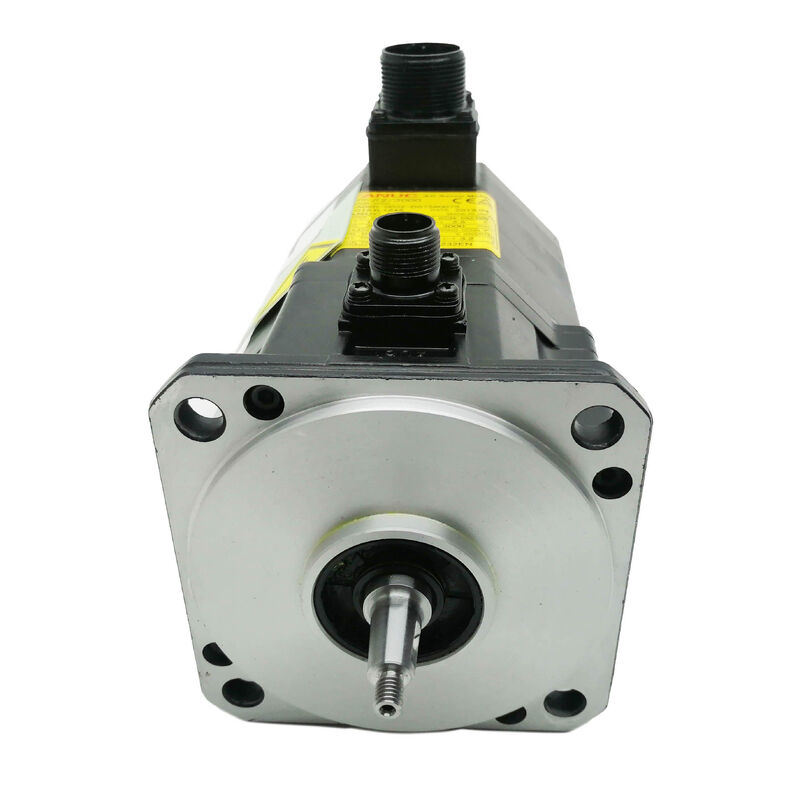
Fanuc A06B-0075-B303 | Beta i Series AC Servo Motor BiS8/3000 — 1.2kW, Taper Shaft, 24V Brake, B128iA Encoder
Part Number: A06B-0075-B303
Series: Beta i (βi) AC Servo Motor
Model: BiS 8 / 3000
Configuration: Tapered Shaft with Keyway, 24V DC Brake, B128iA Incremental Encoder, IP65
Status: Discontinued by Manufacturer — Refurbished & Surplus Stock Available
Condition: Refurbished / Surplus
Overview
The Fanuc A06B-0075-B303 is a compact, fully specified AC servo motor from Fanuc's Beta i series — model BiS8/3000 — combining three configuration choices that define exactly where and how it operates: a tapered shaft with keyway for precision mechanical coupling, a 24V DC spring-applied brake for fail-safe position holding, and the B128iA encoder for incremental feedback.
Rated at 1.2 kW continuous output with 7 Nm stall torque, running to a maximum of 3,000 RPM from a 153V three-phase supply at 133Hz and 4.9A, this is a well-specified compact servo for the secondary and auxiliary axes of CNC machine tools and industrial automation equipment.
The Beta i series occupies a specific place in Fanuc's product architecture — designed for the lower-power axes of CNC systems where full ALPHA series capability is not required, but where reliable motion control, accurate feedback, and appropriate environmental protection are not negotiable.
The BiS8/3000 at 7 Nm and 1.2 kW was a standard specification for fourth-axis rotary tables, tool magazine drives, tailstock axes, and compact positioning mechanisms that cycle thousands of times per shift and must deliver repeatable, accurate positioning with mechanical certainty at each dwell point.
Key Specifications
| Parameter |
Value |
| Rated Output |
1.2 kW |
| Stall Torque |
7 Nm |
| Maximum Speed |
3,000 RPM |
| Rated Speed |
2,000 RPM |
| Input Voltage |
153 V (3-phase) |
| Rated Frequency |
133 Hz |
| Rated Current |
4.9 A |
| Encoder |
B128iA Incremental |
| Shaft Type |
Tapered with Keyway |
| Brake |
24V DC Spring-Applied |
| Phase |
3-Phase |
| Poles |
8 |
| Series |
Beta i (βi) — BiS8/3000 |
| Status |
Discontinued by Manufacturer |
The BiS8/3000 — Compact Torque for High-Cycle Axes
The BiS8 designation puts this motor in the 8 Nm stall torque class of the Beta i series — a class sized for the auxiliary and secondary axes where the mechanical load is moderate but the motion cycle rate is high and the positioning accuracy must be consistent across thousands of cycles per shift.
The 3,000 RPM ceiling provides the speed range needed for adequate rapid traverse through typical ballscrew or gearing arrangements on compact mechanisms, while the 1.2 kW continuous rating covers the sustained power requirement of normal operating load without pushing the motor toward its thermal limit.
At 4.9A rated current, this motor places modest demands on the Beta i servo amplifier module that drives it.
The Beta i system was designed by Fanuc as a cost-effective, space-efficient servo architecture for axes that do not require the full performance envelope of the ALPHA series — lower current, smaller amplifier footprint, and appropriate integration for the CNC systems this motor family serves.
The 8-pole electromagnetic design at 133Hz and 153V reflects the electrical geometry of the BiS series at this speed and torque class.
The 2,000 RPM rated speed alongside the 3,000 RPM maximum is worth noting.
The motor operates in continuous rated duty within the 0–2,000 RPM range; above that it enters the field-weakening region toward the 3,000 RPM ceiling.
For applications that spend most of their cycle time at moderate speed with occasional faster traverse, this is a normal and appropriate operating profile.
Tapered Shaft with Keyway — Mechanical Certainty at the Coupling Interface
The tapered shaft with keyway on the A06B-0075-B303 is the mechanical configuration that defines how this motor transmits torque to the driven mechanism — and how it needs to be matched when a replacement is sourced. The taper creates a self-centering interference fit: when the coupling hub or driven component is drawn onto the shaft, it seats concentrically by geometry, eliminating the small eccentricities that can accumulate in clamping-only straight shaft connections over years of thermal cycling and vibration.
The keyway adds the second critical function: positive rotational engagement.
With a properly fitted key in place, the hub cannot slip rotationally on the shaft regardless of the torque loading, the frequency of direction reversals, or the shock forces generated during acceleration from heavy mechanisms.
On a motor driving a fourth-axis table or a tool magazine carousel that indexes through thousands of operations per day, coupling slip is a failure mode that cannot be allowed to develop — the taper plus key combination ensures it does not.
The practical implication for replacement purchasing is precise: the replacement motor must carry the same taper geometry and keyway specification. A straight-shaft motor cannot be installed in a taper-bored coupling hub without replacing or re-boring the hub.
The B303 part number suffix confirms the taper shaft and brake combination — any motor substitution must match both these mechanical characteristics.
24V DC Brake — Fail-Safe Holding on Every Power Cycle
The 24V spring-applied electromagnetic brake integrated into the A06B-0075-B303 is a holding device, not a service brake. The distinction is important: the spring engages the brake mechanically whenever 24V DC is absent from the coil — whether because the machine has been powered down intentionally, because an E-stop has been triggered, or because power has been lost unexpectedly.
The servo drive releases the brake by supplying 24V before commanding any motion, and re-engages it after the axis has stopped and the servo has been disabled.
This fail-safe logic makes the 24V brake the correct specification for any axis where uncontrolled movement under gravity or residual mechanical load is a risk.
On a vertical table, a tilting rotary axis, or any mechanism where the driven load is not self-locking through the transmission, the brake provides mechanical position certainty whenever the motor is not actively controlled — regardless of what the servo drive is doing.
The 24V supply voltage is the critical installation parameter. This motor uses 24V DC — not 90V, which is used on brakes fitted to ALPHA series motors in larger power classes. Applying 24V DC to a 90V brake coil produces partial engagement that damages the brake and the motor.
The 24V specification must be confirmed at the machine's brake power supply before commissioning any replacement unit in this position.
B128iA Encoder — Incremental Feedback at 128,000 ppr
The B128iA is Fanuc's 128,000 pulse-per-revolution incremental encoder for the Beta i series — providing position and velocity feedback via the Beta i servo amplifier's serial encoder interface. At 3,000 RPM maximum speed, the encoder generates 6.4 million pulses per second, giving the drive sufficient feedback density to maintain smooth velocity control and precise position endpoint accuracy throughout the full operating speed range.
Incremental operation requires a homing sequence at each machine startup to re-establish absolute axis position — the CNC drives the axis to its reference position, reads the encoder marker, and sets the position counter from that datum.
On the auxiliary and secondary axes typical for the BiS8/3000, homing is a brief startup routine that completes quickly and operates without incident when both the encoder and the reference position switch are in good condition.
On used motors, the B128iA encoder connector and cable exit are the first components to inspect.
Moisture ingress at the connector, pin corrosion from extended exposure to machine environment humidity, and cable damage at the exit strain relief are the most common encoder-related service findings — and they produce axis position error, encoder alarm codes, or velocity instability that can be misdiagnosed as amplifier faults before the encoder is confirmed as the source.
FAQ
Q1: What is the key difference between the B303 and B203 variants of the BiS8/3000?
Both carry a tapered shaft, 24V brake, and B128iA encoder within the same 1.2 kW / 7 Nm / 3,000 RPM electrical specification. The B203 carries a straight shaft with keyway rather than the taper of the B303. At the coupling interface, these are mechanically incompatible — a taper-bored hub will not accept a straight shaft motor without re-boring.
When replacing the B303, the taper shaft specification must be matched; fitting a B203 requires modifying or replacing the machine's coupling hub.
Q2: The brake is listed as 24V DC — why does this voltage matter so much?
Larger Fanuc ALPHA series motors use 90V spring-applied brakes. If a 24V coil receives 24V it releases cleanly; if it receives 90V it immediately burns out. Conversely, a 90V coil receiving only 24V provides partial engagement — the spring is not fully overcome and the motor runs with mechanical drag, generating heat and causing premature brake wear. Before any installation, confirm the machine's brake supply voltage at the connector matches the 24V specification of the B303.
This takes two minutes with a voltmeter and prevents a brake failure that is both expensive and time-consuming to diagnose after the fact.
Q3: What Beta i servo amplifier is compatible with the A06B-0075-B303?
The BiS8/3000 requires a Fanuc Beta i series servo amplifier — βiSVSP or equivalent — sized for the 4.9A continuous current class and compatible with the B128iA encoder interface. The amplifier must be parameterised with the motor type code for the BiS8/3000 before axis operation.
On machines where the drive has been upgraded or replaced since the original build, confirm the installed amplifier generation supports the Beta i B128iA encoder protocol — encoder interface compatibility must be verified before commissioning.
Q4: Is the B128iA encoder absolute or incremental, and what does this mean at machine startup?
The B128iA is an incremental encoder — it does not retain position through power interruptions. At each machine startup, the CNC must run a homing sequence to establish the absolute position of this axis before production motion is commanded.
On most auxiliary axes using the BiS8/3000, this is a short and routine process. For applications where eliminating homing delay is a priority, the absolute encoder variants within the BiS8/3000 family (B128iA suffix replaced by an absolute encoder suffix) would be the appropriate specification — but these require matching parameter changes in the servo drive.
Q5: What are the most important inspection steps for a used A06B-0075-B303?
Test the brake first and thoroughly: apply 24V DC and verify the shaft rotates completely freely with no mechanical drag, then remove power and confirm the shaft locks firmly without creep under moderate hand torque.
A brake that partially releases or fails to hold must be serviced before installation on any axis where mechanical position holding is a safety or quality requirement. Then inspect the taper shaft surface for scoring, fretting, or impact damage — taper surface damage cannot be corrected in the field.
Check the keyway for fretting at the key contact faces. Inspect the B128iA encoder connector for corroded pins and the cable exit for damage. Measure three-phase winding resistance for phase balance and verify insulation resistance to earth. A bench run-up with encoder signal verification on a Beta i drive completes the pre-installation assessment.


 Your message must be between 20-3,000 characters!