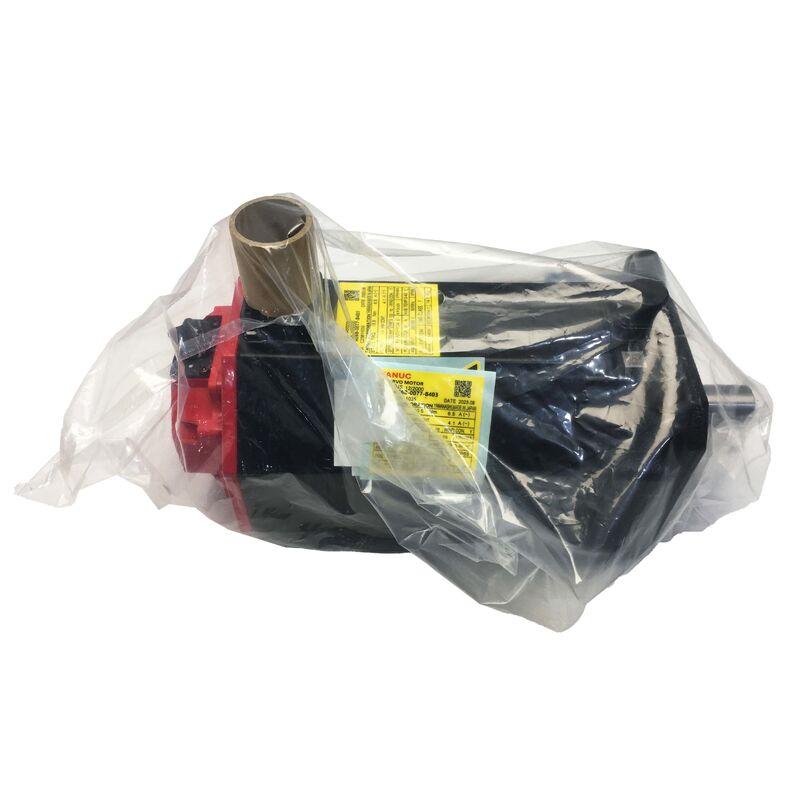
Fanuc A06B-0075-B403 | Beta i Series AC Servo Motor BiS8/3000 — 1.2kW, Straight Shaft, 24V Brake, biA128 Encoder
Part Number: A06B-0075-B403
Series: Beta i (βi) AC Servo Motor
Model: BiS 8 / 3000
Configuration: Straight Plain Shaft (SLK), 24V DC Brake, biA128 Absolute Encoder, IP65
Encoder Part: A860-2020-T301
Condition: New / Refurbished
Overview
The Fanuc A06B-0075-B403 is a 1.2 kW AC servo motor from Fanuc's Beta i series — model BiS8/3000 — carrying three defining configuration elements: a straight plain shaft without keyway, a 24V DC spring-applied brake, and the biA128 absolute encoder. Rated at 7 Nm stall torque, 153V three-phase at 133Hz, drawing 4.9A at rated load from a 200–240VAC mains supply, and tipping the scales at 9.62 kg, this motor was built for the compact, high-cycle positioning axes of CNC machine tools and automation equipment where absolute position retention, fail-safe holding, and reliable performance across the full speed range up to 3,000 RPM are all required simultaneously.
The straight plain shaft — sometimes called SLK or slick shaft — distinguishes this B403 variant from the B203 and B303 variants within the same BiS8/3000 family.
Where the B203 carries a keyed straight shaft and the B303 carries a taper shaft with brake, the B403 presents a clean, keyway-free straight shaft that transmits torque entirely through coupling clamping force.
At 7 Nm stall torque, this is an appropriate and reliable interface for the drive elements this motor typically connects to — provided the coupling is correctly specified and installation torque is properly applied.
The combination of biA128 absolute encoder and 24V brake makes the B403 a motor configured for axes where position certainty through both active operation and power-off conditions is a design requirement, not an option.
Key Specifications
| Parameter |
Value |
| Rated Output |
1.2 kW |
| Stall Torque |
7 Nm |
| Rated Current |
4.9 A |
| Input Current |
6 A |
| Motor Voltage |
153 V |
| Rated Frequency |
133 Hz |
| Phase |
3-Phase |
| Poles |
8 |
| Maximum Speed |
3,000 RPM |
| Rated Speed |
2,000 RPM |
| Power Factor |
97% |
| Encoder |
biA128 Absolute (A860-2020-T301) |
| Shaft Type |
Straight Plain (No Keyway) |
| Brake |
24V DC Spring-Applied |
| Ingress Protection |
IP65 |
| Thermal Class |
F |
| Weight |
9.62 kg |
| Series |
Beta i (βi) — BiS8/3000 |
BiS8/3000 in the Beta i Family
The BiS8 designation identifies a motor in the 8 Nm stall torque class within the Beta i series. The 3,000 RPM ceiling complements this torque capability — producing a motor whose constant-torque operating range runs from low speed up to the base speed, and whose constant-power zone extends to 3,000 RPM.
At rated speed, the biA128 encoder generates 384 million pulses per second across its 128,000 ppr resolution, providing the position and velocity feedback density the Beta i servo amplifier needs to close its control loops accurately throughout the full speed range.
Alongside the related B403, the BiS8/3000 family also includes the B103 (no brake, straight plain shaft), B203 (no brake, straight keyed shaft), and B303 (taper shaft with brake). Understanding which variant is installed on a machine before ordering a replacement is essential — the shaft geometry and brake presence change the mechanical and electrical installation requirements in ways that prevent straightforward cross-variant substitution without modification.
Straight Plain Shaft — Design Logic and Installation Requirements
The plain slick shaft on the A06B-0075-B403 presents a smooth, uninterrupted cylindrical surface. Torque is transmitted to the coupling hub by the friction between shaft and bore surfaces — generated entirely by the clamping force applied when the coupling hub's retention fasteners are tightened to specification.
For a motor rated at 7 Nm stall torque, a properly specified servo coupling clamped to the manufacturer's torque specification is more than adequate for the axis loads this motor encounters in normal CNC operation.
The plain shaft offers a practical advantage over the keyed version in some installations: there is no keyway angular orientation to reconcile during installation, and the absence of a keyway slot means the coupling hub can be positioned at any angular orientation around the shaft.
For applications where the coupling hub position relative to the shaft matters for mechanical reasons, this freedom can simplify setup.
The critical installation parameter is coupling clamping torque. An under-torqued coupling on a plain shaft loses its friction interface under sustained loading — the hub migrates angularly, initially producing small position errors that accumulate without triggering an immediate servo alarm, eventually leading to visible axis positioning scatter.
On any replacement installation, the coupling hub clamping torque must be set to the coupling manufacturer's value as measured with a calibrated torque wrench, not estimated by feel.
biA128 Encoder — Absolute Position, 128,000 ppr
The biA128 (encoder unit A860-2020-T301) is Fanuc's Beta i absolute encoder at 128,000 pulses per revolution. Absolute means the encoder retains its position reference through power interruptions without any backup battery. When the servo system powers up after shutdown, E-stop, or power loss, the servo drive reads the absolute shaft position directly from the biA128 — and the axis has full position knowledge before any motion is commanded. No homing sequence is needed.
This matters operationally in several ways.
Machine startup is faster because auxiliary axes don't add homing time. The failure mode of interrupted homing sequences — which can arise on incremental systems when power is lost mid-homing — doesn't exist with the biA128.
And for axes in any orientation, the absolute reference provides continuous protection against the position counter drift that can occur on incremental systems through accumulated electrical noise on the feedback line.
The biA128 pulsecoder body is mounted at the rear of the motor, protected within the IP65 housing.
On used motors, the encoder connector (A860-2020-T301 interface) and its cable exit are the primary inspection focus — pin corrosion, connector damage, and cable chafing at the strain relief are the most common failure modes on this encoder family. These produce position errors, encoder alarm codes, or velocity instability at the drive before the encoder is identified as the root cause.
24V DC Brake — Spring-Applied, Electrically Released
The brake fitted to the A06B-0075-B403 is spring-applied and electrically released — it requires an active 24V DC supply to open, and engages mechanically whenever that supply is removed. The engagement logic is fail-safe: power loss, E-stop, and normal shutdown all engage the brake without any positive action from the control system.
On the axes this motor serves — vertical drives, rotary tables, gravity-loaded positioning mechanisms, or any axis where uncontrolled movement at rest is a concern — the brake provides mechanical position assurance that servo torque retention alone cannot guarantee during all possible machine states.
The spring engagement force is calibrated for the 7 Nm torque class of this motor, matching the holding requirement to the motor's torque output.
The 24V specification is the critical installation parameter. This is a Beta i series motor and its brake uses 24V DC — not the 90V DC supply used on ALPHA series brakes in larger power classes. Applying 90V to a 24V coil immediately burns the coil windings.
Applying only 24V to a 90V coil produces partial engagement with mechanical drag during motor operation, causing progressive brake and motor damage.
Before commissioning any replacement motor, measure the brake supply voltage at the machine's brake cable connector to confirm it delivers 24V DC.
IP65 and Thermal Class F — Environmental and Thermal Design
IP65 sealing protects the B403 against dust ingress and directed water jets — the standard protection level across the BiS8/3000 family that covers the routine environmental exposure of a production CNC machine tool. Coolant mist, cleaning operations, and incidental fluid contact are all within the IP65 envelope.
The shaft seal at the motor front end is part of the IP65 assembly and should be inspected for hardening or lip damage on motors with extended service histories.
Thermal Class F insulation is rated for continuous winding operation up to 155°C.
With a rated current of 4.9A and a power factor of 97%, this motor runs with minimal reactive current losses — the high power factor reflects an efficient electromagnetic design that generates less heat per unit of mechanical output than lower power factor designs. At 9.62 kg frame size, the motor has adequate thermal mass for the duty cycles typical of CNC auxiliary axis applications.
Beta i Amplifier Compatibility
The A06B-0075-B403 is designed for use with Fanuc's Beta i series servo amplifiers — the βiSVSP or equivalent — and integrates with Fanuc CNC controls including Series 0i-C, 0i-D, 30i, 31i, and 32i. The servo amplifier must carry the correct motor type parameter for the BiS8/3000 and have the biA128 absolute encoder interface enabled.
The 24V brake supply is a separate circuit from the servo amplifier — it must be independently powered from a 24V DC source on the machine and interlocked to engage before servo disable is signalled.
FAQ
Q1: What is the difference between the B403 and the B303 in the BiS8/3000 family?
Both carry a 24V DC spring-applied brake and the biA128 absolute encoder, and both share the same 1.2 kW / 7 Nm / 153V / 133Hz / 4.9A electrical specification.
The difference is shaft geometry: the B303 has a taper shaft with keyway — a self-centering interference fit that positions the driven component concentrically and provides positive rotational engagement.
The B403 has a straight plain shaft with no keyway — torque transmission by clamping force only. The choice between them is determined by the machine's drive element design. A taper-bored hub will not accept a straight shaft motor without replacement.
Q2: Why does the biA128 absolute encoder eliminate the need for homing on startup?
The biA128 retains shaft position data through power cycles without a battery — it reads the true shaft position each time the servo system powers up, regardless of how long the machine has been off or whether the shaft moved during shutdown.
This means the CNC axis has accurate position knowledge before any motion is commanded, eliminating the homing traverse that incremental encoder systems require at every startup.
For machines with multiple axes using absolute encoders, this reduces startup time and removes the risk of position errors introduced by interrupted homing sequences.
Q3: The brake is rated at 24V — why is this voltage critical to get right?
The BiS8/3000 brake coil is designed for 24V DC. ALPHA series motors in larger power classes use 90V DC brakes.
Applying 90V to this 24V coil instantly burns the winding. Applying 24V to a 90V coil produces partial engagement — the spring is only partly overcome, the motor runs with the brake surface dragging, generating heat and progressive mechanical damage.
Before installing this motor, measure the machine's brake supply voltage at the brake cable connector. This takes less than a minute with a voltmeter and prevents a costly failure that will not be immediately obvious at first power-on.
Q4: What is the advantage of the straight plain (SLK) shaft compared to a keyed straight shaft?
The plain shaft allows the coupling hub to be positioned at any angular orientation around the shaft, which can simplify installation where the hub's angular position relative to the shaft matters for mechanical layout reasons.
It also presents a fully symmetric rotating surface without keyway slots that could affect balance at higher speeds.
The trade-off is that torque transmission relies entirely on coupling clamping force, with no mechanical interlock.
For 7 Nm applications with correctly specified and properly torqued couplings, this is reliable. The keyed variant (B203) provides positive rotational engagement for applications where coupling slip risk needs to be mechanically eliminated.
Q5: What checks are most important when evaluating a used A06B-0075-B403?
Test the brake first: apply 24V DC and confirm the shaft spins freely with no drag, then remove power and verify the shaft locks firmly without creep. A brake that partially releases or fails to hold needs service before the motor goes on any production axis.
Check the straight shaft end for fretting or scoring from previous coupling installation. Inspect the biA128 encoder connector (A860-2020-T301) for corroded or damaged pins and the cable exit for chafing at the strain relief.
Verify the IP65 shaft seal is intact. Measure winding resistance for three-phase balance and check insulation resistance to earth. A bench run-up to 3,000 RPM with absolute encoder position verification on a Beta i amplifier is the correct final check before commissioning.


 Your message must be between 20-3,000 characters!