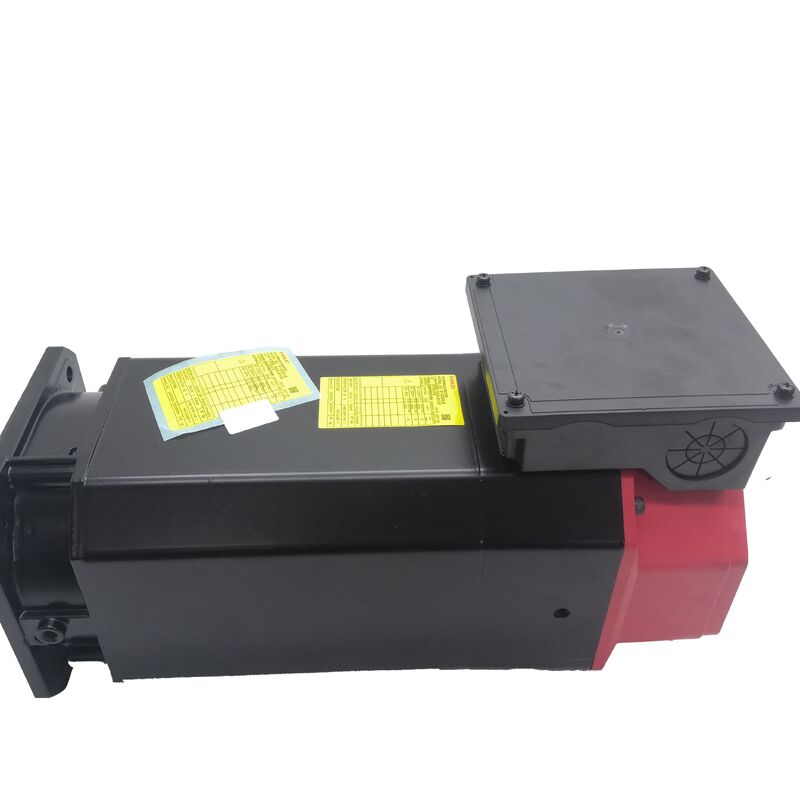
Fanuc A06B-1408-B153 | Alpha i Series AC Spindle Motor
Part Number: A06B-1408-B153
Type: AC Spindle Motor
Series: Alpha i (αi)
Model: Ai 12 / 7000
Configuration: Flange Mount, Keyed Shaft, iMZ Speed/Position Sensor, Rear Exhaust Cooling
Speed Range: 1,500 - 7,000 RPM
Condition: New / Refurbished / Surplus
Product Overview
The Fanuc A06B-1408-B153 is an Alpha i series AC spindle motor configured with flange mount, keyed output shaft, iMZ sensor feedback, and rear exhaust cooling. Rated at 7.5 kW continuous (S1) rising to 12 kW in intermittent duty cycles, this substantial mid-range spindle motor is engineered for CNC machining centers, turning centers, and multi-process machine tools where spindle performance determines material removal rates and part surface quality.
Technical Specifications
| Rated Output (S1 Continuous) |
7.5 kW |
| Rated Output (S2 / S3 Duty) |
12 kW |
| Speed Range |
1,500 - 7,000 RPM |
| Phase |
3-Phase |
| Mounting |
Flange |
| Shaft Type |
Keyed Shaft |
| Sensor |
iMZ (Speed and Position Feedback) |
| Cooling |
Rear Exhaust |
| Series |
Alpha i - Ai12/7000 |
Power Rating Details
The motor features dual power ratings: 7.5 kW continuous (S1) for sustained operations and 12 kW peak for intermittent heavy cutting phases. This design accommodates typical machining cycles where high-power cutting alternates with lower-power recovery phases, optimizing performance while maintaining thermal stability.
Keyed Shaft Design
The keyed shaft provides positive mechanical drive for belt pulleys, timing sprockets, or coupling hubs, ensuring reliable torque transmission even under shock loading or direction reversals. This configuration is essential for spindle drives with belt tension or intermittent shock loads at 12 kW peak output and 7,000 RPM operation.
iMZ Sensor Technology
The integrated iMZ sensor enables critical spindle functions including:
- Oriented Stop: Precise spindle positioning for tool changes and probe operations
- Cs-Axis Operation: Spindle function as a programmable positioning axis
- Rigid Tapping: Synchronized spindle rotation and Z-axis feed for accurate threading
Cooling System
Rear exhaust cooling directs heat away from the spindle bearing zone, enhancing thermal stability and dimensional consistency. This design minimizes thermal expansion effects on spindle centerline position, ensuring close tolerance maintenance throughout extended operation cycles.
Compatibility Information
Compatible with Fanuc Alpha i spindle amplifier series (6111, 6112, 6141, 6142) and integrates with Fanuc CNC platforms including Series 0i-B/C/D, 16i, 18i, and 30i/31i/32i. Proper amplifier parameterization with Ai12/7000 motor type and iMZ sensor interface is required for optimal performance.
Frequently Asked Questions
What is the difference between the A06B-1408-B153 (keyed shaft) and the A06B-1408-B103 (slick shaft)?
Both are Ai12/7000 motors with identical specifications except for shaft configuration. The B153 features a keyed shaft for positive mechanical drive, while the B103 has a plain shaft relying on clamping force for torque transmission.
What does the iMZ sensor do, and why is it important?
The iMZ sensor provides speed and position feedback for precise spindle regulation and enables advanced functions including oriented stop, Cs-axis operation, and rigid tapping. Proper sensor function is essential for these CNC spindle operations.
Which Fanuc spindle amplifier is compatible with this motor?
Compatible with Fanuc Alpha i spindle amplifier modules in the 6111, 6112, 6141, and 6142 series, properly sized for 12 kW peak power class and configured with correct motor parameters.
Why are there two power ratings (7.5 kW and 12 kW)?
The 7.5 kW rating represents continuous operation capability, while the 12 kW rating is available during intermittent heavy cutting phases within a cycle that includes recovery periods. This matches typical machining operation patterns.
What are the most important checks when evaluating a used A06B-1408-B153?
Inspect the keyed shaft for fretting and corrosion, verify iMZ sensor assembly integrity, measure winding resistance balance, check insulation resistance, and confirm rear exhaust duct interface condition. Bench testing with current monitoring provides final verification.


 Your message must be between 20-3,000 characters!