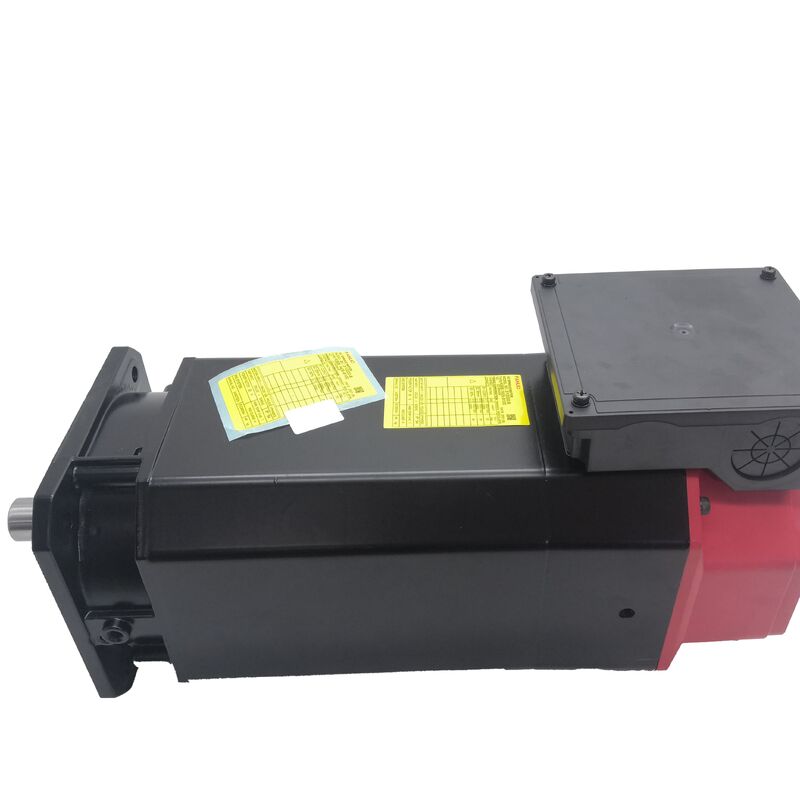
Fanuc A06B-1412-B100 | Alpha i Series AC Spindle Motor Ai 30/6000 — 22/30kW, Flange Mount, Slick Shaft, MZi Sensor, Rear Exhaust
Part Number: A06B-1412-B100
Type: AC Spindle Motor
Series: Alpha i (αi) — Highest-Speed Upgraded Model
Model: Ai 30 / 6000
Configuration: Flange Mount, Slick Shaft (No Keyway), MZi Speed/Position Sensor, Rear Exhaust Cooling
Speed Range: 1,500 – 6,000 RPM
Ingress Protection: IP54
Condition: New / Refurbished / Surplus
Overview
The Fanuc A06B-1412-B100 is an Alpha i series AC spindle motor — model Ai 30/6000 — designated by Fanuc as the highest-speed upgraded model in its power class. Delivering 22 kW in continuous S1 operation and reaching 30 kW in short-duty and intermittent cycles, with a speed range of 1,500 to 6,000 RPM, this is a high-power spindle motor for the primary cutting spindle of large machining centres, heavy-duty horizontal machining platforms, and multi-axis CNC machine tools where sustained material removal rate and spindle stiffness under heavy cutting loads are the defining performance requirements.
The Ai 30/6000 is not a compact motor. It ships freight-only, confirming the physical scale appropriate to its power class.
Flange-mounted with a slick shaft, MZi sensor feedback, and rear exhaust cooling, it brings the same spindle function architecture — oriented stop, Cs-axis control, rigid tapping — as the smaller Alpha i spindle motors to a platform that can maintain genuine cutting power through aggressive roughing passes, large-diameter face milling, and sustained production cycles on heavy workpiece materials.
The #0Z02 suffix variant adds an oil seal for environments with higher fluid exposure; the base B100 carries standard IP54 protection. Both configurations run on the same Alpha i spindle amplifier platform and deliver the same core performance.
Key Specifications
| Parameter |
Value |
| Rated Output (S1 Continuous) |
22 kW |
| Rated Output (S2 / S3 Duty) |
30 kW |
| Speed Range |
1,500 – 6,000 RPM |
| Ingress Protection |
IP54 |
| Mounting |
Flange |
| Shaft Type |
Slick (Plain, No Keyway) |
| Sensor |
MZi (Speed and Position) |
| Cooling |
Rear Exhaust |
| Compatible Amplifier |
αiSP 30 (A06B-6141-H030) |
| Series |
Alpha i — Ai30/6000 (Highest-Speed Upgraded) |
| Shipping |
Freight Required |
22 kW Continuous, 30 kW Duty — Power for Sustained Heavy Cutting
At 22 kW S1 continuous, the Ai 30/6000 delivers genuine sustained cutting power that most machining centre spindles in this speed class cannot match across an extended production run. The S1 rating is not a peak — it is the level the motor can hold indefinitely under thermal steady state, as long as the spindle amplifier's current limits are respected and the cooling airflow through the motor is unobstructed.
The 30 kW S2/S3 duty rating covers the aggressive phases of heavy roughing cycles: the initial entry cut into a casting, a deep shoulder milling pass in hardened steel, or sustained face milling of large workpieces where the spindle is taking full-width engagement cuts at substantial depth.
These phases are heavy but not continuous — the duty cycle always includes lighter passes, rapid traverses, and tool change pauses.
The motor's thermal mass absorbs the heat during the heavy phases; the cooling airflow dissipates it during the lighter phases.
Together, S1 and S3 define the real machining capability of this spindle across a production cycle, and at 22/30 kW the window is wide.
The "highest-speed upgraded model" designation marks this as an evolution from the standard α30 platform — a configuration that extends the upper speed limit to 6,000 RPM, compared to earlier α30 variants that topped out at lower speeds.
That 6,000 RPM ceiling, combined with 22 kW continuous, covers the surface speed requirements of large-diameter tooling on steel and cast iron, as well as the high-speed regime for aluminium structural machining with larger cutters.
Slick Shaft at 30 kW — The Case for No Keyway
A 30 kW spindle motor with a plain shaft surprises some engineers more accustomed to associating high torque with mechanical keying. The logic at this power class is rooted in balance, not torque capacity.
At 6,000 RPM, rotational balance of the shaft assembly is a meaningful contributor to spindle vibration, and keyway slots introduce an asymmetric mass discontinuity that requires compensating for in the balancing process.
On a motor of this frame size and power class, the forces involved at maximum speed amplify any imbalance more than on lighter motors.
The slick shaft presents a fully symmetric rotating surface — simpler to precision balance, and contributing to cleaner vibration characteristics at high spindle speeds.
The torque transmission question is addressed by the coupling specification: the clamping force available from a properly designed hub and retention arrangement at this shaft diameter is more than sufficient to transmit 30 kW without slippage, provided the hub is installed to the coupling manufacturer's torque specification and checked periodically in service.
The critical installation step is applying and verifying the correct clamping torque with a calibrated tool — not estimated by feel, and not from memory of the previous installation value.
For machine designs that require a keyed interface, the B150 variant of the same Ai 30/6000 motor carries a keyway without changing the electrical or sensor specification.
MZi Sensor — Spindle Control at Scale
The MZi sensor at the rear of the Ai 30/6000 provides the speed and position feedback that enables the full set of Alpha i spindle control functions. At 30 kW and 6,000 RPM, the operational context for these functions is different in scale from lighter spindle motors — but the functions themselves are identical.
Oriented stop brings the spindle to a defined angular position after deceleration.
On a large machining centre with a heavy spindle head, the deceleration dynamics and the inertia of the spindle-motor assembly mean that oriented stop accuracy depends directly on the MZi providing clean, stable position reference through the entire deceleration profile.
Cs-axis control converts the spindle into a programmable angular axis.
On multi-function horizontal machining centres and flexible manufacturing cells where the spindle may carry out boring, milling, and contour operations with controlled spindle angle, Cs-axis function is an operational prerequisite.
At 22 kW, this motor has the torque to drive the workpiece rotation forces of these operations without the velocity compliance that lighter spindle motors can exhibit.
Rigid tapping is perhaps where the Ai 30/6000's power becomes most directly relevant to spindle function performance.
On large workpieces requiring deep tapped holes in hard materials, the synchronisation accuracy between spindle torque and Z-axis feed that rigid tapping demands is maintained by the MZi's position feedback accuracy throughout the threading cycle.
The MZi sensor assembly — sensing ring on the shaft, pickup in the housing — requires the correct air gap to generate its specified signal amplitude.
At this motor's frame size, bearing wear rates and the mechanical tolerances of the sensor mounting position are worth verifying during scheduled maintenance intervals, not just at failure.
IP54 and Rear Exhaust — Environmental and Thermal Management
The Ai 30/6000 carries IP54 protection — confirmed in the Fanuc Alpha spindle motor descriptions manual as specific to the α30/6000 class, where the motor's larger frame size and the enclosed cooling fan arrangement combine to achieve a higher ingress rating than the IP40 of smaller motors in the same generation.
IP54 means fully dust-protected and shielded against water splashing from any direction, providing appropriate coverage for the production environments where a 22 kW spindle motor typically operates.
The rear exhaust cooling arrangement — standard on flange-mounted Alpha i spindle motors — draws air through the motor body and exhausts it rearward, away from the spindle nose and bearing zone.
At 22/30 kW of continuous/peak power, the heat generated during sustained cutting cycles is substantial. Directing this heat rearward through machine-side ducting, rather than allowing it to conduct toward the spindle front bearings, is the primary mechanism that enables the machine to maintain consistent dimensional accuracy through long production runs.
Thermal drift at the spindle nose — the gradual migration of the spindle centerline as the housing expands during warmup — is reduced by this rear exhaust architecture.
Amplifier Compatibility
The Ai 30/6000 pairs with the Fanuc Alpha i spindle amplifier module αiSP 30 (A06B-6141-H030), which provides 35 kW capacity from a 283–339V input bus at up to 133A output. This amplifier is correctly sized for the Ai 30/6000's continuous and peak current demands.
It integrates with Fanuc CNC platforms including Series 0i-B, 0i-C, 0i-D, 16i, 18i, and 30i/31i/32i. The spindle motor type parameter in the amplifier must be set for the Ai 30/6000 and the MZi sensor interface enabled before the spindle is operated.
FAQ
Q1: What is the difference between the A06B-1412-B100 (slick shaft) and the A06B-1412-B150 (keyed shaft)?
Both are Ai 30/6000 motors sharing the same 22/30 kW output, 1,500–6,000 RPM speed range, flange mount, MZi sensor, and rear exhaust configuration. The B100 has a plain slick shaft; the B150 has a keyway. The choice depends on the machine's coupling design.
A keyed drive element cannot be fitted to a plain shaft motor without replacing the coupling hub, and vice versa. Confirm which shaft variant is installed on the machine before ordering.
Q2: What spindle amplifier is required for the A06B-1412-B100?
The Ai 30/6000 is designed for the Fanuc αiSP 30 spindle amplifier module (A06B-6141-H030), which delivers 35 kW capacity at 133A from a 283–339V DC bus. It integrates with Fanuc CNC Series 0i-B, 0i-C, 0i-D, 16i, 18i, and 30i/31i/32i. The amplifier motor type parameter must match the Ai 30/6000.
Using an undersized amplifier module risks both cutting performance and motor protection function, as the amplifier's peak current capability determines the motor's ability to accelerate spindle inertia and resist cutting torque variations.
Q3: What does "highest-speed upgraded model" mean in practice?
The Ai 30/6000 is designated by Fanuc as an upgraded higher-speed variant compared to standard α30 motors in the same power class. The 6,000 RPM maximum speed extends the spindle's productive range compared to earlier α30 configurations.
The upgrade affects the motor's electromagnetic design and mechanical construction to support 6,000 RPM at 22 kW continuous — demanding a more capable bearing arrangement, balanced rotating assembly, and thermal management than a lower-speed variant at the same continuous output.
Q4: Why does the Ai 30/6000 have IP54 protection when smaller Alpha i spindle motors have only IP40?
The Fanuc Alpha spindle motor descriptions manual explicitly notes that IP54 applies specifically to the α30/6000 model, while most other motors in the series carry IP40. The higher rating on the α30/6000 results from its enclosed fan cooling arrangement and the larger, more robustly sealed housing that its power class requires.
For a high-power spindle motor installed in a production machining environment where coolant and metal chips are present at higher concentrations near the work area, IP54 provides the appropriate baseline protection level.
Q5: What are the most important service checks for a used A06B-1412-B100?
At this power class and frame size, winding insulation is the priority: measure insulation resistance to earth on all three phases with a megger — a motor that has seen coolant ingress or operated in a damp environment will show degraded insulation before winding failure occurs.
Measure winding resistance for phase balance. Check bearing condition by rotating the shaft by hand and listening for roughness — at this frame size, bearing wear is one of the most common failure modes. Inspect the MZi sensor mounting and air gap.
Verify the cooling fan operates freely and confirm the rear exhaust path is unobstructed. A full load run test on a compatible αiSP 30 amplifier at incremental speeds to 6,000 RPM with current monitoring and MZi signal verification is the correct commissioning check before the motor is installed on a production machine.


 Your message must be between 20-3,000 characters!