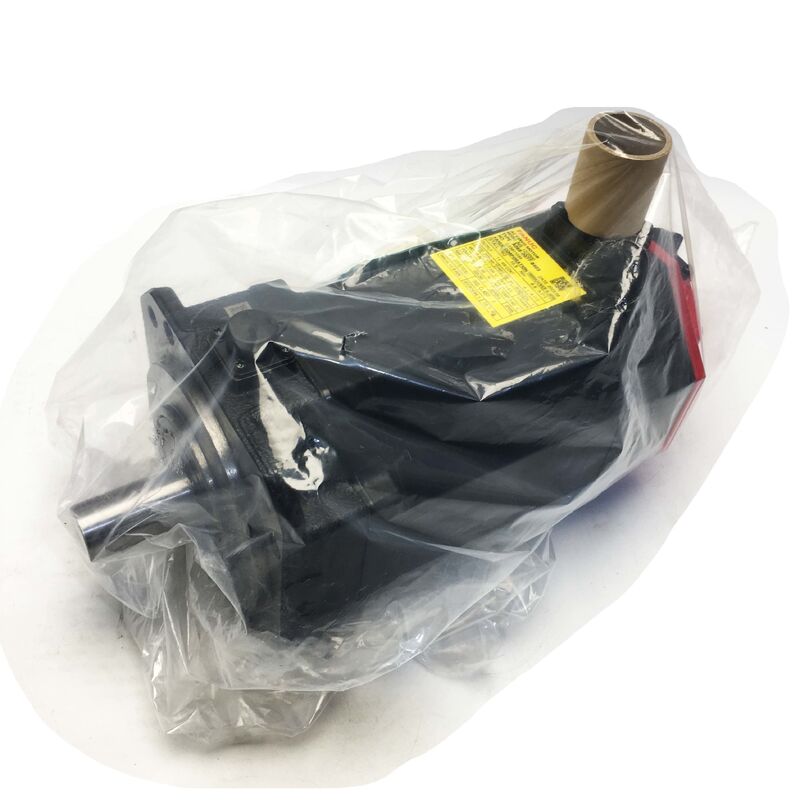
Fanuc A06B-0078-B103 | Beta iS Series AC Servo Motor BiS12/3000 — 1.8kW, 11Nm, Straight Plain Shaft, biA128 Absolute Encoder
Part Number: A06B-0078-B103
Series: Beta iS (βiS) AC Servo Motor
Model: BiS 12 / 3000
Configuration: Straight Plain Shaft (SLK, No Keyway), No Brake, biA128 Absolute Encoder, IP65
Encoder Part: A860-2020-T301
Condition: New / Refurbished
Overview
The Fanuc A06B-0078-B103 is a 1.8 kW AC servo motor from Fanuc's Beta iS series — model BiS12/3000 — built with a straight plain shaft, the biA128 absolute encoder, and no brake.
Rated at 11 Nm stall torque, up to 3,000 RPM, from a 200–240 VAC three-phase supply, and protected to IP65, this motor occupies the 12 Nm torque class within the Beta iS family — a step up from the BiS8/3000, sized for axes where higher stall torque rather than higher rated power drives the motor selection decision.
The B103 variant defines this motor precisely among several configurations available in the A06B-0078 series. It has a straight shaft — not taper — and that shaft is plain, without a keyway.
The encoder is the biA128 absolute pulsecoder, which means no homing is needed at startup; the axis has full position knowledge from the moment the servo amplifier powers up. There is no brake — the B103 suffix identifies no brake.
Understanding these three configuration elements in combination is the only reliable way to determine whether the A06B-0078-B103 matches what a given machine axis requires, because swapping a taper-shaft variant for a straight-shaft motor, or installing a brake-equipped unit where none is expected, creates installation problems that aren't visible until the machine is commissioned.
The BiS12/3000 appears on the feed axes and positioning axes of compact to mid-size CNC machine tools, on rotary tables and fourth-axis indexers, and on automation equipment where 11 Nm holding torque and 3,000 RPM maximum speed define the axis performance envelope.
Key Specifications
| Parameter |
Value |
| Rated Output |
1.8 kW |
| Stall Torque |
11 Nm |
| Maximum Speed |
3,000 RPM |
| Input Voltage |
200–240 VAC |
| Phase |
3-Phase |
| Encoder |
biA128 Absolute (A860-2020-T301) |
| Encoder Resolution |
128,000 ppr |
| Shaft Type |
Straight Plain (No Keyway) |
| Brake |
None |
| Ingress Protection |
IP65 |
| Encoder Type |
Absolute — no homing required |
| Series |
Beta iS (βiS) — BiS12/3000 |
BiS12/3000 in the Beta iS Servo Family
The Beta iS series uses neodymium rare-earth permanent magnets in the rotor — the same magnet technology that gives the Alpha i series its compact torque density, available in an economical drive architecture that pairs with Fanuc's Beta i servo amplifiers and the integrated βiSVSP combined servo-spindle module.
At 11 Nm stall torque and 1.8 kW rated output, the BiS12/3000 sits between the BiS8/3000 (7 Nm, 1.2 kW) and the BiS22/2000 (20 Nm, 2.5 kW) in the torque-sorted lineup.
The model designation carries the relevant operating parameters directly: BiS denotes Beta i Strong (neodymium magnet design), 12 identifies the torque class in Newton-meters, and /3000 sets the maximum operating speed.
Choosing between the BiS12/2000 and BiS12/3000 variants comes down to the axis speed requirement — the /2000 model provides 11 Nm stall torque within a 2,000 RPM ceiling, while the /3000 extends the speed range at the same torque.
Both have the same stall torque, making the speed ceiling the differentiating specification for application matching.
The B103 suffix specifically means: straight shaft (S), plain bore coupling interface (LK from SLK), biA128 encoder (103), no brake.
When searching for the right replacement motor, the full suffix matters — B003 is the taper shaft variant of the same electrical motor, and fitting a plain-shaft coupling hub to a taper shaft motor (or a taper-bored hub to a plain shaft motor) is a mechanical mismatch that requires either a different motor or a different coupling element.
Straight Plain Shaft — No Keyway, All Clamping
The plain slick shaft of the A06B-0078-B103 transmits torque to the coupling hub entirely through clamping friction.
The coupling hub's bore clamps the shaft diameter with the force generated by the hub's retention fasteners, and that friction interface carries the axis load. No keyway is present — there is no mechanical interlock between shaft and hub, and no angular orientation requirement to manage during installation.
At 11 Nm stall torque, the plain shaft interface is reliable and appropriate when the coupling is correctly specified and installed to the manufacturer's clamping torque specification. The critical installation step is applying and verifying the hub clamping torque with a calibrated wrench — not estimating it, not carrying it over from a previous installation without measurement, and not re-using a hub that shows signs of bore distortion from a previous slip event.
A coupling hub that has been allowed to slip on a plain shaft leaves fretting marks on both the shaft surface and the hub bore. The fretting itself is not always immediately obvious, but its effect on shaft-to-hub concentricity and the progressive runout that follows from a worn hub bore are.
On any replacement installation, both the shaft surface and the hub bore should be inspected before the new motor is installed — an existing fretted hub fitted to a new shaft sets up the same slip condition on the replacement motor.
biA128 Absolute Encoder — Position Without Homing
The biA128 pulsecoder (A860-2020-T301) is an absolute rotary encoder at 128,000 pulses per revolution.
Absolute means the encoder retains its angular position reference through power interruptions — when the servo system powers up after any shutdown, planned or unplanned, the servo amplifier reads the shaft position directly from the biA128 and has accurate axis position data before any motion is commanded.
The practical value of this is straightforward: no homing cycle is required.
On axes with incremental encoders, startup involves a homing sequence — typically a slow traverse to a reference switch — to establish position reference before the axis can be used.
On machines with multiple axes, homing all axes in sequence adds to startup time and creates the failure mode of interrupted homing, where loss of power mid-sequence leaves position reference indeterminate. The biA128 eliminates both of these.
For axes on automation equipment or transfer lines where machine restart time directly affects line productivity, the difference between an absolute encoder axis and an incremental one can be measured in production output per shift.
On CNC machine tools, the benefit appears most clearly after emergency stops or unplanned power loss events, where recovery to production-ready status is faster when axes don't need to re-home.
The biA128 pulsecoder body mounts at the motor rear end within the IP65 housing.
The encoder cable connector (A860-2020-T301 interface) exits the rear face and connects to the servo amplifier's feedback input.
On used motors, the connector pins and cable exit strain relief are the primary inspection points — both are more vulnerable to damage from environmental exposure and cable handling than the pulsecoder body itself.
IP65 — Sealed Against the Production Environment
IP65 protection covers the A06B-0078-B103 against complete dust ingress and water jets from any direction. Within a production machine tool environment, IP65 is the appropriate baseline: it handles coolant mist, incidental fluid contact, periodic cleaning, and the particulate environment of active machining.
The shaft end seal is part of the IP65 assembly and warrants inspection on motors with service histories longer than a few years, particularly on axes with significant radial shaft loading that accelerates seal lip wear.
The protection rating applies to the assembled motor body.
The encoder cable connector, when seated and locked, maintains the IP65 envelope at the rear.
An unseated or damaged connector exposes the pulsecoder interface to the same environment the motor body is sealed against — corrosion on the signal pins produces position errors or encoder alarm codes before the cause is identified.
Beta i Amplifier Compatibility
The A06B-0078-B103 is designed for Fanuc's Beta i series servo amplifiers — the βiSV single-axis drive or the βiSVSP combined servo-spindle module, in the current class appropriate for the BiS12/3000.
It integrates with Fanuc CNC controls including Series 0i-C, 0i-D, 0i-F, and the 30i/31i/32i family. The servo amplifier must carry the correct motor type parameter for the BiS12/3000 and have the biA128 absolute encoder interface enabled before the axis is operated.
FAQ
Q1: What does "SLK" mean on the A06B-0078-B103, and how does it differ from the B003 variant?
SLK stands for slick — a plain straight shaft with no keyway. Torque is transmitted entirely through the friction generated by clamping the coupling hub onto the shaft diameter.
The A06B-0078-B003 carries a taper shaft: a self-centering conical interface that provides both concentric positioning and positive mechanical engagement between motor and coupling element.
The two shaft types require fundamentally different coupling components and are not interchangeable without replacing the coupling hub.
Confirm the shaft type on the installed motor before ordering a replacement.
Q2: The biA128 encoder is listed as absolute — does that mean no homing is needed after power loss?
Correct. The biA128 retains the shaft position reference through power cycles without a battery. When the servo system powers up — whether after a planned shutdown, an emergency stop, or an unplanned power loss — the servo drive reads the absolute shaft position from the biA128 and has accurate axis position data immediately.
No reference return or homing traverse is required. This contrasts with incremental encoder systems, which require a homing sequence at every startup to establish position reference.
Q3: The B103 has no brake — when is a brake variant needed and which part number applies?
A brake is needed on axes where uncontrolled movement under gravity or load at rest is a concern: vertical axes, tilting axes, or any axis where the servo torque holding position is removed during E-stop or power-off conditions. For the BiS12/3000 with a 24V DC brake, the appropriate variant is A06B-0078-B403 (straight plain shaft, brake) or A06B-0078-B303 (taper shaft, brake). Installing the A06B-0078-B103 (no brake) on an axis that requires one creates a drop or drift risk whenever the servo is disabled.
Q4: What Beta i servo amplifier is required for the A06B-0078-B103?
The BiS12/3000 is compatible with Fanuc's Beta i servo amplifiers — the βiSV single-axis drive or the βiSVSP combined servo-spindle module — in the current class for the BiS12/3000 torque rating.
It integrates with Fanuc CNC controls including 0i-C, 0i-D, 0i-F, and 30i/31i/32i. The amplifier must have the BiS12/3000 motor type parameter configured and the biA128 absolute encoder interface enabled. Verify the amplifier's rated output current covers the BiS12/3000's peak current requirement at the axis's maximum acceleration demand.
Q5: What are the most important checks when inspecting a used A06B-0078-B103?
Start with the plain shaft: inspect the shaft surface for fretting marks or scoring from a previous coupling that slipped. Fretting on the shaft surface indicates that the coupling was under-torqued or the hub was damaged — a fretted shaft that hasn't been reground will cause concentricity problems with the next coupling. Check the biA128 encoder connector (A860-2020-T301) for corroded or bent pins and inspect the cable exit at the strain relief for chafing or cracking.
Verify the IP65 shaft seal is intact and supple. Measure winding resistance across all three phases for balance and check insulation resistance to earth with a megger. A bench run-up to 3,000 RPM on a Beta i amplifier with absolute encoder position verification and current monitoring is the correct final check before the motor is returned to production service.


 Your message must be between 20-3,000 characters!