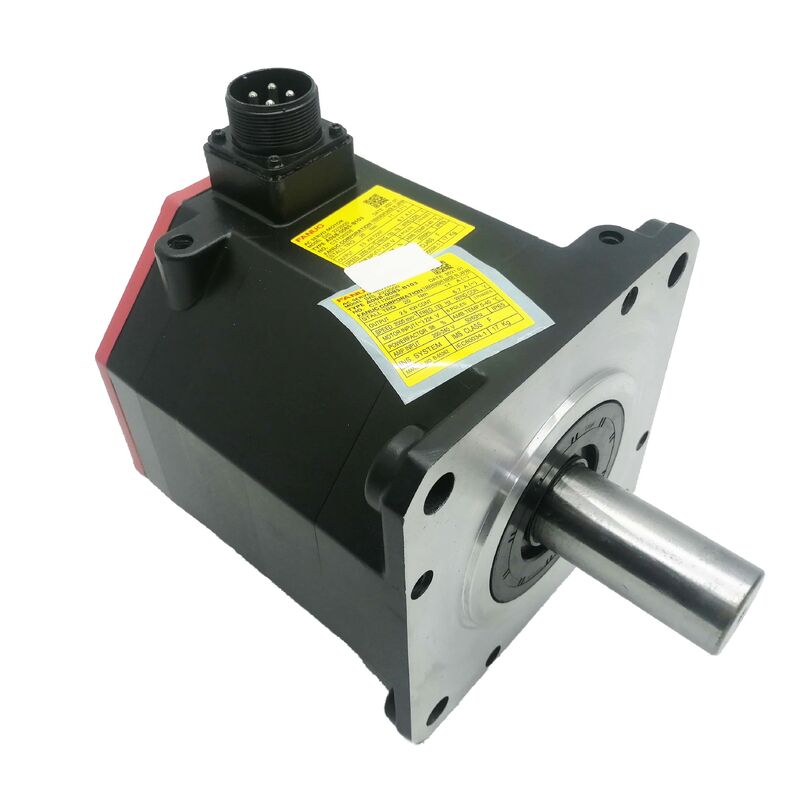
Fanuc A06B-0085-B100 | Beta iS Series AC Servo Motor BiS22/2000 — 2.5kW, 20Nm, biA128 Absolute Encoder, IP65
Part Number: A06B-0085-B100 Series: Beta iS (βiS) AC Servo Motor Model: BiS 22 / 2000 Encoder: biA128 Absolute (A860-2020-T301) Maximum Speed: 2,000 RPM Ingress Protection: IP65 Condition: New / Refurbished / Exchange Available
Overview
The Fanuc A06B-0085-B100 is a 2.5 kW AC servo motor from Fanuc's Beta iS series — model BiS22/2000. With a stall torque of 20 Nm, a 2,000 RPM maximum speed, three-phase 200–240 VAC operation, IP65 sealing, and the biA128 absolute pulsecoder, this motor occupies the upper end of the Beta iS compact servo range. It is built for the heavier feed axes of small to mid-size CNC machine tools, for rotary tables and fourth-axis indexers requiring substantial holding torque, and for automation equipment where 20 Nm stall torque and absolute position retention through power interruptions are both required by the axis design.
The "22" in BiS22/2000 identifies the torque class — 20 Nm stall — and "/2000" sets the maximum operating speed. Within the A06B-0085 product series, the B100 is one of several variants built on this same electromagnetic core.
What distinguishes specific variants from each other is shaft geometry and brake presence; the electrical specification, encoder interface, and IP65 construction are shared across the series.
Verifying that the B100 shaft configuration matches what the machine's coupling arrangement requires is the most important check before ordering, because the physical installation is what changes between variants — not the motor's fundamental performance.
The BiS22/2000 is the highest-torque motor in the BiS compact range before stepping up to larger frame classes.
That 20 Nm stall torque — nearly three times the BiS8/3000's 7 Nm — serves axes with greater load inertia, longer ball screws, heavier workholding, or the sustained torque demands of a rotary table drive that the smaller BiS motors cannot comfortably accommodate.
Key Specifications
| Parameter |
Value |
| Rated Output |
2.5 kW |
| Stall Torque |
20 Nm |
| Maximum Speed |
2,000 RPM |
| Input Voltage |
200–240 VAC |
| Phase |
3-Phase |
| Encoder |
biA128 Absolute (A860-2020-T301) |
| Encoder Resolution |
128,000 ppr |
| Brake |
None |
| Ingress Protection |
IP65 |
| Series |
Beta iS (βiS) — BiS22/2000 |
| Encoder Type |
Absolute — no homing required |
BiS22/2000 — Torque-Priority Motor for Demanding Axes
The Beta iS series uses neodymium rare-earth permanent magnets, the same magnet technology that gives the Alpha i servo motors their compact torque density — available at a system cost level appropriate for the economy CNC machine tools and entry-level automation equipment the Beta i architecture targets.
Within the BiS family, the "S" denotes this strong neodymium magnet design, which delivers higher torque per unit volume than earlier ferrite-magnet motors of comparable frame size.
At 20 Nm stall torque and 2.5 kW rated power, the BiS22/2000 is specified for axes where the load torque requirement — not just the power requirement — drives the motor selection. The maximum speed of 2,000 RPM is lower than the BiS12/3000 (3,000 RPM) or the BiS8/3000 (3,000 RPM), but the BiS22/2000 is not a high-speed motor; it is a high-torque motor.
The axes it serves are characterised by the need to maintain commanded positions against substantial load, accelerate higher-inertia mechanisms without position error, and recover from external disturbances — properties that depend on stall torque more directly than on maximum speed.
On a CNC machining centre, the axes most likely to carry a BiS22/2000 are the heavier linear axes of a larger table or the rotary axis of a tilting trunnion table — axes where the table mass, workpiece weight, and clamping loads combine to create a load-torque demand that lighter Beta iS motors cannot hold without servo following errors.
On automation equipment, the BiS22/2000 appears on welding positioner axes, heavy-duty material handling arms, and multi-axis fixtures where holding position under load is as important as moving quickly between positions.
biA128 Encoder — Absolute Position at 128,000 ppr
The biA128 pulsecoder (A860-2020-T301) fitted to the A06B-0085-B100 is an absolute rotary encoder at 128,000 pulses per revolution. Absolute encoding means the encoder retains its angular position reference continuously — through planned shutdowns, E-stops, and unplanned power loss events alike.
When the servo drive powers up after any such event, it reads the true shaft position from the biA128 immediately and passes it to the CNC.
No reference return, no homing traverse, no startup delay for position establishment.
On heavier axes like the ones the BiS22/2000 serves, this has a specific practical value beyond the convenience of faster machine startup. Incremental encoder systems require a homing sequence that traverses the axis to a reference position before the CNC accepts position commands — on a heavy rotary table or a large-mass linear axis, this traversal has to be done at reduced speed, adds time to every startup cycle, and represents a real failure mode if power is interrupted mid-homing.
The biA128 eliminates all three of these issues.
The biA128 pulsecoder body mounts at the rear of the motor, protected within the IP65 housing.
The encoder cable exits through the motor rear and connects to the Beta i servo amplifier's feedback input via the A860-2020-T301 connector.
On motors returning from service or sourced as surplus, the encoder connector and cable exit strain relief are the two components most vulnerable to damage from handling and environmental exposure — inspection of both is a standard first step before any return-to-service testing.
IP65 — Sealed for the Production Environment
The IP65 protection rating on the A06B-0085-B100 provides full dust exclusion and protection against water jets from any direction — the appropriate baseline for a servo motor operating inside a production machine tool or industrial automation cell. Coolant mist, periodic washdown, and the incidental fluid exposure of a machining environment are all within the IP65 envelope.
The shaft seal at the motor front end is part of the IP65 assembly. On axes with significant radial shaft loading — which applies to many of the applications the BiS22/2000 serves — shaft seal inspection is worth including in periodic maintenance, since radial load accelerates seal lip wear over time.
A worn shaft seal allows coolant or oil vapour to migrate into the motor body, degrading winding insulation before any other visible failure symptom appears.
The encoder connector, when correctly seated and locked, maintains the IP65 boundary at the motor rear.
An unseated or damaged connector creates a gap in the seal that exposes the pulsecoder interface to the same environment the motor body is sealed against, producing pin corrosion that manifests as position errors or encoder alarm codes.
Beta i Amplifier Compatibility
The A06B-0085-B100 is compatible with Fanuc's Beta i series servo amplifiers — the βiSV single-axis drive module or the βiSVSP combined servo-spindle module — in the current class appropriate for the BiS22/2000's rated output.
It integrates with Fanuc CNC controls including Series 0i-C, 0i-D, 0i-F, and the 30i/31i/32i family. The amplifier must be parameterised with the BiS22/2000 motor type code and have the biA128 absolute encoder interface enabled before the axis is operated.
Given the BiS22/2000's higher output compared to the smaller Beta iS motors, confirming the servo amplifier's rated current matches the BiS22/2000's peak current demand at maximum acceleration is an important commissioning step — particularly on axes where aggressive acceleration and deceleration cycles are part of the production cycle.
FAQ
Q1: What makes the BiS22/2000 different from the BiS12/3000 or BiS8/3000?
All three are Beta iS motors using neodymium magnets and the biA128 absolute encoder. The key differences are torque and speed: the BiS8/3000 offers 7 Nm stall torque at up to 3,000 RPM; the BiS12/3000 offers 11 Nm at up to 3,000 RPM; the BiS22/2000 offers 20 Nm at up to 2,000 RPM. The BiS22/2000 is the torque-priority motor of the three — correct for axes with high load inertia or high sustained load torque where the lower-speed ceiling of 2,000 RPM is acceptable in exchange for nearly three times the stall torque of the BiS8/3000.
Q2: Does the biA128 encoder require a backup battery to retain position?
No. The biA128 is a true absolute encoder that retains shaft position through power interruptions without a battery. Position data is maintained by the encoder's internal mechanism and is read directly by the servo drive each time it powers up.
This is different from some absolute encoder designs that use a battery-backed capacitor or cell to maintain a revolution counter — the biA128 does not rely on any backup power source for its absolute position retention.
Q3: Which Beta i servo amplifier is compatible with the A06B-0085-B100?
The BiS22/2000 operates with Fanuc Beta i servo amplifier modules — the βiSV single-axis drive or βiSVSP combined servo-spindle module — sized for the BiS22/2000's 2.5 kW rated output and associated peak current.
It integrates with Fanuc CNC controls including 0i-C, 0i-D, 0i-F, and 30i/31i/32i series.
The amplifier motor type parameter must match the BiS22/2000, and the biA128 absolute encoder interface must be enabled. At this power class, verifying the amplifier's peak current rating against the axis's maximum acceleration demand is an important commissioning step.
Q4: Can the A06B-0085-B100 be used on vertical axes without an external holding brake?
The B100 variant carries no brake. On vertical axes where the motor is the sole means of preventing gravity-driven descent during servo-off or E-stop conditions, a separate holding brake mechanism — either a motor with the B403 brake variant or an external axis brake — is required.
Running a brake-free motor on an unbalanced vertical axis creates a drop risk whenever servo power is removed. For horizontal axes or balanced vertical axes where this risk doesn't apply, the B100's absence of a brake is irrelevant to safety.
Q5: What are the most important checks when inspecting a used A06B-0085-B100?
Measure winding resistance across all three phases for balance, then check insulation resistance to earth with a megger — at 20 Nm and 2.5 kW, this motor works harder than lighter Beta iS motors, and winding insulation is worth verifying particularly if the motor has been exposed to coolant or operated in a damp environment.
Inspect the biA128 encoder connector (A860-2020-T301) for corroded or bent pins and the cable exit for chafing.
Check the IP65 shaft seal for hardening or lip damage. Rotate the shaft by hand to feel for bearing roughness.
A full bench run-up to 2,000 RPM on a Beta i amplifier with absolute position verification and amplifier current monitoring is the correct final check before the motor is returned to production service.


 Your message must be between 20-3,000 characters!