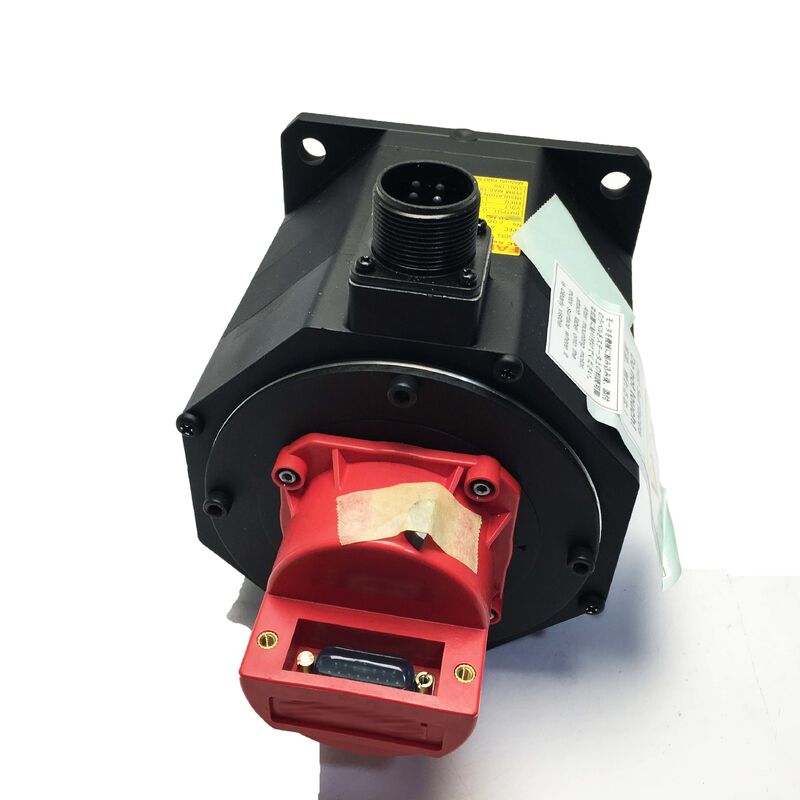
Fanuc A06B-0087-B103 | Beta iS Series AC Servo Motor BiS30/2000 — 3kW, 27Nm, Straight Plain Shaft, biA128 Absolute Encoder, IP65
Part Number: A06B-0087-B103 Series: Beta iS (βiS) AC Servo Motor
Model: BiS 30 / 2000
Configuration: Straight Plain Shaft (SLK, No Keyway), No Brake, biA128 Absolute Encoder
Rated Output: 3 kW
Stall Torque: 27 Nm
Maximum Speed: 2,000 RPM
Input Voltage: 200–240 VAC, 3-Phase
Ingress Protection: IP65
Encoder Part: A860-2020-T301
Condition: New / Refurbished
Overview
The Fanuc A06B-0087-B103 is a 3 kW Beta iS series AC servo motor — model BiS30/2000 — configured with a straight plain shaft, no brake, and the biA128 absolute pulsecoder. At 27 Nm stall torque and a 2,000 RPM ceiling, it is the largest motor in the standard Beta iS compact range before stepping up to the BiS40/2000, and it positions itself firmly in the territory where load inertia, sustained holding torque, and axis rigidity under heavy cutting forces are what drive the selection decision — not raw speed.
The B103 suffix defines this specific configuration exactly: straight shaft, plain bore (no keyway), biA128 absolute encoder, and no brake.
Each of these elements matters independently. The straight plain shaft transmits torque through clamping force only. The biA128 means the axis has full position knowledge the moment the servo system powers up, requiring no homing reference return.
The absence of a brake means the motor is unsuitable as specified for unbalanced vertical axes or any application where servo-off creates a gravity-driven movement risk. Understanding all three before ordering a replacement avoids installation problems that are only discovered at commissioning.
The BiS30/2000 appears most often on the heavier feed axes of mid-size to large CNC machining centres, on direct-drive rotary table axes where holding torque rather than positioning speed is the design constraint, and on multi-axis automation equipment where large workpieces or fixtures load the servo axis significantly above what lighter Beta iS motors can confidently control.
Key Specifications
| Parameter |
Value |
| Rated Output |
3 kW |
| Stall Torque |
27 Nm |
| Maximum Speed |
2,000 RPM |
| Input Voltage |
200–240 VAC |
| Phase |
3-Phase |
| Encoder |
biA128 Absolute (A860-2020-T301) |
| Encoder Resolution |
128,000 ppr |
| Shaft Type |
Straight Plain (SLK, No Keyway) |
| Brake |
None |
| Ingress Protection |
IP65 |
| Series |
Beta iS (βiS) — BiS30/2000 |
BiS30/2000 in the Beta iS Torque Ladder
The Beta iS series is Fanuc's neodymium-magnet compact servo motor range, designed for the feed and positioning axes of CNC machine tools and industrial automation equipment where the Beta i amplifier architecture's cost-effectiveness matters more than the peak-performance envelope of the Alpha i series.
Within the BiS family, the "30" identifies the stall torque class in Newton-meters, and the 27 Nm stall torque of the BiS30/2000 places it clearly at the upper end of what the compact Beta iS frame can deliver. The progression runs: BiS8 at 7 Nm, BiS12 at 11 Nm, BiS22 at 20 Nm, BiS30 at 27 Nm, and BiS40 at 36 Nm.
Compared to the BiS22/2000 that precedes it, the BiS30/2000 adds 35% more stall torque within the same 2,000 RPM maximum speed. This matters directly on axes where the difference between 20 Nm and 27 Nm determines whether the motor can hold commanded position under the load without generating a servo following error alarm.
The /2000 speed ceiling is a consequence of the torque density this motor achieves within its frame size.
A larger motor producing 27 Nm neodymium permanent magnet torque at 2,000 RPM operates at a different electrical frequency than a smaller motor producing less torque at higher speed.
The BiS30/2000 is not a high-speed motor; its electrical and mechanical design is optimised for high torque delivery in the 0–2,000 RPM working range. For applications that need both high torque and high speed, a different motor class is required.
Straight Plain Shaft — Torque by Clamping
The plain slick shaft of the A06B-0087-B103 transmits 27 Nm of stall torque to its coupling component entirely through the friction generated by the coupling hub's clamping force. No keyway is present.
At 27 Nm, the coupling specification becomes a more serious engineering exercise than it is for lighter Beta iS motors — the coupling hub must be rated for this torque class, the shaft diameter match must be correct, and the hub must be installed to the manufacturer's specified clamping torque, verified with a calibrated torque wrench.
A coupling that is marginally adequate at 20 Nm may not be at 27 Nm — particularly on axes with frequent direction reversals, aggressive acceleration, or sustained high-load positioning.
The first symptom of a coupling that is approaching its friction limit is usually position scatter that the servo alarm threshold does not immediately catch: small repeatability errors that accumulate before the axis fails a positioning check cycle.
Identifying the coupling as the source requires comparing commanded position to actual position at the coupling hub interface under different load conditions, not just reading the CNC's positioning error display.
For applications with frequent high-load direction reversals, the taper shaft variants in the A06B-0087 series (where available) offer a self-centering interference fit that eliminates the friction-dependency of the plain shaft interface.
The B103 plain shaft configuration is correct for the broad majority of standard coupling arrangements, but the coupling specification must be matched to the motor's actual torque output.
biA128 Absolute Encoder — Full Position Reference at Power-Up
The biA128 pulsecoder (A860-2020-T301) mounted at the rear of the A06B-0087-B103 is an absolute encoder with 128,000 pulses per revolution. Absolute means the encoder retains its shaft position reference permanently — through power cycles, E-stop events, and unplanned power loss — without any backup battery.
When the servo amplifier powers up, it reads the shaft position directly from the biA128 and has accurate axis position data before any motion command is issued.
For an axis carrying the BiS30/2000 — a heavy-load axis with significant inertia and load torque — this absolute position retention has operational consequences beyond the convenience of faster machine startup.
On an axis with an incremental encoder, reference return (homing) must be completed before the CNC accepts any axis commands.
On a heavily loaded axis, homing traverses are done at reduced speed, the reference switch approach must be slow enough to avoid overshoot, and any power interruption mid-homing leaves position indeterminate, requiring a full restart of the homing sequence.
The biA128 removes all three of these constraints.
In production environments where machine uptime after E-stop events or power interruptions directly affects output, the time saved by eliminating reference return cycles compounds across a shift. This is particularly relevant on axes that are slow to home because of load constraints.
IP65 Construction and the Beta iS Amplifier
IP65 sealing — full dust exclusion, protection against water jets from any direction — is standard on the BiS30/2000 and appropriate for the production machine tool environments this motor operates in.
Coolant mist, wash-down exposure, and incidental fluid contact during part loading and unloading are within the IP65 design envelope.
At 3 kW output from a compact frame, this motor runs warmer than lighter Beta iS motors at comparable duty cycles.
The IP65 shaft seal at the front end of the motor is the component most susceptible to accelerated wear when the axis carries significant radial shaft loading — bearing radial load limits should be checked against the application before installation, and the shaft seal condition included in periodic maintenance inspection.
The A06B-0087-B103 is designed for Fanuc's Beta i servo amplifier family — βiSV single-axis drives and the βiSVSP combined servo-spindle module — in the current class appropriate for the BiS30/2000's 3 kW rated output.
It integrates with Fanuc CNC controls including Series 0i-C, 0i-D, 0i-F, 30i, 31i, and 32i.
The amplifier must carry the BiS30/2000 motor type parameter and have the biA128 absolute encoder interface enabled before the axis is operated.
FAQ
Q1: What separates the BiS30/2000 from the BiS22/2000 (A06B-0085 series), and when does it make sense to use the larger motor?
Both run at 2,000 RPM maximum and share the same shaft, encoder, and IP65 construction. The practical difference is stall torque: the BiS22/2000 delivers 20 Nm; the BiS30/2000 delivers 27 Nm — a 35% increase.
The BiS30/2000 is the right choice when the axis load analysis shows that 20 Nm is insufficient to hold commanded position against the combined effect of workpiece weight, fixture clamping forces, and cutting load torque without generating servo following errors or requiring detuned servo gains that compromise dynamic performance.
If 20 Nm is adequate, the BiS22/2000 is the lighter and more economical selection.
Q2: The B103 has no brake. Is that a problem on vertical axes?
On any axis where the motor is the sole means of preventing gravitational movement when servo torque is removed — E-stop, power-off, or servo disable conditions — the absence of a brake is a safety and equipment protection risk.
The BiS30/2000 with a 24V DC brake is available as the B403 variant within the A06B-0087 series. For vertical axes, tilting axes, or any configuration where gravity acts on the axis load, the brake variant should be specified.
The B103 without brake is appropriate for horizontal axes or balanced vertical axes where gravitational drift during servo-off conditions is not a concern.
Q3: Does the biA128 absolute encoder need a battery to retain position?
No battery is required. The biA128 is a true batteryless absolute encoder — it retains shaft position reference through power interruptions by means of its internal optical or magnetic detection system.
When the servo drive powers up, position data is read directly from the encoder without any startup traversal or homing sequence.
This distinguishes it from some older absolute encoder designs that rely on battery-backed counters to maintain their position reference.
Q4: What Beta i amplifier is needed for the A06B-0087-B103?
The BiS30/2000 requires a Beta i servo amplifier — βiSV or βiSVSP — rated for the 3 kW output class and the motor's peak current demand. It integrates with Fanuc CNC controls including 0i-C, 0i-D, 0i-F, 30i, 31i, and 32i.
The amplifier motor type parameter must be set for the BiS30/2000 and the biA128 absolute encoder interface enabled.
When specifying the amplifier, verify the peak current output matches the motor's maximum acceleration current requirement at the axis's design acceleration rate — on a high-inertia axis, peak current demand is proportionally higher than on lighter axes.
Q5: What are the most important inspection steps when evaluating a used A06B-0087-B103?
Start with the plain shaft surface — inspect for fretting marks from previous coupling slip, which indicates the coupling was under-torqued or the hub bore is damaged. A fretted shaft surface compromises concentricity on the next coupling installation.
Check the biA128 encoder connector (A860-2020-T301) for corroded or damaged pins and the cable exit strain relief for cracking or chafing.
Measure winding resistance across all three phases for balance, then check insulation resistance to earth — at 3 kW, winding insulation exposure to coolant or sustained high-temperature operation is worth verifying.
Rotate the shaft by hand and note any bearing roughness. A bench run-up to 2,000 RPM on a Beta i amplifier with absolute encoder position verification, current monitoring, and load testing is the correct final check before the motor returns to production service.


 Your message must be between 20-3,000 characters!