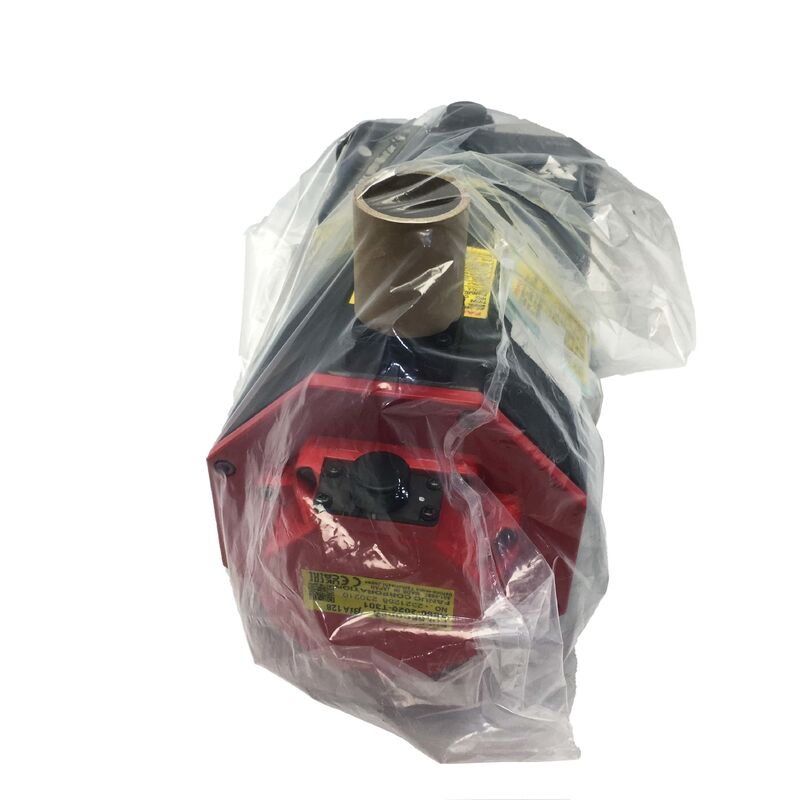
Fanuc A06B-0089-B103 | Beta iS Series AC Servo Motor BiS40/2000 — 3kW, 36Nm, Straight Plain Shaft, biA128 Absolute Encoder
Part Number: A06B-0089-B103
Series: Beta iS (βiS) AC Servo Motor
Model: BiS 40 / 2000
Configuration: Straight Plain Shaft (SLK, No Keyway), No Brake, biA128 Absolute Encoder, IP65
Rated Output: 3 kW
Stall Torque: 36 Nm
Maximum Speed: 2,000 RPM
Input Voltage: 200–240 VAC, 3-Phase
Encoder: biA128 Absolute (A860-2020-T301)
Ingress Protection: IP65
Condition: New / Refurbished
Overview
The Fanuc A06B-0089-B103 is the largest standard model in Fanuc's Beta iS compact servo range — model BiS40/2000, rated at 3 kW with a stall torque of 36 Nm and a 2,000 RPM maximum speed.
Configured with a straight plain shaft, no brake, and the biA128 absolute pulsecoder, this motor sits at the top of the Beta iS torque ladder:
36 Nm from a compact frame, driven by neodymium rare-earth permanent magnets, sealed to IP65, and paired with the absolute encoder that gives the axis full position knowledge at every power-up without a homing sequence.
The number to focus on is 36 Nm. That is 9 Nm more than the BiS30/2000 (A06B-0087-B103) at exactly the same 3 kW rated output and the same 2,000 RPM ceiling. Both motors deliver 3 kW, but the BiS40/2000 produces its 36 Nm at a lower base speed — the speed where the motor transitions from its constant-torque region into its constant-power region. This makes the BiS40/2000 the correct choice when the axis load analysis shows that 27 Nm is insufficient to hold commanded position, accelerate the mechanism to speed, or maintain velocity against a sustained cutting or process force, and when the 2,000 RPM maximum speed is already adequate for the application's traverse rate requirements.
The B103 suffix on this motor is precise: straight shaft, plain bore without keyway, biA128 absolute encoder, no brake.
Each element has a corresponding alternative in the A06B-0089 series — B003 for taper shaft, B403 for straight plain shaft with 24V brake, B303 for taper shaft with brake. Confirming the B103 matches the machine's actual requirements before ordering is more important at this torque class than on lighter motors, because the mechanical installation of a 36 Nm motor involves coupling specifications and axis mechanical design that differ substantially between straight and taper shaft variants.
Key Specifications
| Parameter |
Value |
| Rated Output |
3 kW |
| Stall Torque |
36 Nm |
| Maximum Speed |
2,000 RPM |
| Rated Current |
approx. 19 A |
| Input Voltage |
200–240 VAC |
| Phase |
3-Phase |
| Encoder |
biA128 Absolute (A860-2020-T301) |
| Encoder Resolution |
128,000 ppr |
| Shaft Type |
Straight Plain (SLK, No Keyway) |
| Brake |
None |
| Ingress Protection |
IP65 |
| Series |
Beta iS (βiS) — BiS40/2000 |
36 Nm at 3 kW — The Torque-Density Trade-Off
Both the BiS30/2000 and the BiS40/2000 are rated at 3 kW. This is not a coincidence and not an error — it reflects how the Beta iS series uses its compact neodymium permanent magnet design to achieve different torque characteristics within the same power envelope by varying the motor's base speed.
A motor's rated output in kilowatts is the product of its torque and its rotational speed at the point where both are at their maximum sustained values.
The BiS30/2000 achieves its 27 Nm stall torque at a base speed that, when multiplied by 27 Nm, produces 3 kW. The BiS40/2000 achieves its 36 Nm stall torque at a lower base speed — multiplied by 36 Nm, still 3 kW.
Above each motor's base speed, rated power remains roughly constant while torque reduces proportionally with speed. At maximum speed (2,000 RPM for both), the torques converge closer together.
The practical meaning: the BiS40/2000 produces its higher stall torque across a wider speed range before power limiting begins to pull the torque curve down.
For axes where the working speed range centres in the low-speed region — slow-turning rotary tables, low-speed heavy-load linear axes, or positioning cycles that spend most of their time below 1,000 RPM — the BiS40/2000's torque advantage over the BiS30/2000 is present and meaningful throughout most of the actual operating range.
This is where the motor selection decision is made: if the required holding torque under maximum load is below 27 Nm, the BiS30/2000 is appropriate. If the load analysis puts peak holding torque between 27 and 36 Nm, the BiS40/2000 is necessary.
Moving to the BiS40/2000 does not increase rated output — it increases the motor's ability to deliver torque against heavy loads at lower speeds, which is exactly what heavy-axis CNC applications require.
Straight Plain Shaft at Maximum Beta iS Torque
At 36 Nm, the plain slick shaft's coupling interface is at its most demanding within the Beta iS family.
The entire torque transmission relies on the friction between the shaft surface and the coupling hub bore — generated by the hub's clamping force, applied through the retention fasteners torqued to specification. No keyway, no mechanical interlock, no secondary engagement mechanism.
At this torque level, the coupling specification demands proper engineering attention rather than estimation.
The coupling hub must carry a dynamic torque rating — not just a static rating — that covers the peak axis torque during acceleration, deceleration, and any load disturbance events. The hub bore-to-shaft diameter fit must be confirmed to the coupling manufacturer's tolerance specification.
And the installation clamping torque must be applied with a calibrated wrench and verified, not applied once and assumed correct through successive operations.
A coupling hub installed at the correct clamping torque on a clean, undamaged shaft surface will transmit 36 Nm reliably for extended service life.
A hub installed at reduced clamping torque — either through estimation, uncalibrated tooling, or hub bore distortion from a previous slip event — will begin to micro-slip under load cycles, progressively fretting both the shaft surface and the hub bore.
On a motor this size, the fretting damage accumulates faster and becomes more costly to address than on lighter Beta iS motors. Inspection of both shaft surface and hub bore condition before fitting a new coupling is the minimum standard for replacement motor installation.
biA128 Absolute Encoder — Seamless Restart at Any Speed
The biA128 pulsecoder (A860-2020-T301) mounted at the rear of the A06B-0089-B103 provides shaft position data that survives power interruptions without any backup battery. When the servo system initialises, the CNC reads the absolute shaft position directly from the biA128 and has correct axis position data before any motion command is accepted.
For a heavy-load axis running on the BiS40/2000, this encoder architecture removes a specific operational constraint.
On incremental encoder systems, every startup — including those following unexpected E-stop events — requires a reference return traverse before the axis can accept position commands.
On a heavily loaded axis, this traverse must be slow, the reference switch approach must allow for approach velocity and deceleration distance, and the overall restart sequence adds time to production recovery.
An E-stop at an inopportune moment in a production cycle, with a heavily loaded axis that needs to re-home before it can move, adds downtime that compounds across a shift.
The biA128 eliminates this sequence entirely.
The axis powers up, reads its position, and is immediately ready for commanded motion — regardless of what happened during the previous shutdown and regardless of where in its travel range the axis stopped. For process-intensive CNC applications where machine recovery time matters, this is not a minor convenience.
IP65 Construction and Amplifier Compatibility
The IP65 rating on the BiS40/2000 provides the standard Beta iS protection level — full dust exclusion and protection against water jets from any direction.
At the BiS40/2000's torque class, the axis is likely to be driven by a ball screw or worm gear with more significant mechanical loading than the lighter Beta iS motors experience. Ensuring the shaft seal is correctly intact, and that the coupling does not impose radial loads beyond the motor's rated shaft loading specification, is part of the commissioning check for any installation at this torque level.
The A06B-0089-B103 pairs with Fanuc's Beta i servo amplifier family — βiSV single-axis drives and βiSVSP combined servo-spindle modules — in the current class appropriate for the BiS40/2000's approximately 19A rated current.
It integrates with Fanuc CNC controls including Series 0i-C, 0i-D, 0i-F, 30i, 31i, and 32i.
The amplifier motor type parameter must be set for the BiS40/2000 and the biA128 absolute encoder interface enabled.
The BiS40/2000 is also compatible with Fanuc's Alpha i servo amplifiers (αiSV), which provides flexibility for machine tools that use the Alpha i servo drive generation.
FAQ
Q1: What is the difference between the BiS40/2000 (A06B-0089-B103) and the BiS30/2000 (A06B-0087-B103)?
Both deliver 3 kW rated output and 2,000 RPM maximum speed. The difference is stall torque: 36 Nm for the BiS40/2000 versus 27 Nm for the BiS30/2000 — a 33% increase.
The BiS40/2000 produces this higher torque at a lower base speed, meaning its torque advantage over the BiS30/2000 is most pronounced in the lower portion of the speed range, which is exactly where heavily loaded axes typically operate.
If axis load analysis shows peak holding torque below 27 Nm, the BiS30/2000 is sufficient. Between 27 and 36 Nm, the BiS40/2000 is the correct selection.
Q2: The B103 has no brake. Does the BiS40/2000 at this torque level require a brake for vertical axes?
At 36 Nm, the motor's stall torque capability does not substitute for a mechanical brake on gravity-loaded axes. When servo power is removed — E-stop, power-off, or amplifier fault — the motor produces no holding torque regardless of its stall torque rating.
For vertical axes, tilting axes, or any load-bearing axis where servo-off allows gravitational movement, the brake-equipped variant (A06B-0089-B403, straight plain shaft with 24V DC brake) is the correct specification. The B103 without brake is appropriate for horizontal axes and balanced configurations where servo-off creates no movement risk.
Q3: Does the biA128 encoder need any battery backup to hold position through a power interruption?
No. The biA128 is a genuinely batteryless absolute encoder.
It retains shaft position reference through power interruptions by its internal detection mechanism and requires no backup battery, capacitor, or external power source.
When the servo drive powers up after any shutdown, it reads the absolute shaft position directly and has correct axis data immediately. No homing traversal is required.
Q4: Which Beta i amplifier is required for the A06B-0089-B103?
The BiS40/2000 requires a Beta i servo amplifier — βiSV or βiSVSP — rated for approximately 19A output current. It also runs on Fanuc Alpha i servo amplifier modules (αiSV) where those are present in the machine.
It integrates with Fanuc CNC controls including 0i-C, 0i-D, 0i-F, 30i, 31i, and 32i. The amplifier motor type parameter must match the BiS40/2000, and the biA128 absolute encoder interface must be enabled.
At 19A rated current and peak current demand during acceleration of a high-inertia axis, confirm the amplifier's peak current capability matches the axis's maximum acceleration requirement before commissioning.
Q5: What inspection steps are most important for a used A06B-0089-B103?
At 36 Nm stall torque, coupling and shaft condition are the first priority. Inspect the shaft surface for fretting from previous coupling slip — fretting at this torque class is more severe and more damaging to shaft dimensional tolerance than on lighter motors.
Assess whether the shaft surface is within the coupling specification's acceptable diameter range before fitting any new coupling component.
Check the biA128 encoder connector (A860-2020-T301) for corroded or bent pins, and the cable exit strain relief for cracking or hardening. Measure winding resistance across all three phases for balance and check insulation resistance to earth.
Rotate the shaft by hand for bearing roughness. A bench run-up to 2,000 RPM on a compatible amplifier with biA128 absolute position verified, rated current monitored, and the shaft inspected for runout under load is the correct final commissioning check before the motor is installed on a production axis.


 Your message must be between 20-3,000 characters!