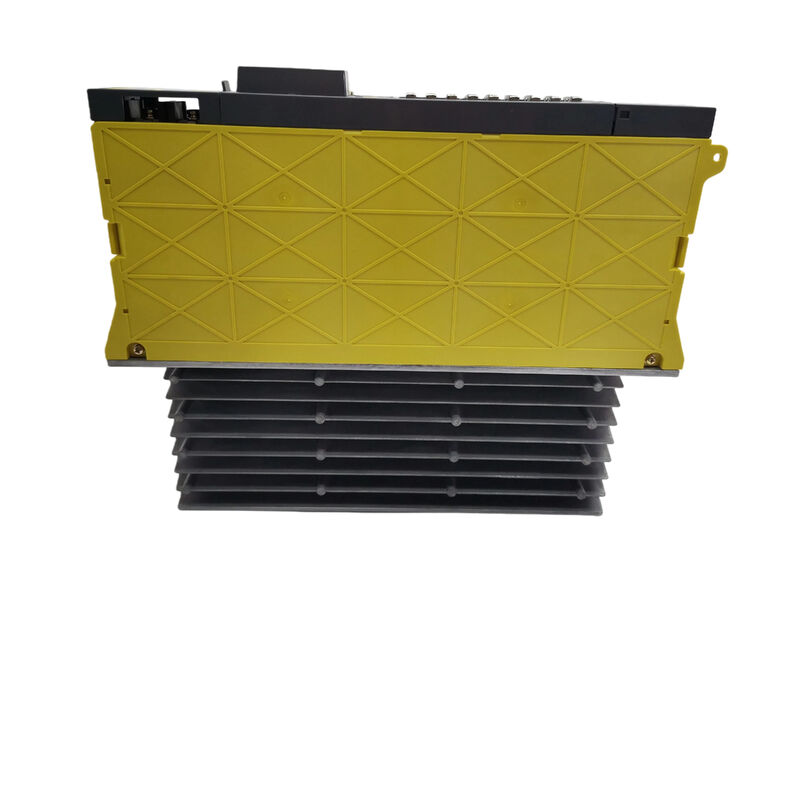
Fanuc A06B-6079-H303 | Alpha Series Three-Axis Servo Amplifier Module SVM3-12/20/20 — 3.1kW, Type A, L:3A / M:5.9A / N:5.9A
Part Number: A06B-6079-H303
Type: Three-Axis Servo Amplifier Module
Model: SVM3-12/20/20
Series: Fanuc Alpha (A06B-6079)
Interface: Type A Serial
DC Bus Input: 283–325 VDC
Rated Input Power: 3.1 kW
Maximum Output Voltage: 230 VAC
L Axis Output Current: 3 A rated
M Axis Output Current: 5.9 A rated
N Axis Output Current: 5.9 A rated
Width: 90 mm
Compatible CNC: Series 0, 15, 16, 18, 20, 21
Condition: New / Refurbished
Overview
The Fanuc A06B-6079-H303 is a three-axis Alpha series servo amplifier module — model SVM3-12/20/20 — that drives three independent servo motor axes from a single 90 mm wide module, sharing the DC bus supplied by the Alpha Power Supply Module.
It is the third step in the A06B-6079 three-axis SVM range: the H301 (SVM3-12/12/12) drives three small-capacity axes at 3A each; the H302 (SVM3-12/12/20) adds a larger N channel at 5.9A; the H303 steps the asymmetry further by keeping the L axis at 3A while upgrading both M and N axes to 5.9A.
The H304 (SVM3-20/20/20) then runs all three at the higher rating.
The H303 occupies the position for machine tools with one small axis and two medium-capacity axes — typically a compact CNC machining centre or EDM machine with a smaller Z or W axis on the L channel and standard X/Y or U/V axes on M and N.
Three-axis integration in a single 90 mm module is the core value of the SVM3 form factor.
A machine that would otherwise require three separate single-axis drive modules, or an SVM2 plus an SVM1, fits all three channels into one unit — reducing cabinet width, cutting cable runs between separate modules, and providing a single replacement unit if the drive system fails.
For the machine tool builder, the A06B-6079-H303 was a logical choice when the axis current requirements matched the 12/20/20 profile: three axes of motion control from one compact module, interfacing directly with the CNC via a single Type A serial connection.
Key Specifications
| Parameter |
Value |
| Model |
SVM3-12/20/20 |
| Axes |
3 (L, M, N) |
| DC Bus Input |
283–325 VDC |
| Rated Input Power |
3.1 kW |
| Maximum Output Voltage |
230 VAC |
| L Axis Rated Current |
3 A |
| M Axis Rated Current |
5.9 A |
| N Axis Rated Current |
5.9 A |
| Interface |
Type A Serial |
| Control Method |
Transistor PWM |
| Width |
90 mm |
| Compatible CNC |
Series 0, 15, 16, 18, 20, 21 |
| Cooling |
Internal Heatsink and Fan |
| Series |
Fanuc Alpha — A06B-6079 |
The A06B-6079 SVM3 Family — Where H303 Sits
The A06B-6079 product series covers Fanuc's complete Alpha servo amplifier module range across single-axis (SVM1), two-axis (SVM2), and three-axis (SVM3) configurations. Within the SVM3 sub-group, the H-suffix identifies the current capacity on each of the three channels:
H301 — SVM3-12/12/12: All three axes at 3A rated. Typical application: three small Alpha motors such as α1/3000 or α2/2000 across X, Y, Z on a compact machine.
H302 — SVM3-12/12/20: L and M channels at 3A, N channel at 5.9A. One channel steps up to serve a slightly larger motor — common on machines with a fourth axis or where the Z-axis motor is larger than X and Y.
H303 — SVM3-12/20/20: L channel at 3A, M and N channels at 5.9A. Two channels at the higher rating, one at the smaller. The L channel typically serves the smallest axis, with M and N driving the primary positioning axes.
H304 — SVM3-20/20/20: All three channels at 5.9A. Appropriate when all three axes require the larger motor current class.
Selecting the correct suffix matters — the current rating on each channel determines which Alpha servo motors can be connected. Connecting a motor that demands more current than the channel is rated for will cause the IPM transistor modules to trip on overcurrent under any significant axis load.
The H303 matches machine configurations where the primary X/Y or U/V axes use motors in the αC6 or α3/2000 class, while a smaller motor — α1/3000 or α2/2000 — handles the third channel.
Type A Interface — Communication with the CNC
The A06B-6079-H303 uses Type A serial communication between the servo amplifier module and the CNC. This interface transmits axis position commands from the CNC to the SVM3 and returns position feedback from the motor encoders to the CNC's position control loop.
The interface runs as a serial daisy chain through the amplifier system — the CNC connects to the first module in the chain, and the chain passes through the spindle and servo amplifier modules in sequence.
Type A is the interface standard for the Fanuc Alpha drive generation, covering CNC Series 0, 15, 16, 18, 20, and 21 including their variant designations (0-C, 0-MD, 0-MF, 15-B, 16-B, 18-B, 21-B, and similar).
The successor to this interface — FSSB (Fanuc Serial Servo Bus), implemented via optical fibre — was introduced with the Alpha i generation.
The FSSB-interface equivalent of this module is the A06B-6096-H303. The two are not interchangeable: FSSB CNCs cannot use the Type A module, and Type A CNCs cannot use FSSB modules.
When sourcing a replacement A06B-6079-H303, confirming that the machine's CNC uses Type A interface (A06B-6079 module family) rather than FSSB (A06B-6096 module family) is the first verification step.
The two module series share the same physical form factor and power ratings but differ at the interface connection.
PWM Transistor Architecture — Internal Construction
The SVM3-12/20/20 uses a transistor PWM inverter — pulse width modulation — to convert the DC bus voltage from the PSM into the variable-frequency, variable-amplitude AC output that each servo motor requires.
The module houses three sets of IPM (Intelligent Power Module) transistor assemblies, one for each axis channel, along with the wiring board (A16B-2202-078x series) and the Type A control card (A20B-2001-094x series) that handles communication with the CNC and closed-loop servo position and velocity control.
The IPM transistor modules are the components most susceptible to failure from sustained overcurrent, excessive bus voltage transients, and thermal stress from inadequate cabinet cooling or blocked airflow through the module's internal fan.
A failed IPM module typically presents as an IPM alarm on the CNC — alarm codes 8, 9, A, b, C, d, E in the red 7-segment display on the module face, depending on which channel's IPM has tripped and the nature of the fault.
Importantly, the boards themselves — wiring board and control card — are not available separately for field replacement.
When a transistor module fails and the unit cannot be repaired at component level, the complete SVM3 module must be replaced or exchanged through a specialist repair facility that holds stock of the individual IPM components, fuses, fans, and transistor modules as internal service parts.
Alpha PSM — The Power Supply This Module Requires
The A06B-6079-H303 draws from the DC bus provided by a Fanuc Alpha Power Supply Module (PSM). The PSM handles the mains AC input (200–240 VAC), converts it to the 283–325 VDC bus, and manages energy regeneration during motor deceleration — returning braking energy to the mains rather than dissipating it as heat in a resistive discharge unit.
The SVM3-12/20/20 at 3.1 kW input, together with the other drive modules connected to the same PSM, must not exceed the PSM's rated continuous output capacity.
When specifying a replacement module or designing an upgraded drive cabinet, the PSM capacity must be confirmed against the total simultaneous current demand of all servo and spindle modules sharing the same DC bus.
The SVM3 modules share the bus bar that connects to the PSM; each SVM3-12/20/20 must be within the PSM's remaining capacity after accounting for the spindle amplifier module's contribution to the total load.
Compatible Servo Motors by Channel
L Channel (3A): Appropriate for small Alpha series servo motors including α1/3000 and α2/2000. The 3A rated current matches the peak current demand of these motors at maximum axis acceleration on small to medium CNC machines.
M and N Channels (5.9A each): Appropriate for Alpha series motors including αC3/2000, αC6/2000, and similar class motors.
The 5.9A rating covers the rated and peak current requirements of these medium-capacity Alpha servo motors used on primary positioning axes.
Connecting a motor whose peak current demand exceeds the channel rating — for example, an α6/3000 on the L channel — risks IPM overcurrent trips during acceleration from rest or rapid traverse at high feedrate. Motor type parameters in the CNC must also be correctly set to match the connected motors; incorrect motor type parameters produce suboptimal current control and may cause instability or alarms.
FAQ
Q1: What is the difference between the A06B-6079-H303 and the A06B-6096-H303?
Both are SVM3-12/20/20 three-axis servo modules with identical current ratings and power specifications.
The difference is the servo interface: the A06B-6079-H303 uses a Type A serial interface for Fanuc CNC Series 0, 15, 16, 18, 20, and 21; the A06B-6096-H303 uses FSSB (Fanuc Serial Servo Bus, via optical fibre) for Alpha i generation CNC controls.
The two modules are physically similar but electrically incompatible — the CNC interface connector and communication protocol differ completely. Always confirm which interface the machine's CNC uses before ordering.
Q2: What servo motors can be connected to each channel?
The L channel (3A rated) is appropriate for small Alpha series motors such as α1/3000 and α2/2000. The M and N channels (5.9A rated each) suit medium-capacity Alpha motors including αC3/2000 and αC6/2000.
The channel current rating must not be exceeded by the motor's peak current demand during maximum acceleration — oversized motors on undersized channels will trip on overcurrent alarms under axis load. Motor type parameters in the CNC must be set to match each connected motor before the servo system is operated.
Q3: The module is showing an alarm code on the 7-segment display — what does this mean?
The 7-segment LED display on the module face shows a hexadecimal alarm code when a fault is detected. Codes 8 through E indicate IPM (transistor module) faults on specific axes: these typically result from sustained overcurrent, a motor winding insulation fault, or thermal overload.
The diagnostic procedure starts with disconnecting the motor power cables (U, V, W) for the alarmed channel and testing insulation resistance between each wire and the PE terminal — hundreds of megohms is acceptable, anything significantly less points to the motor rather than the module.
If the alarm persists with the motor disconnected, the fault is in the module's IPM assembly.
Q4: Can the A06B-6079-H303 be repaired, or must it be replaced?
The module is repairable at specialist CNC drive repair facilities. The most common failure components — IPM transistor modules, fuses, electrolytic capacitors, and the internal cooling fan — are held as service stock by experienced repair shops and can be replaced at component level.
The printed circuit boards (wiring board A16B-2202-078x and control card A20B-2001-094x) are not available as separate field-replacement parts, but board-level repair is possible at specialist level. Exchange programs — where a tested reconditioned unit is supplied on a swap basis — are the fastest route back to production when the machine is down.
Q5: What is the Alpha PSM capacity requirement for this module?
The A06B-6079-H303 draws 3.1 kW from the shared Alpha DC bus. The PSM must supply this plus the spindle amplifier module's demand and any other SVM modules on the same bus, simultaneously.
If multiple axis modules are operating at peak current at the same time — for example, during simultaneous multi-axis rapid traverse — the PSM must have sufficient headroom.
If the total simultaneous demand exceeds the PSM's rated capacity, the PSM will alarm on overload. PSM sizing should be confirmed by summing the peak demands of all modules sharing the bus and cross-referencing against the PSM's rated continuous and peak output specification.


 Your message must be between 20-3,000 characters!