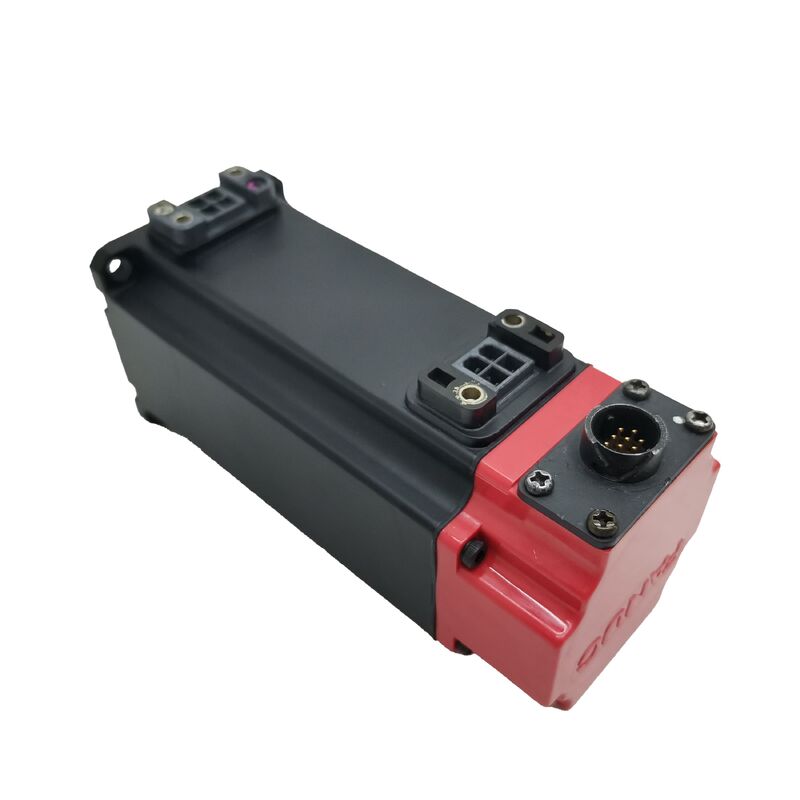
Fanuc A06B-0116-B103 | Beta iS Series AC Servo Motor BiS1/6000 — 0.5kW, 6000RPM, b64iA Encoder
Part Number: A06B-0116-B103
Series: Beta iS (BiS) AC Servo Motor
Model: BiS 1 / 6000
Configuration: Straight Plain Shaft (SLK), b64iA Encoder, No Brake
Condition: New / Refurbished / Exchange Available
Overview
The Fanuc A06B-0116-B103 is a compact, high-speed AC servo motor from Fanuc's Beta iS series — the BiS 1/6000, a 0.5 kW motor built for the 6,000 RPM operating range. Weighing just 1.9 kg and delivering 1.2 Nm continuous torque, this is the lightest-duty motor in the BiS series power range, and its 6,000 RPM ceiling is the figure that defines where it belongs in a machine's axis architecture: fast-positioning auxiliary drives, high-speed secondary axes, and applications where the mechanical load is light but the motion cycle rate is high.
The motor runs on a 200–240VAC three-phase supply through a frequency range of 0–400Hz — the variable-frequency output from the paired Beta iS servo amplifier — and draws 1.8A continuous at rated torque. The plain straight shaft (designated SLK, indicating no keyway) and b64iA incremental encoder complete a motor configuration designed for coupling-based drive arrangements where clean, backlash-free torque transmission and reliable incremental position feedback are the operating requirements.
At 1.9 kg, the BiS 1/6000 is genuinely hand-portable in a way that larger servo motors are not — an installation and maintenance detail that matters when the motor is positioned in a tight machine location or requires frequent access.
Key Specifications
| Parameter |
Value |
| Rated Output |
0.5 kW |
| Continuous Torque |
1.2 Nm |
| Continuous Current |
1.8 A |
| Peak Current |
2.6 A |
| Maximum Speed |
6,000 RPM |
| Supply Voltage |
200–240VAC, 3-Phase |
| Input Frequency |
0–400 Hz |
| Back-EMF Constant |
15.4 V |
| Winding Resistance |
1.5 Ω |
| Encoder |
b64iA Incremental |
| Shaft Type |
Straight — Plain (SLK, no keyway) |
| Brake |
None |
| Ingress Protection |
IP65 |
| Weight |
1.9 kg |
| Series |
Beta iS (BiS) — BiS 1/6000 |
6,000 RPM in the Lightest BiS Frame
The BiS 1/6000 sits at the low-power end of the Beta iS family — 0.5 kW in a motor that weighs under two kilograms. That combination tells you something specific about the applications it was designed for. This is not a motor for driving heavy saddles or resisting aggressive cutting forces.
It is a motor for moving things quickly and accurately on a short stroke, high-cycle-rate basis: tool changer magazines, pallet shuttle mechanisms, rotary indexers on secondary axes, and positioning drives on compact automation equipment where the load is light, the distance is short, and the cycle happens many times per shift.
At 6,000 RPM, the BiS 1/6000 can drive mechanisms at surface velocities that smaller motors at lower speeds simply cannot match without intermediate gearing.
On direct-coupled drives with appropriate ballscrew lead or gear ratios, 6,000 RPM translates to fast positioning that reduces non-productive cycle time — a real productivity gain on high-volume production equipment.
The 1.2 Nm continuous torque limits the motor to genuinely light loads. Inertia matching for the application must be verified before specifying this motor — if the reflected load inertia significantly exceeds the motor's own low-inertia rotor, the velocity loop may become difficult to tune for the high-speed operation this motor is designed for.
Beta iS drives apply the same servo algorithm optimised for this frame's inertia class.
Plain Straight Shaft — SLK Configuration
The SLK designation indicates a plain straight shaft with no keyway machined into it. Torque transmission relies entirely on the coupling hub's clamping force against the shaft diameter. For a 0.5 kW motor at 1.2 Nm continuous torque, a correctly specified and properly torqued precision servo coupling handles this cleanly.
The plain shaft also produces a rotationally symmetric coupling engagement — there is no angular preference in how the hub seats, which matters for balance at 6,000 RPM where coupling asymmetry produces vibration proportionally more damaging than at lower speeds.
For applications that require a keyed shaft — due to shock loads, sustained direction reversals, or coupling designs that need a key for positive engagement — a keyed variant in the same model family is the appropriate specification.
The SLK plain shaft is matched to the precision clamping coupling arrangements standard in the servo axis applications this motor targets.
At 6,000 RPM, coupling quality and balance deserve more attention than at lower speeds.
Use couplings rated to the motor's maximum speed, verify clamping torque to the hub manufacturer's specification, and confirm alignment carefully during installation.
Coupling imbalance at this speed produces shaft vibration that loads the motor's front bearing at a frequency that shortens bearing life.
b64iA Encoder — Incremental Feedback
The b64iA is a 64,000-pulse-per-revolution incremental encoder providing shaft position and velocity feedback to the Beta iS servo drive. At 6,000 RPM, the encoder generates 6.4 million pulses per second — the drive's feedback processor handles this within the BiS amplifier's control bandwidth, which is part of why this motor is matched to the specific Beta iS amplifier series rather than older Fanuc drive generations.
Incremental operation means the machine establishes absolute axis position through a homing sequence on each startup.
The CNC drives the axis to its reference position, reads the encoder's marker pulse, and the position counter is set from that reference point forward. For the application types the BiS 1/6000 serves — auxiliary axes, magazine drives, indexing mechanisms — this is standard and expected operating behavior.
The b64iA's resolution at 6,000 RPM provides the velocity feedback granularity that the drive needs to close the speed loop cleanly at high shaft speeds.
Velocity ripple at 6,000 RPM appears as position error at the load — the encoder resolution determines how precisely the drive can measure and correct that ripple in real time.
Beta iS Drive Compatibility
The A06B-0116-B103 is designed for use with Fanuc Beta iS series servo amplifiers. The amplifier must be selected and parameterized for the BiS 1/6000 motor specification, including the b64iA encoder interface.
Beta iS amplifiers are compatible with Fanuc CNC control platforms including the 0i-Mate, 0i, and related series that were specified with Beta iS drive systems.
The servo amplifier's motor type parameter must be set correctly before the axis is operated.
An incorrect motor type setting affects velocity loop gain, current limits, and maximum speed scaling — all of which are critical for correct and safe operation at 6,000 RPM.
Verify this parameter during any motor replacement commissioning before running the axis at speed.
IP65 and the #0100 Sealed Variant
The standard A06B-0116-B103 carries IP65 protection — full dust sealing and resistance to low-pressure water jets from any direction.
For installations in clean automation environments, control cabinets, or away from direct fluid exposure, IP65 is adequate.
The #0100 suffix variant of the same motor (A06B-0116-B103#0100) carries IP67 rating — full immersion protection — for installations in machine tool environments with active coolant exposure. When ordering, confirm which protection level the application requires and specify the correct variant accordingly.
FAQ
Q1: What makes the BiS 1/6000 appropriate for high-speed applications compared to lower-speed Beta iS motors?
The BiS 1/6000's electromagnetic design optimises for low rotor inertia and extended speed range rather than maximum torque. Its 6,000 RPM ceiling — achieved through careful rotor construction and high-frequency encoder feedback — allows direct or lightly geared drives to reach traverse speeds that would require intermediate gearing with a 2,000 or 3,000 RPM motor.
The trade-off is limited continuous torque at 1.2 Nm, which restricts the motor to light-load applications. Inertia matching must be verified against the load before specifying.
Q2: Why does this motor use a plain shaft (SLK) rather than a keyed shaft?
The plain straight shaft suits precision servo couplings that grip the shaft diameter through clamping force — the standard drive arrangement for servo-coupled ballscrew and mechanism drives. At 1.2 Nm continuous torque, clamping-based couplings transmit torque reliably without a keyway.
For applications involving shock loads, high-torque reversals, or coupling designs that need a key for positive drive, a keyed shaft variant should be specified instead.
Q3: What servo drive is compatible with the A06B-0116-B103?
The motor is designed for use with Fanuc Beta iS series servo amplifiers. The amplifier must support the BiS 1/6000 motor type and the b64iA incremental encoder interface, and must be parameterized with the correct motor type code before commissioning.
Beta iS amplifiers integrate with Fanuc CNC controls in the 0i-Mate, 0i, and related series. Older analogue Fanuc drive generations are not compatible with this motor's encoder interface.
Q4: What is the difference between the B103 and the B103#0100 variant?
The standard A06B-0116-B103 carries IP65 ingress protection, suited for clean industrial and automation environments. The #0100 suffix variant is a sealed IP67 version of the same motor — identical in all electrical and mechanical specifications but with enhanced sealing for coolant and fluid exposure in machine tool applications.
Specify the #0100 variant where the motor position is subject to coolant splash or sustained fluid contact.
Q5: How should I inspect a used A06B-0116-B103 before installation?
At 1.9 kg, handling is straightforward, but the motor's small size means bearing condition and encoder health are the primary concerns rather than winding integrity.
Rotate the shaft by hand and feel for roughness or drag — the front bearing on a high-speed motor sees significant radial load and is the most common wear point.
Inspect the b64iA encoder connector for pin corrosion and the cable exit for damage.
Check the plain shaft surface for fretting or coupling contact damage. Measure winding resistance across all three phases for balance. A bench run-up to rated speed with encoder signal verification is the correct standard before returning any used unit to production service.


 Your message must be between 20-3,000 characters!