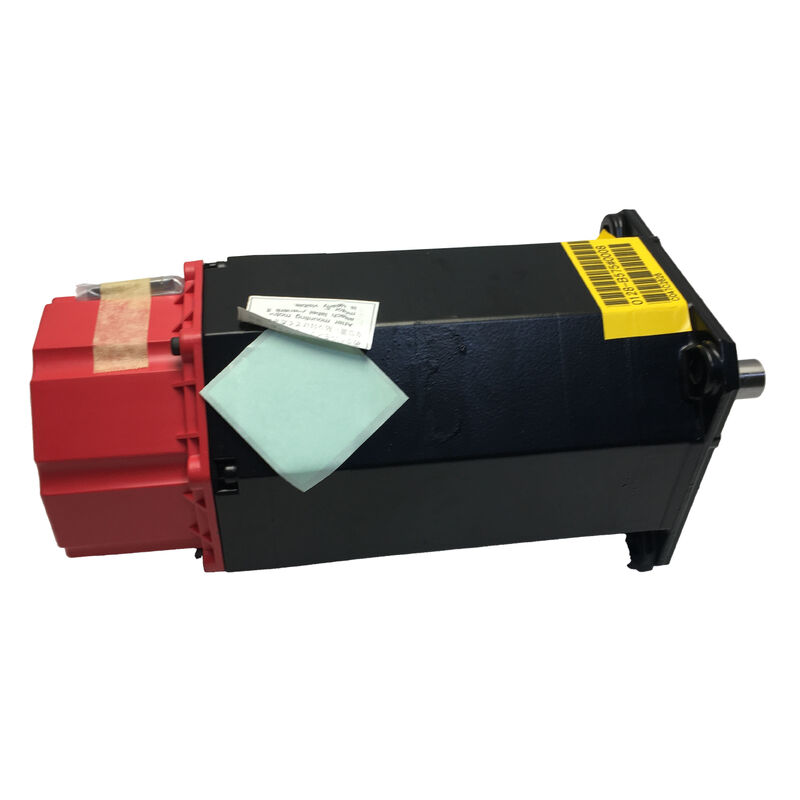
Fanuc A06B-0126-B075 | Alpha C Series AC Servo Motor αC6/2000 — 0.6kW, 6Nm, Tapered Shaft, A64 Encoder, No Brake
Part Number: A06B-0126-B075 (also A06B0126B075)
Series: Fanuc Alpha C (αC) Series AC Servo Motor
Model: αC6 / 2000
Configuration: Tapered Shaft with Keyway, No Brake, A64 Incremental Encoder, IP65
Rated Output: 0.6 kW
Stall Torque: 6 Nm
Maximum Speed: 2,000 RPM
Motor Voltage: 210 VAC
Rated Current: 3.5 A
Rated Frequency: 133 Hz
Phase: 3-Phase
Encoder: A64 Pulsecoder (A860-0360-T101)
Condition: New / Refurbished / Surplus
Overview
The Fanuc A06B-0126-B075 is an Alpha C series AC servo motor — model αC6/2000 — rated at 0.6 kW, 6 Nm stall torque, 2,000 RPM, with a tapered keyed shaft, the A64 incremental pulsecoder, and no brake.
Running at 210V three-phase, 133 Hz, and 3.5A rated current, this motor is the αC6 — the "C" designating the Alpha C generation, which used high-performance neodymium magnets to deliver greater torque density than the earlier ferrite-magnet Alpha series motors of the same frame size.
At 0.6 kW, the αC6/2000 sits at the compact end of the Alpha C range, serving the smaller positioning axes of small to medium CNC machine tools: the secondary axes of compact machining centres, fourth-axis rotary indexers where moderate torque and 2,000 RPM meets the kinematics of the drive mechanism, and auxiliary axes where a lower-power motor is appropriate but the Alpha C's neodymium torque density is still required to keep the physical motor size small.
This particular motor — the B075 variant — carries no brake, which defines its application as horizontal axes or load-balanced configurations where servo-off leaves no gravitational movement risk.
The A64 pulsecoder provides 64,000 pulses per revolution of incremental position feedback, sufficient for the positioning accuracy demands of the machine tools this motor was designed for.
It is an incremental encoder — position reference is established through a reference return (homing) cycle at startup, and the CNC tracks position cumulatively from that reference throughout the operating session.
Key Specifications
| Parameter |
Value |
| Rated Output |
0.6 kW |
| Stall Torque |
6 Nm |
| Maximum Speed |
2,000 RPM |
| Motor Voltage |
210 VAC |
| Rated Current |
3.5 A |
| Rated Frequency |
133 Hz |
| Phase |
3-Phase |
| Shaft Type |
Tapered with Keyway |
| Brake |
None |
| Encoder |
A64 Incremental (A860-0360-T101) |
| Ingress Protection |
IP65 |
| Magnet Type |
Neodymium (High-Performance) |
| Series |
Fanuc Alpha C — αC6/2000 |
Alpha C Series — The Neodymium Upgrade
The Alpha C series was Fanuc's high-performance tier within the Alpha generation, using strong neodymium rare-earth permanent magnets where the standard Alpha (αF) series used ferrite. The practical consequence is higher torque per unit volume — the αC6/2000 at 6 Nm stall torque and 0.6 kW occupies a smaller physical frame than a ferrite-magnet motor of equivalent output, or alternatively delivers more torque from the same frame size.
This compact torque density is why the Alpha C series was specified on machine tools where axis performance was prioritised and cabinet or machine space was constrained.
At 0.6 kW and 6 Nm, the αC6/2000 is the entry point of the Alpha C servo range. Above it sit the αC12/2000, αC22/1500, and αC30/1200, each with higher stall torque and rated power serving progressively larger axis load requirements.
The shared Alpha C architecture means the same servo amplifier generation, the same CNC interface, and the same accessory ecosystem apply across the range.
The Alpha C motor generation was widely used in Japanese and international machine tool builds from the mid-1990s through the early 2000s.
Many of these machines remain in productive service, and the A06B-0126-B075 remains one of the more commonly encountered replacement and exchange items in the Alpha C range because of the installed base.
Tapered Shaft with Keyway — Installation and Loading
The tapered shaft on the A06B-0126-B075 provides a self-centering, high-friction connection between the motor shaft and its driven component.
The taper geometry means the hub's bore has only one correct seating position — the point where the taper diameters match — so concentricity between motor shaft and driven component is established by the shaft geometry rather than by the installer's skill.
This self-centering property makes the tapered shaft less sensitive to installation variation than a straight-shaft plain bore arrangement where misalignment depends on the installer's technique.
The keyway on the taper adds positive rotational engagement to the interference fit's friction coupling.
Under the alternating direction reversals and vibration of CNC positioning cycles, a taper shaft without a key can experience slow relative rotation between shaft and hub as the interference fit is gradually overcome by repeated torque impulses — a failure mode that progresses silently until visible position errors develop.
The keyway prevents this by locking the rotational relationship between shaft and hub regardless of accumulated fatigue on the interference fit.
At 6 Nm stall torque, the removal force required to separate the hub from the taper is substantial. A proper tapered shaft puller — one that pushes axially against the shaft end face while pulling on the hub flange — is the correct removal tool.
Improvised removal methods that apply radial or bending loads to the shaft risk encoder damage and bearing damage from shock transmitted through the motor structure.
A64 Encoder — Incremental Feedback at 64,000 ppr
The A64 pulsecoder (A860-0360-T101) provides 64,000 pulses per revolution. At this resolution on a typical 10mm ball screw pitch with a direct motor coupling, each pulse corresponds to 0.16 μm of table travel — resolution finer than the mechanical accuracy of the guideway and screw system it drives.
The A64 is not the limiting factor in positioning precision for any axis where the αC6/2000 is appropriately specified.
As an incremental encoder, the A64 requires a reference return at every startup to establish position reference.
The machine must traverse the axis to a reference switch position — slowly enough that the switch activates cleanly and the CNC captures the exact pulse count at the reference point — before accepting any programmed position command on that axis.
On machines with multiple axes each using incremental encoders, the reference return sequence extends startup time proportionally to the number of axes.
The A64 pulsecoder body mounts at the rear of the motor, protected within the IP65 housing.
The encoder connector (A860-0360-T101 series) and its cable exit strain relief are the most vulnerable components during motor removal and replacement — the connector locking mechanism should be checked for completeness and the strain relief for cracking before the replacement motor is installed.
A partially engaged encoder connector produces intermittent feedback errors that present as unexplained axis alarms rather than an obvious connector fault.
No Brake — Application Scope
The B075 suffix explicitly identifies this motor as carrying no brake. This is the correct specification for the large majority of horizontal axis applications where the axis load does not exert gravitational force when the motor is at rest. On CNC machining centres where the X and Y axes are horizontal, brake-free motors are standard — there is no load-driven tendency to move when the servo is disabled, and the absence of a brake eliminates the brake supply circuit, the brake interlock in the servo enable/disable sequence, and the periodic brake wear inspection.
For vertical axes — Z-axis on a machining centre carrying a spindle head, or W-axis on certain multi-axis platforms — a brake-equipped variant is required.
The equivalent αC6/2000 motor with a 90V DC brake is available in the A06B-0126 series with the appropriate brake suffix. Installing the B075 brake-free motor on a gravity-loaded vertical axis creates a situation where servo disable causes the axis to drop under its own weight, with no mechanical holding mechanism.
IP65 Protection and Alpha Servo Amplifier Compatibility
IP65 sealing is standard on the A06B-0126-B075. The sealed construction protects against coolant mist, cleaning jets, and the particulate environment of active metal cutting — the conditions the motor encounters in the small-to-medium CNC machine tools for which it was specified.
The motor is compatible with the Fanuc Alpha servo amplifier module range — the A06B-6079 SVM series (Type A interface) and the A06B-6096 FSSB-interface series — in the appropriate current class for the αC6/2000.
It operates with Fanuc CNC Series 0, 15, 16, 18, 20, and 21. The servo amplifier must carry the αC6/2000 motor type parameter and have the A64 incremental encoder interface enabled before the axis is operated.
On machines being retrofitted or serviced, confirming the amplifier parameters match the encoder type (incremental A64 vs absolute A64 or A1000) is an important commissioning step.
FAQ
Q1: What is the difference between the A06B-0126-B075 and the A06B-0127-B075?
Both are Alpha C series motors with tapered shafts, A64 encoders, and no brakes. The difference is the motor output class: the A06B-0126-B075 is the αC6/2000 at 0.6 kW and 6 Nm stall torque; the A06B-0127-B075 is the αC6/2000 at 1.0 kW in the α6/2000 series — a slightly higher-output version in the same torque class. Both are used on small-to-medium CNC axes, but the 0127 series delivers higher continuous power.
The motor voltage also differs: 210V for the 0126 vs 140V for the 0127 variant of the same torque class. These are not interchangeable without verifying amplifier current class and machine wiring.
Q2: Does the A06B-0126-B075 require a reference return at startup?
Yes. The A64 is an incremental encoder — it counts pulses from the moment power is applied but has no stored absolute position reference. At every startup, the CNC must perform a reference return (homing) traverse to a reference switch position before position data can be trusted.
The machine's reference return sequence must complete successfully before the CNC accepts programmed position commands. If the reference return is interrupted by an E-stop or power loss, the axis must re-home from the beginning.
Q3: Can the A06B-0126-B075 be used on a vertical CNC axis?
Only if the axis has an external counterbalance mechanism (such as a hydraulic or pneumatic counterbalance cylinder) that prevents the axis load from dropping when servo torque is removed.
As a brake-free motor, the A06B-0126-B075 provides no mechanical holding when the servo is disabled — on an unbalanced vertical axis, this means the axis moves under gravity when the servo is off.
The brake-equipped variant (with a 90V DC brake, available in the A06B-0126 series with the appropriate brake suffix) must be used on gravity-loaded vertical axes without external counterbalance.
Q4: Which servo amplifier current class is required for this motor?
The αC6/2000 draws 3.5A rated current. In the Fanuc Alpha servo amplifier SVM range, this falls within the SVM1-40 or SVM2-12/xx module capability — the "40" and "12" indicating the rated axis current in amps.
Verify the specific amplifier module in the machine against the current class table in the Fanuc Alpha amplifier documentation for the installed CNC generation.
An amplifier undersized relative to the motor's peak current demand will overheat and alarm under aggressive acceleration cycles even if it can handle the steady-state rated current.
Q5: What are the most important checks when inspecting a used A06B-0126-B075?
Rotate the shaft by hand to check for bearing roughness or roughness through the taper-mounted pulsecoder. Inspect the taper shaft surface for fretting or scoring from previous installations — a scored taper provides insufficient interference fit for the next hub.
Check the A64 encoder connector (A860-0360-T101) for bent or corroded pins and verify the cable exit strain relief is intact and uncracked.
Measure winding resistance across all three phases for balance and check insulation resistance to earth with a megger. A bench run-up to 2,000 RPM on a compatible Alpha servo amplifier with position feedback verified against expected counts per revolution is the final validation before installation.


 Your message must be between 20-3,000 characters!