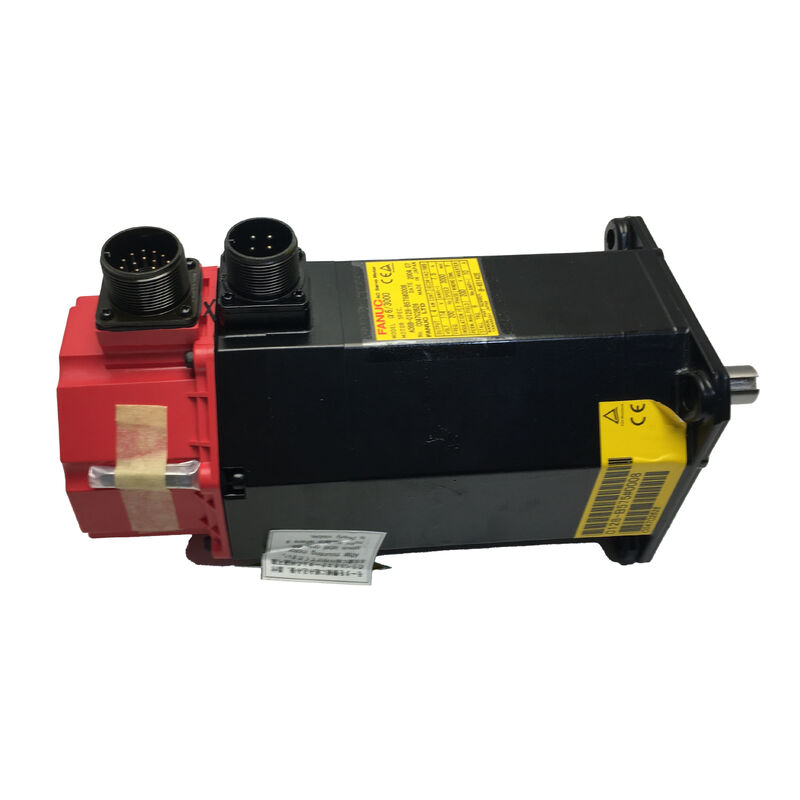
Fanuc A06B-0142-B075 | Alpha Series AC Servo Motor α12/2000 — 2.1kW, 12Nm, 35mm Straight Plain Shaft, aA64K Absolute Encoder
Part Number: A06B-0142-B075
Series: Fanuc Alpha (α) Series AC Servo Motor
Model: α12 / 2000
Configuration: Straight Plain Shaft 35mm (No Keyway), No Brake, aA64K Absolute Encoder, Standard Shaft Seals
Rated Output: 2.1 kW
Stall Torque: 12 Nm
Maximum Speed: 2,000 RPM
Motor Voltage: 155 VAC
Rated Current: 8.8 A
Rated Frequency: 133 Hz
Phase: 3-Phase
Compatible CNC: Series 0-D, 16, 18, 21
Condition: New / Refurbished / Surplus
Overview
The Fanuc A06B-0142-B075 is an Alpha series AC servo motor — model α12/2000 — rated at 2.1 kW, 12 Nm stall torque, and 2,000 RPM maximum speed. At 155V three-phase, 133 Hz, and 8.8A rated current, with a 35mm straight plain shaft, no brake, and the aA64K absolute pulsecoder, this motor was one of the workhorse feed axis drives on mid-sized CNC machine tools built around Fanuc's late-0 and 16/18/21 series control generation.
The α12/2000 torque class covered a wide range of primary axis applications on machining centres, turning centres, and multi-axis platforms where 12 Nm stall torque and 2.1 kW continuous power were sufficient for the axis load without over-specifying toward a heavier, more expensive motor.
The B075 suffix defines this specific configuration: straight plain shaft with no keyway, no brake, and the aA64K absolute encoder.
These three elements together determine the mechanical installation approach, the safety architecture for the axis, and the CNC startup behaviour — and all three need to match the machine's design before a replacement motor can be fitted.
A machine wired for a 90V DC brake supply, or whose CNC expects incremental encoder homing on this axis, cannot simply accept the B075 as a drop-in replacement without verifying the configuration match first.
Key Specifications
| Parameter |
Value |
| Rated Output |
2.1 kW |
| Stall Torque |
12 Nm |
| Maximum Speed |
2,000 RPM |
| Motor Voltage |
155 VAC |
| Rated Current |
8.8 A |
| Rated Frequency |
133 Hz |
| Phase |
3-Phase |
| Shaft Diameter |
35 mm |
| Shaft Type |
Straight Plain (No Keyway) |
| Brake |
None |
| Encoder |
aA64K Absolute Pulsecoder |
| Encoder Resolution |
64,000 ppr |
| Sealing |
Standard Shaft Seals |
| Series |
Fanuc Alpha — α12/2000 |
| Compatible CNC |
Series 0-D, 16, 18, 21 |
α12/2000 — Torque Class and Application Context
The α12/2000 designation identifies a motor in the 12 Nm stall torque class at a 2,000 RPM maximum speed. Within the Fanuc Alpha servo range, the "12" in the model name directly indicates the stall torque in Newton-metres, and "/2000" sets the speed ceiling.
This torque level — twice that of the α6/2000 — was specified for the primary X, Y, and Z feed axes of mid-sized CNC machining centres where table mass, workpiece weight, and the acceleration requirements of a machine optimised for steel and cast iron machining pushed the axis load beyond what the lighter α6 class could handle comfortably.
The 2.1 kW continuous rating reflects the power delivered at 2,000 RPM at rated torque — adequate for the rapid traverse and feed rates these machine tools require, and appropriate for servo drives using the Alpha amplifier generation's current capacity in the 40A SVM module class.
The motor's 155V operating voltage and 133 Hz frequency at maximum speed are the electrical signature of the α12/2000 within the Alpha series, useful for confirming the motor is correct when comparing against a machine's documented servo parameters.
The α12/2000 sits between the α6/2000 (1.0kW, 6Nm) and the α22/2000 (3.5kW, 22Nm) in the Alpha torque progression. Machine builders choosing the α12/2000 were targeting the mid-range: enough torque for mid-sized axis loads without the cost and physical bulk of the α22 class, and significantly more capability than the smaller α6 series when the axis inertia and cutting force combination exceeded what that motor could track without servo following errors.
35mm Straight Plain Shaft — No Keyway, All Clamping
The 35mm straight plain shaft transmits 12 Nm of stall torque to the driven component — coupling hub, timing pulley, or gear — entirely through the friction generated by the hub's clamping force on the shaft diameter. There is no keyway, no rotational interlock beyond friction; the entire torque transmission depends on the contact pressure between shaft surface and hub bore.
At 12 Nm, this is a more demanding requirement than on the smaller Alpha motors.
The coupling specification must account for the peak torque during axis acceleration — which can exceed the rated stall torque by the overload factor of the servo amplifier — not just the steady-state rated torque. Hub clamping torque must be set to the coupling manufacturer's specified value using a calibrated wrench, verified at installation, and rechecked periodically on axes with aggressive acceleration cycles.
The 35mm diameter imposes a matching bore requirement on the coupling component. The bore must be accurately machined to the shaft tolerance specification and the mating surfaces must be clean and free of nicks or contamination that would prevent uniform contact across the interface.
A hub bore distorted from a previous installation, or a shaft surface with fretting damage from a previous coupling slip, creates a non-uniform contact zone that reduces the effective clamping torque capacity below the calculated value — setting up the next coupling for progressive slip, fretting, and eventually measurable axis positioning error before the root cause is identified.
Where the driven mechanism uses a toothed belt or V-belt drive, belt tension adds a radial shaft load that compounds with the torque transmission requirement.
On the plain straight shaft, this radial load must be accommodated within the coupling hub's concentric seating, making coupling alignment more sensitive to installation precision than on a tapered shaft where the interference fit geometry inherently centres the hub.
aA64K Absolute Encoder — No Homing at Startup
The aA64K pulsecoder provides 64,000 pulses per revolution of absolute position feedback. Absolute encoding means the encoder retains shaft position reference continuously, including through power interruptions — when the servo drive powers up after any shutdown, planned or otherwise, it reads the true shaft position directly from the aA64K. No reference return cycle is needed.
For mid-sized CNC machining centres with three or more axes, the elimination of reference return has a concrete daily value.
A machine with multiple axes using incremental encoders requires every axis to complete a reference return traversal before any programmed operation can begin — on a machining centre where the Z-axis stroke is long, this adds noticeable time to every startup and every emergency stop recovery.
The aA64K eliminates this wait, and more importantly, eliminates the failure mode where power loss mid-reference-return leaves axis position indeterminate and requires restarting the entire sequence from scratch.
The aA64K is distinguished from the non-K A64 by its absolute capability.
The standard A64 is incremental only; the A64K adds the absolute function to the same 64K ppr hardware platform. The lowercase "a" prefix identifies it as an Alpha-series encoder variant, compatible with the Alpha servo amplifier's feedback interface and the Fanuc CNC controls (Series 0-D, 16, 18, 21) that the A06B-0142-B075 was designed to serve.
When sourcing a replacement motor, confirming that the encoder is the absolute K variant — not the incremental non-K version — is critical, because the CNC parameter setup and startup behaviour differ fundamentally between the two.
No Brake — Horizontal Axis Configuration
The B075 carries no brake. This is the correct specification for horizontal axes where the servo-off condition leaves no axis load capable of causing unintended movement, and for vertical axes on machines that use an external pneumatic or hydraulic counterbalance to support the vertical moving mass when the motor is de-energised.
On mid-sized machining centres, the Z-axis typically carries a pneumatic counterbalance cylinder that supports the spindle head and associated mass.
This allows the Z-axis to run without a motor brake while still meeting the safety requirement that the spindle head does not drop when servo power is removed. Machines without such a counterbalance require a brake-equipped Z-axis motor variant.
Fitting the B075 brake-free motor on an unbalanced vertical axis without a counterbalance creates a drop hazard every time the servo is disabled.
This is not a risk that becomes apparent during normal operation — it only manifests at E-stop, power interruption, or servo alarm, precisely the moments when unexpected mechanical movement causes injury or workpiece/tooling damage.
Standard Shaft Seals and Alpha Servo Compatibility
Standard shaft seals provide IP65-level protection — adequate for the dry and mist-coolant environments that mid-sized CNC machine tools typically generate. The lip seal at the motor shaft exit prevents oil mist and coolant from migrating into the motor body through the shaft gap.
On motors returned from extended service, seal hardening is one of the first visible signs of age — a hardened or cracked seal lip allows progressive coolant ingress to the motor body, degrading winding insulation gradually before any electrical fault alarm appears.
The A06B-0142-B075 runs with the Alpha servo amplifier module range — the A06B-6079 SVM series and the A06B-6096 FSSB series — in the 40A current class appropriate for the α12/2000.
It integrates with Fanuc CNC Series 0-D, 16, 18, and 21 with the aA64K absolute encoder interface enabled in both the amplifier and CNC servo parameters.
The motor type code for the α12/2000 must be correctly set in the amplifier parameters; an incorrect motor type produces a mismatched current control loop that manifests as instability or poor servo performance rather than an obvious alarm.
FAQ
Q1: What is the difference between the A06B-0142-B075 and the A06B-0143-B075?
Both are straight plain shaft, no-brake Alpha series motors. The A06B-0142-B075 is the α12/2000 at 2.1 kW, 12 Nm, 155V, 8.8A. The A06B-0143-B075 is the next model up — the α22/2000 at higher kW and 22 Nm stall torque — requiring a higher-rated servo amplifier module.
They are not interchangeable: each requires the correct motor type parameter in the amplifier, and the α22/2000 draws significantly more current than the 40A module can supply if it replaces an α12/2000 on an undersized drive.
Q2: Does the aA64K encoder require a reference return (homing) at startup?
No. The "K" denotes absolute capability — the encoder retains shaft position through power loss without any battery backup. When the CNC powers up, the axis has correct position data immediately. This contrasts with the non-K A64 incremental version, which requires a reference return at every startup.
Verify the CNC servo parameter specifies the absolute encoder type before commissioning: fitting an aA64K-equipped motor to an amplifier configured for an incremental A64 produces a parameter mismatch that prevents correct absolute position initialisation.
Q3: There is no keyway on the 35mm shaft — how is the coupling held at 12 Nm stall torque?
Entirely by friction from the coupling hub's clamping force on the shaft surface. At 12 Nm, the coupling must be rated for the motor's peak torque including the amplifier's overload headroom above stall, not just the rated stall torque.
Clamping torque must be applied and verified with a calibrated torque wrench to the coupling manufacturer's specification. Fretting on the shaft surface — grey oxidation and surface disruption — indicates that micro-slip has occurred and the coupling arrangement needs re-evaluation.
A fretted shaft reduces the next installation's torque capacity and concentricity.
Q4: Which servo amplifier module suits the A06B-0142-B075?
The α12/2000 at 8.8A rated current operates with the Alpha SVM1-40S single-axis module or equivalent dual/triple-axis SVM modules with a 40A output capacity on the relevant axis channel. The FSSB-interface A06B-6096 series equivalents also apply.
The module must be parameter-set for the α12/2000 motor type code and the aA64K absolute encoder interface enabled. Compatible CNC controls are Series 0-D, 16, 18, and 21 — confirm the amplifier interface type (Type A vs FSSB) matches the installed CNC before sourcing the replacement amplifier or motor.
Q5: What are the most important checks when inspecting a used A06B-0142-B075?
Inspect the 35mm shaft surface for fretting — at 12 Nm this motor sees more coupling stress than the lighter Alpha motors, and shaft fretting is correspondingly more common. Check the standard shaft seal lip for hardening, cracking, or lip damage.
Inspect the aA64K encoder connector for corroded or bent pins and the cable exit strain relief for cracking. Measure winding resistance across all three phases for balance; at 8.8A and 155V, insulation resistance to earth should also be checked with a megger since coolant ingress through a deteriorated shaft seal is a realistic service history for a motor of this age.
A bench run-up to 2,000 RPM with aA64K absolute position verified and drive current monitored is the correct final check before the motor goes back on a production machine.


 Your message must be between 20-3,000 characters!