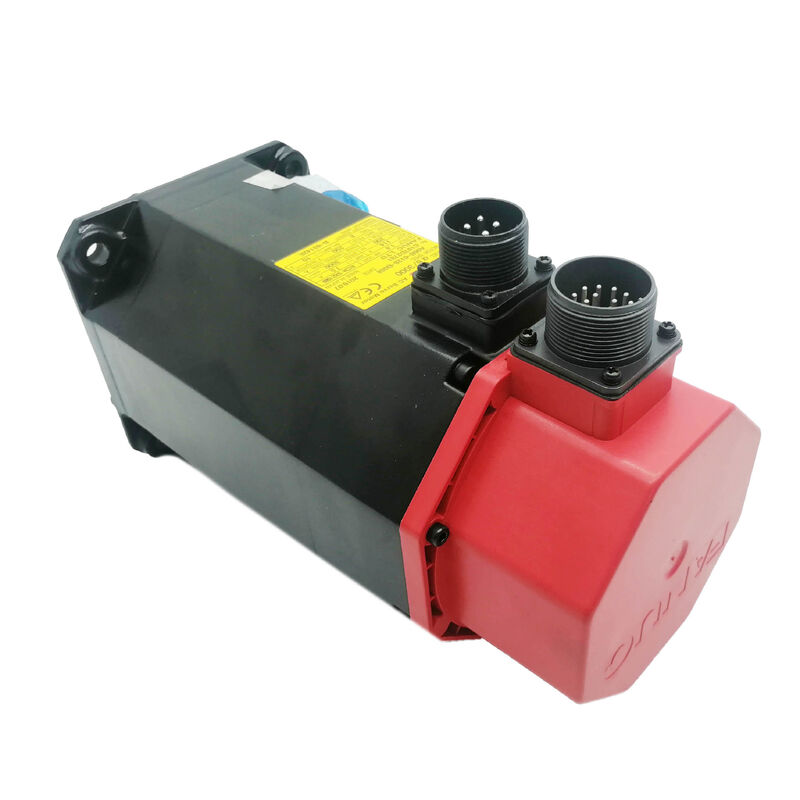
Fanuc A06B-0143-B075 | Alpha Series AC Servo Motor A12/3000 — 2.8kW, 12Nm Stall, 3000rpm, 12A, Alpha A64 Absolute Encoder, CNC 16i / 18i / 21i
Overview
The Fanuc A06B-0143-B075 is the A12/3000 in Fanuc's original alpha motor series — a 2.8kW, 3000rpm servo motor that was, for over a decade, a cornerstone of mid-size CNC machining centre and turning centre axis design. Machines built around the 16i/18i/21i controls routinely specified this motor for X, Y, and Z axes in the medium load range, and the result is a massive installed base that still demands maintenance support today.
The alpha series itself sits between the older S-series motors and the later alpha i generation in Fanuc's product history. It introduced the Alpha A64 absolute encoder as the standard feedback device, bringing no-homing startup capability to the mainstream of Fanuc servo systems in a way that the S-series incremental coders never could.
With 65,536 counts per revolution, the A64 encoder provides positioning resolution that exceeds the mechanical repeatability of any ball screw assembly by a comfortable margin, ensuring the encoder is never the limiting factor in axis accuracy.
At 12Nm of stall torque delivered up to 3000rpm, the A12/3000 handles the full range of axis duties a mid-size machining centre demands — rapid traverse at 3000rpm is fast enough for practical rapid positioning, while the 12Nm torque budget sustains the motor through mid-weight cutting cycles without the servo amplifier entering current limit territory. This is why machine builders of the 16i/18i era selected this motor family so widely: it performed adequately across the full operational range without requiring the next-size amplifier.
Key Specifications
| Parameter |
Value |
| Motor Designation |
A12/3000 (alpha series) |
| Rated Output |
2.8 kW |
| Stall Torque |
12 Nm |
| Stall Current |
15 A |
| Rated Speed |
3000 rpm |
| Rated Current |
12 A |
| Rated Voltage |
155V |
| Encoder |
Alpha A64 (absolute, 65,536 cpr) |
| Shaft |
Straight, no keyway |
| Brake |
None |
| Matching SVM |
SVM1-80 (A06B-6079-H105 / 6096-H105) |
| CNC |
16i, 18i, 21i, 0i-A/B |
| Manual |
B-65142E |
The Alpha A64 Encoder
When the alpha motor series launched, the A64 represented a step change in servo feedback for Fanuc's mainstream machine tool market.
The "64" refers to 64K — 65,536 absolute position counts per revolution from a single-turn absolute encoder.
At the time, this was a significant resolution upgrade from the 2500P incremental encoders common on earlier S-series motors, and it delivered absolute position data that made reference-return-free machine startup a practical standard rather than a premium option.
The full part-number suffix B075 encodes the specific encoder and shaft type: "B0" (no brake), "75" (Alpha A64 encoder, slick shaft).
The motor is also available as B175 (A64 encoder, brake fitted) and B077/B084/B088 (same motor body with more modern encoder types, enabling compatibility with newer amplifier generations).
The physical motor body — frame, windings, shaft, bearings — is identical across these variants, which is why encoder-type conversions are well-established maintenance practice for this motor family.
Alpha vs Alpha i: Operating in a Legacy System
The A06B-0143-B075 belongs to the original alpha motor generation, not the alpha i (B075/B077 suffix confusion aside — the "075" part number designation predates the alpha i generation naming).
This motor is designed around the original alpha SVM amplifier architecture, using the A64 encoder's serial data protocol and the amplifier interface of the A06B-6079 / A06B-6096 SVM families.
Machines running 16i/18i/21i controls with these original alpha amplifiers are the natural home of the A06B-0143-B075.
The combination is fully validated, has decades of field history, and continues to deliver the motion control performance that made these machines productive. Replacing an A06B-0143-B075 in this system is straightforward — fit, parameter verify, reference return, confirm performance.
Maintenance Realities for Alpha-Generation Motors
Alpha series motors of this specification are now frequently 20+ years old in the field.
Bearing wear is the most common reason for replacement or overhaul — the combination of years of thermal cycling, vibration, and sometimes marginal lubrication eventually causes bearing noise, increased running temperature, and position noise symptoms that the servo loop reads as disturbances.
Full strip, clean, and bearing replacement restores a mechanically sound motor to like-new performance without the cost of a new unit.
Encoder failure is the second most common service event.
The A64 encoder's bearing and optical system have finite service lives, and a motor with a failed encoder requires either encoder replacement (restoring the original B075 specification) or encoder upgrade (converting to a newer type for compatibility with a modernised amplifier). Both paths are established and well-supported by Fanuc-specialist service companies.
FAQ
Q1: Does the A06B-0143-B075 require a reference return at every startup, or does the absolute encoder retain position?
The Alpha A64 absolute encoder retains position through power-off, provided the servo amplifier battery is healthy. The battery maintains the multi-turn count in the amplifier's SRAM during machine power-off.
On power-up with a healthy battery, the CNC reads the stored position and the axis is ready for motion without a reference return.
If the battery has been exhausted (BAT alarm), position data is lost and a reference return is required after battery replacement.
Q2: Can the A06B-0143-B075 (alpha) work with an A06B-6114 (alpha i) SVM amplifier?
Alpha motors and alpha i amplifiers were designed with backward-compatibility provisions, but this is not a plug-and-play substitution. The compatibility depends on the specific A06B-6114 amplifier revision and the encoder communication protocol it supports.
Fanuc publishes compatibility tables in the alpha i amplifier startup manuals — consult these before attempting to pair alpha motors with alpha i amplifiers.
Parameter settings for motor type and encoder type in the CNC will need to match the specific combination being used.
Q3: The B075 has no brake. What machine conditions make the B175 (with brake) necessary instead?
A holding brake is required when the axis must remain stationary while the servo is de-energised or during an emergency stop, and gravity or mechanical forces would otherwise move the axis.
The most common case is a vertically-oriented axis (Z-axis on a vertical machining centre, a knee mill, a gantry) without a mechanical counterbalance.
On horizontal axes where friction and the mechanical system prevent unwanted motion when the servo shuts off, the B075 without brake is appropriate and avoids the additional weight and wiring complexity of the brake variant.
Q4: How does the 12Nm stall torque relate to the motor's continuous safe operating zone in a real cutting cycle?
The stall torque is the continuous torque the motor can sustain indefinitely at zero speed without exceeding thermal limits — it is the worst-case thermal load.
In a real cutting cycle, the motor alternates between high-speed low-torque rapid traverse and moderate-speed moderate-torque cutting passes, with the average torque well below the stall figure.
The continuous safe operating zone expands at higher speeds due to improved motor ventilation and the falling torque requirement.
The SVM amplifier enforces thermal protection through its current limit, preventing sustained operation at stall torque for extended periods on the motor's actual operating cycle.
Q5: What shaft coupling is appropriate for the slick (no-keyway) straight shaft on the B075?
A shrink-fit bore coupling or a clamping-type hub (split hub with clamping screw, zero-backlash disc coupling with clamping bore) is the correct approach for a smooth shaft.
These coupling types transmit torque entirely through the clamping force against the shaft surface — no mechanical key is involved.
The shaft surface must be clean, undamaged, and free from burrs before fitting the coupling.
If the machine's original coupling has a keyway cut for a key, the motor must be the keyed variant. Do not attempt to use a keyed coupling on a slick shaft; the key contact area is absent and the coupling will slip under load.


 Your message must be between 20-3,000 characters!