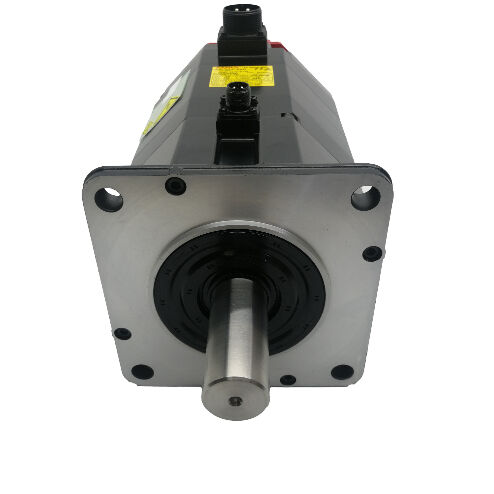
Fanuc A06B-0146-B075 | ALPHA Series AC Servo Motor a22/1500 — IP65, Straight Shaft
Part Number: A06B-0146-B075
Series: ALPHA AC Servo Motor
Model: a22 / 1500
Shaft Variants: Plain Straight (#7000) / Keyed Straight (#7008)
Condition: New / Refurbished / Exchange Available
Overview
The Fanuc A06B-0146-B075 is a mid-frame ALPHA series AC servo motor — model a22/1500 — built for the kind of sustained, torque-heavy axis work that small to medium CNC machine tools demand.
At 22 Nm continuous torque and 3.8 kW output, this is not a lightweight positioning motor. It was designed to drive real mechanical loads: large ballscrews, heavy saddles, and axes where the cutting forces are significant and the servo system needs to hold feedrate accuracy without flinching under load.
The red end cap is the hallmark of the ALPHA generation, and the a22/1500 wearing it was a familiar sight on the axis drives of vertical machining centers, turning centers, and milling platforms throughout the period when this motor series was in active production.
It runs at a maximum of 1,500 RPM — a deliberate low-speed, high-torque design choice — and operates on a three-phase 157 V supply at 100 Hz, drawing 19 A at rated load.
One practical detail worth knowing upfront: the A06B-0146-B075 was produced in two shaft configurations within the same base part number.
The #7000 suffix denotes a plain straight shaft with no keyway, and the #7008 suffix denotes a keyed straight shaft.
Both are the same motor electrically and mechanically in every other respect — the shaft variant is the only difference, but it is a critical one when ordering a replacement or specifying a coupling.
Key Specifications
| Parameter |
Value |
| Rated Output Power |
3.8 kW |
| Continuous Torque |
22 Nm |
| Rated Current |
19 A |
| Supply |
3-Phase, 157 V |
| Rated Frequency |
100 Hz |
| Maximum Speed |
1,500 RPM |
| Shaft Type |
Straight — Plain (#7000) or Keyed (#7008) |
| Brake |
None |
| Ingress Protection |
IP65 |
| End Cap |
Red (ALPHA Generation) |
High Torque at Moderate Speed — the a22 Design Philosophy
The a22/1500 occupies a specific slot in the ALPHA motor hierarchy. The torque rating is the defining number — 22 Nm continuous places it well above the AC12 family motors and into territory where the motor is expected to move and control genuinely heavy mechanical loads.
The 1,500 RPM ceiling is the trade-off that makes that torque density possible within a manageable frame size: the electromagnetic design prioritises force production over rotational speed.
For machine tool applications, this translates directly into axis capability. A motor in this class can maintain programmed feedrates under full cutting load on a large facing pass or a heavy roughing cut, where a lower-torque motor would show velocity droop or drive current limiting.
The 19 A continuous current draw reflects that torque output — servo amplifier selection and cable sizing both need to be matched to this rating, not estimated down from a lighter motor in the same family.
At 100 Hz rated frequency and 157 V, the drive system parameters for this motor are specific.
They are not shared with the AC12 or other a22 variants running at different speed ratings. This matters when commissioning a replacement: the servo amplifier motor type parameter must match the a22/1500 specification exactly.
Shaft Variants: Plain vs Keyed
The A06B-0146-B075 was produced in two shaft configurations, and both remain in circulation:
#7000 — Plain Straight Shaft: No keyway. Torque is transmitted entirely through the coupling clamping force. Suitable for precision servo couplings (bellows, jaw, or disc type) where concentricity and backlash-free connection are priorities, and where the load profile does not include severe shock or sustained high-torque reversals.
#7008 — Keyed Straight Shaft: Includes a standard keyway machined into the shaft.
The key provides a positive mechanical drive that resists slippage under shock loading and repeated direction changes — important for belt-driven arrangements, pulley mounts, or any drive where the coupling cannot guarantee full torque transmission through clamping force alone.
When ordering a replacement motor, identifying which shaft variant is installed on the machine before sourcing is essential.
Fitting a plain shaft motor in a position designed for a keyed shaft — or vice versa — requires either a new coupling or shaft modification, both of which add time and cost to what should be a straightforward swap.
IP65 Sealing
The IP65 rating on the a22/1500 provides full dust ingress protection and resistance to directed low-pressure water jets.
In the context of a CNC machine tool environment, this covers coolant mist, incidental splash from cutting operations, and compressed air cleaning — the daily exposure conditions that servo motors on productive machines deal with continuously.
IP65 is one step below the IP67 rating found on fully immersion-rated ALPHA variants.
For most axis drive positions on a standard machining center, IP65 is adequate. If the motor mounting location sees direct high-volume coolant flow or is in an area prone to coolant pooling, it is worth assessing whether the installation requires additional shielding or whether an IP67-rated variant would be the better long-term choice.
Drive & Control Compatibility
The A06B-0146-B075 works with Fanuc ALPHA series servo amplifiers — SVM and SVU modules — and is compatible with the Fanuc CNC control generations that were current alongside this motor series, including Series 0, 0i, 16, 18, and 21 platforms.
At 19 A rated current, the amplifier module must be specified to handle this load. Pairing the a22/1500 with an undersized amplifier is a reliable way to generate sustained overcurrent faults under normal cutting conditions.
For retrofit and repair projects, confirm the feedback device type on the installed motor and ensure the servo drive parameters reflect the correct motor type code, maximum speed, and encoder specification before axis commissioning.
Sourcing & Inspection Notes
Both the #7000 and #7008 shaft variants of the A06B-0146-B075 are available through the refurbished and surplus servo motor market. When assessing a used unit, start with the shaft — check for wear, fretting at the keyway on #7008 variants, and any signs of coupling impact damage at the shaft end. Measure three-phase winding resistance for balance and test insulation resistance to earth.
Inspect the IP65 shaft seal for hardening or cracking, particularly on motors with extended service history in wet environments. Spin the shaft by hand to feel for bearing roughness, and verify the encoder connector and cable exit are undamaged before committing to installation.
FAQ
Q1: What is the difference between the A06B-0146-B075 #7000 and #7008 variants?
The only difference is the shaft configuration. The #7000 has a plain straight shaft with no keyway; the #7008 has a keyed straight shaft. Electrically and mechanically they are identical in every other respect — same torque rating, same current draw, same encoder, same mounting.
Before ordering a replacement, confirm which shaft variant is installed on the machine to avoid a coupling mismatch on arrival.
Q2: What servo drive is compatible with this motor, and does the 19 A rating matter for selection?
Yes — the 19 A rated current is a hard requirement for amplifier selection. The motor is designed for Fanuc ALPHA series servo amplifiers (SVM/SVU modules) paired with Series 0, 0i, 16, 18, or 21 CNC controls.
The amplifier module must be rated to supply 19 A continuous output. An undersized module will enter current limiting under normal axis load and produce thermal or overcurrent faults during cutting.
Q3: Why does the a22/1500 run at a lower maximum speed than smaller ALPHA motors?
The a22/1500 is optimised for torque density, not maximum speed. Producing 22 Nm continuous torque in a practical frame size requires an electromagnetic design that prioritises low-speed force output. The 1,500 RPM ceiling is the direct result of that design priority.
For axes that need high traverse speed with lighter loads, a smaller, higher-speed motor in the ALPHA family is the appropriate choice — but for heavy-load axis drives, the torque-first design of the a22/1500 is the correct specification.
Q4: This motor has no brake — is that a limitation for certain applications?
For horizontal axes and applications where the servo drive maintains active torque retention at rest, no brake is needed and the simpler installation is an advantage.
For vertical axes carrying significant workpiece or table weight, a motor without an integrated brake relies entirely on the drive for position holding — which is a risk during E-stop, servo alarm, or power loss events. In those cases, a brake variant should be specified. The A06B-0146-B075 is not suitable as a direct replacement on a gravity-loaded vertical axis without evaluating the axis holding strategy.
Q5: The motor I removed has a keyed shaft but I can only find a plain shaft replacement — can I adapt it?
Technically, a plain shaft motor can be used in a keyed shaft application if the coupling is changed to a clamping-only type and the torque transmission requirements are within the coupling's rated capacity. However, this is only appropriate if the load profile does not include shock loads or frequent high-torque reversals that could cause coupling slip over time.
The cleaner solution is to source the correct #7008 shaft variant. Modifying the shaft in the field to add a keyway is not recommended without specialist machining to maintain runout and shaft integrity.


 Your message must be between 20-3,000 characters!