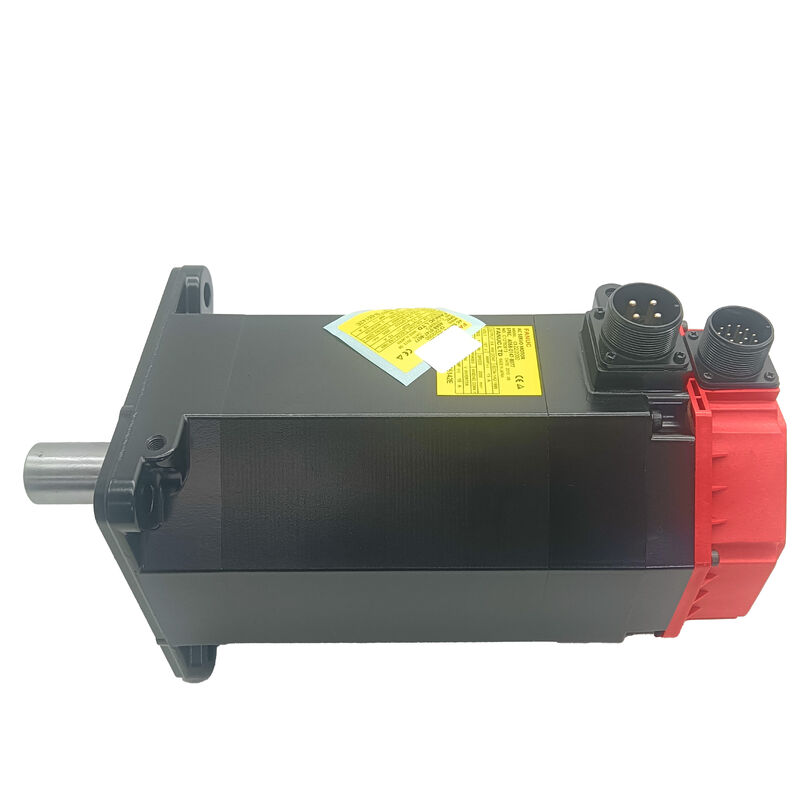
Fanuc Servo Motor A06B-0147-B077
The Fanuc A06B-0147-B077 is an AC servo motor built for precise motion control in CNC and industrial automation systems. It is commonly listed as a 3-phase servo motor in the A22/2000 class, with a straight shaft design, 157 V rating, 15 A current rating, and 2000 rpm speed.
For machine builders and maintenance teams, this kind of motor is typically selected where consistent axis response, stable torque delivery, and reliable integration with existing Fanuc drive systems are more important than generic motor duty.
In practical use, the A06B-0147-B077 fits applications where accurate rotational control and repeatable motion are critical. That includes CNC feed axes, machine tool motion sections, automated handling systems, and retrofit work on equipment already built around Fanuc servo architecture.
The straight shaft configuration also makes it suitable for installations where the mechanical interface must remain unchanged during replacement or service.
For buyers in the MRO and replacement market, this model is best understood as a servo motor intended to preserve system continuity.
In many cases, the real value is not just the motor itself, but the ability to restore a machine without reworking the original mounting, wiring concept, or motion setup. That makes it a practical choice for facilities that need dependable replacement support for established Fanuc-controlled equipment.
Key Product Data
| Item |
Data |
| Product type |
AC Servo Motor |
| Brand |
Fanuc |
| Part number |
A06B-0147-B077 |
| Description |
Servo motor |
| Range / model class |
A22/2000 |
| Phase |
3PH |
| Current rating |
15 A |
| Rated voltage |
157 V |
| Speed |
2000 RPM |
| Shaft type |
Straight shaft |
| Warranty |
1 Year |
Product Overview
The A06B-0147-B077 is designed for controlled industrial motion rather than simple fixed-speed rotation.
In a servo application, the motor works as part of a drive system that needs accurate command response, repeatable speed behavior, and stable axis performance under changing load conditions. That is why this model is more relevant to CNC and automated equipment than to general-purpose motor replacement.
Its 2000 rpm speed class and 3-phase design make it suitable for machine axes that require balanced performance between torque, control stability, and positioning repeatability. The 15 A and 157 V electrical characteristics place it firmly in the industrial servo category, where the motor is expected to operate with the correct matched amplifier and feedback system instead of as a stand-alone mains motor.
Some market listings also associate this model with i64 pulse coder feedback, reinforcing its role in closed-loop motion control environments.
Why It Works Well in Industrial Equipment
A servo motor like the A06B-0147-B077 is typically chosen when the machine cannot tolerate inconsistent motion. In CNC equipment and precision automation, even small deviations in axis behavior can affect machining quality, cycle timing, and repeatability.
A motor in the A22/2000 class is therefore better understood as a motion component within a controlled system, not simply as an electrical rotating device.
Another practical advantage is its relevance in replacement scenarios.
When an installed Fanuc machine already uses this motor class, keeping the same part family often reduces engineering risk.
It helps preserve shaft fit, control response, and existing system compatibility, which is especially important in maintenance environments where minimizing downtime matters more than redesigning the entire axis package.
Installation and Use Notes
As with other industrial servo motors, correct matching is essential. The A06B-0147-B077 should be used within the appropriate servo system, with compatible drive and feedback handling, rather than treated as a direct-to-line motor.
Before replacement or commissioning, users should confirm the electrical rating, shaft configuration, mounting arrangement, and overall machine-side compatibility.
The straight shaft design is important from a mechanical standpoint because it directly affects coupling, alignment, and installation continuity.
In retrofit or repair work, matching the shaft form is often just as important as matching voltage or current, especially on older CNC equipment where the original drive train layout must remain intact.
FAQ
Q1. What kind of equipment is the A06B-0147-B077 typically used in?
The A06B-0147-B077 is typically used in CNC machinery and other industrial motion systems where the axis must accelerate, decelerate, and hold position with controlled response.
In practical terms, this makes it suitable for feed axes, transfer motions, machine tool positioning sections, and other applications where motion repeatability matters more than simple continuous rotation.
Because it is identified as an AC servo motor in the A22/2000 class, it is generally selected as part of an existing Fanuc servo system rather than as a general-purpose replacement motor.
Q2. Is this a standard AC motor or a servo motor, and why does that matter?
It is an AC servo motor, and that distinction is important. A standard AC motor is mainly used for rotational drive, while a servo motor is intended to work in a controlled motion loop with a compatible amplifier and feedback device. In this case, listings for the A06B-0147-B077 describe it as a servo motor with I64 pulse coder feedback, which means the motor is meant for applications where the control system needs to monitor and correct motion continuously.
That is why correct system matching is more important here than it would be for a basic induction motor.
Q3. What should be checked before ordering this motor as a replacement?
The most important checks are part number match, motor class, electrical characteristics, shaft style, and servo-system compatibility. For this model, buyers usually confirm the A06B-0147-B077 part number, 3-phase configuration, 157 V rating, 2000 rpm speed class, 15 A listing, and straight shaft construction before installation.
In real maintenance work, this is not only about fitting the motor electrically; it is also about keeping the original mechanical coupling, axis response, and control behavior as close as possible to the machine’s existing setup.
If the machine is already built around this Fanuc motor family, using the correct replacement helps reduce unnecessary changes during repair.
Q4. Why is the straight shaft configuration important in industrial service?
The shaft configuration directly affects how the motor couples to the driven mechanism.
A straight shaft matters because coupling fit, alignment accuracy, and installation continuity all depend on that mechanical interface being correct.
In CNC and automation equipment, even when the electrical rating is correct, a mismatch in shaft style can create problems during assembly, increase alignment error, or force changes to the original drive train. For maintenance teams, matching the shaft type is often one of the key steps in keeping replacement work fast and predictable.
Q5. What installation and safety points should users keep in mind?
This motor should be installed and used as part of the correct Fanuc servo system, with the applicable amplifier, wiring method, and protective practices.
FANUC safety guidance for servo motors and amplifiers stresses that users should read the safety precautions carefully before use, and current FANUC servo literature also highlights system-level features such as amplifier-side brake control and maintenance-oriented connector design, which shows that these motors are intended to operate within a matched servo architecture rather than as direct-to-line motors.
In practice, that means grounding, wiring integrity, amplifier compatibility, and overall axis-side checks should all be confirmed before commissioning.



 Your message must be between 20-3,000 characters!