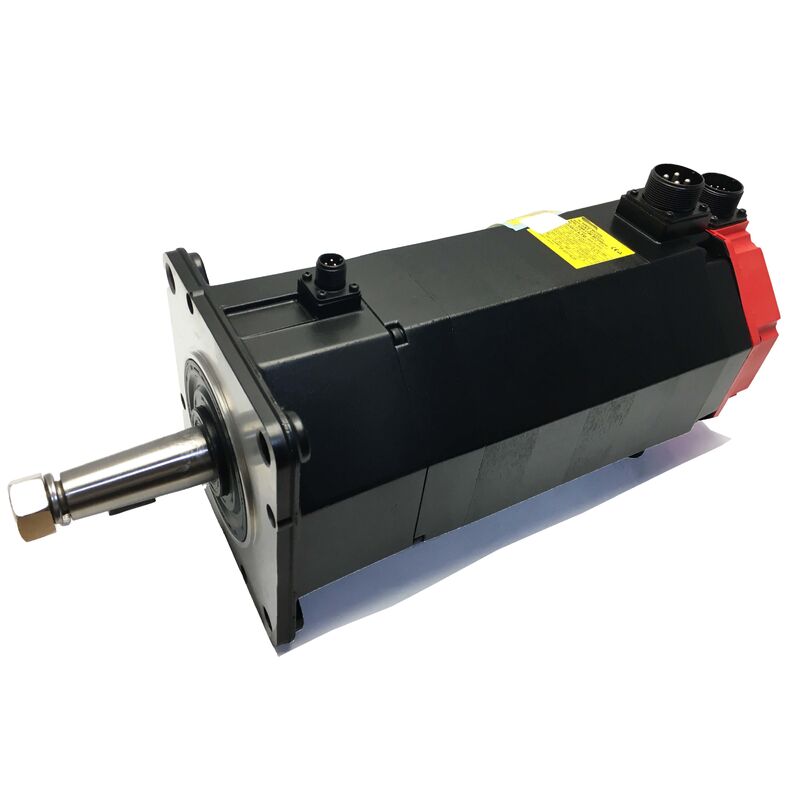
Fanuc A06B-0147-B575 | ALPHA Series AC Servo Motor A22/2000 — 3.8kW, Taper Shaft, Oil Seal, A64 Encoder
Part Number: A06B-0147-B575
Series: ALPHA AC Servo Motor
Model: A22 / 2000
Configuration: Tapered Shaft with Keyway, A64 Encoder, No Brake, Oil Seal
Condition: New / Refurbished / Exchange / Surplus
Overview
The Fanuc A06B-0147-B575 is a 3.8 kW AC servo motor from Fanuc's ALPHA series — model A22/2000 — in a specific configuration that distinguishes it from the more commonly traded B077 and B075 straight-shaft variants within the same family.
The B575 carries a tapered shaft with keyway, giving it the self-centering interference fit geometry and positive rotational engagement that certain machine drive applications require.
Combined with the A64 absolute encoder and standard oil seal sealing, this is a motor configured for precise, repeatable positioning with absolute position retention through power cycles and reliable protection against the coolant and particulate exposure of industrial production environments.
At 22 Nm stall torque, 3.8 kW continuous output, and 2,000 RPM maximum speed, the A22/2000 sits in the substantial mid-range of the ALPHA motor family — above the AC12 motors used on lighter axes, below the AC30 units on the heaviest drives.
It was a standard specification for the X, Y, and Z feed axes of small to medium CNC machine tools where the mechanical loads were real, the cutting forces were meaningful, and the axis needed to maintain feedrate accuracy under sustained machining conditions.
Key Specifications
| Parameter |
Value |
| Rated Output |
3.8 kW (Continuous) |
| Stall Torque |
22 Nm (195 in-lbs) |
| Rated Current |
19 A |
| Motor Voltage |
157 V |
| Rated Frequency |
133 Hz |
| Phase |
3-Phase |
| Maximum Speed |
2,000 RPM |
| Encoder |
A64 Absolute (64,000 ppr) |
| Shaft Type |
Tapered Shaft with Keyway |
| Brake |
None |
| Sealing |
Standard Oil Seal |
| Series |
ALPHA — A22/2000 |
The B575 Configuration — Taper Shaft and What It Changes
The B575 suffix carries two mechanical characteristics that set this variant apart from the straight-shaft A22/2000 motors: the tapered shaft geometry and the keyway machined into it. Together they define the coupling interface in a way that a plain straight shaft does not.
The tapered shaft's conical profile creates a self-centering interference fit when the coupling hub or driven component is drawn onto it.
The hub seats concentrically each time it is installed — a property that a plain clamping-only straight shaft relies on the coupling's clamping precision to achieve, but which the taper delivers mechanically by geometry.
On axes where shaft runout would affect positioning repeatability or surface finish quality, the taper's inherent concentricity advantage is the engineering reason it was specified.
The keyway adds a different kind of security: positive rotational engagement. With a key in place, the coupling hub cannot rotate relative to the shaft regardless of the torque applied, the frequency of direction reversals, or the shock loads generated during axis acceleration from heavy mechanical loads.
At 22 Nm stall torque on a production CNC axis, this distinction matters over a service life measured in years of production shifts.
The practical consequence at replacement time is that the machine's driven components — the pulley, coupling hub, or gearbox input element — are bored and machined to match the taper and keyway geometry. A straight-shaft replacement motor requires new coupling components. A like-for-like B575 slots in without mechanical modification.
A64 Encoder — Absolute Position Without Homing
The A64 is Fanuc's absolute encoder designation for the 64,000 pulse-per-revolution feedback device fitted to this motor. Absolute means the encoder retains its position reference through power interruptions.
When the CNC powers up after a planned shutdown, an emergency stop, or an unplanned power loss, the servo drive reads the current absolute shaft position directly from the A64 — and the machine has full axis position knowledge before any motion is commanded. No homing cycle is needed.
For production machines, this has a compounding operational effect.
Homing sequences take time — on a machine cycling up twice per shift, five days a week, eliminating a 30-second homing routine adds up to measurable productive time per year. More significantly, it removes the failure mode associated with interrupted homing: if a machine loses power mid-homing sequence on an incremental encoder system, the operator must diagnose and restart the homing routine before the machine can resume. With the A64, none of that applies.
The absolute reference also protects against the class of errors where an axis position counter drifts over time — a phenomenon that can occur on incremental systems through accumulated electrical noise on the feedback line. The A64's absolute data acts as a continuous sanity check on the position information the CNC is working with.
Oil Seal and Environmental Fit
The B575 designation in the Fanuc numbering system typically indicates a motor with standard oil seals rather than the enhanced IP67 sealing found on the B075#7076 or B077#7076 variants.
Standard oil seals protect the bearing cavities from the airborne coolant mist, fine metallic particles, and general contamination of a CNC machining environment under normal installation conditions.
For machines where the motor is positioned away from direct coolant spray and in locations with reasonable airflow, standard oil seal protection is adequate for long service intervals.
Where the motor is installed closer to the cutting zone — particularly on machines with high-pressure through-tool coolant or aggressive coolant delivery — the enhanced IP67 sealing of other variants in the A22/2000 family provides stronger long-term protection.
Seal condition is always worth checking on used motors.
A hardened or cracked shaft seal is a straightforward maintenance item when the motor is out of the machine for service, and addressing it prevents the slow bearing contamination that shortens motor life without producing any dramatic immediate symptom.
A22/2000 in the ALPHA Family — Power Class Context
From the GE Fanuc servo product documentation, the A22/2000 delivers 22 Nm continuous stall torque at up to 2,000 RPM — a combination that was rated at 3.7–3.8 kW depending on the specific variant and measurement basis.
At 19A rated current, the servo amplifier module must be sized for this current class.
The A06B-0147 series connects to ALPHA series SVM amplifiers in the current class appropriate for 19A continuous and the higher peak currents needed for axis acceleration.
The 133Hz rated frequency at 2,000 RPM distinguishes the A22/2000 from the A22/1500 family, which uses 100Hz.
This frequency difference reflects the different speed ceilings and associated electromagnetic design, and it means the two families use different motor type parameters in the servo amplifier — they share the same torque class but are not configured identically in the drive system.
Drive & Control Compatibility
The A06B-0147-B575 is compatible with Fanuc ALPHA series SVM servo amplifiers and integrates with Fanuc CNC controls including Series 0, 0i, 15, 16, 18, and 21. The servo amplifier must be parameterised with the motor type code for the A22/2000 with A64 absolute encoder.
On machines that have undergone drive or control upgrades since original build, confirming that the installed amplifier supports the A64 absolute encoder interface before installing a replacement is a necessary commissioning step — not all ALPHA amplifier generations have identical absolute encoder handling capabilities.
FAQ
Q1: What is the key mechanical difference between the B575 and the B077 in the same A22/2000 family?
The B077 carries a straight plain shaft (SLK — no keyway) with an I64 incremental encoder, and the B077#7008 carries a straight shaft with keyway and the same I64.
The B575 carries a tapered shaft with keyway and uses the A64 absolute encoder. The taper shaft creates a self-centering interference fit that a straight shaft does not provide.
The A64 absolute encoder retains position through power cycles, eliminating homing sequences.
Both the shaft geometry and encoder type must be matched when sourcing a replacement — a straight-shaft motor cannot fit in a taper-bored coupling without replacing the coupling hub.
Q2: What is the practical advantage of the A64 absolute encoder over the I64 incremental encoder on this power class motor?
The A64 retains shaft position through power interruptions — the machine knows exactly where each axis is the moment it powers up, without homing. The I64 loses its reference on power loss and requires a homing sequence at every restart.
For a production machine, absolute feedback eliminates homing delay, removes the failure mode of interrupted homing routines, and provides a continuous absolute reference that protects against position counter drift.
When replacing the B575, the A64 encoder type must be matched — fitting an I64 motor changes machine startup behavior and may require servo parameter updates.
Q3: What servo amplifier is required for the A06B-0147-B575?
The motor requires a Fanuc ALPHA series SVM amplifier module rated for at least 19A continuous output current, compatible with the A22/2000 motor type and the A64 absolute encoder interface.
It integrates with Fanuc CNC controls including Series 0, 0i, 15, 16, 18, and 21. The motor type parameter in the amplifier must be set correctly for the A22/2000 A64 specification before the axis is operated under load.
Q4: Can a replacement motor with standard IP65 or IP67 sealing be used instead of the B575's oil seal specification?
Yes, provided the mounting dimensions and shaft geometry match. An IP67-sealed variant of the A22/2000 in the same physical frame will fit the same mounting position and provide a higher level of coolant protection.
The electrical specification, encoder type, and shaft geometry (taper with keyway) must still match the machine's coupling and servo drive configuration.
Upgrading to higher ingress protection is a practical option when the original motor's service history suggests the installation location has higher coolant exposure than the oil seal specification is ideal for.
Q5: What are the most important inspection points for a used A06B-0147-B575?
Inspect the taper shaft surface first — look for fretting, scoring, or impact damage from improper previous removal. Taper surface damage cannot be corrected in the field and compromises the interference fit on reinstallation.
Check the keyway for fretting at the key contact faces. Inspect the A64 encoder connector for corrosion and the cable exit for strain relief damage. Measure three-phase winding resistance for phase balance and check insulation resistance to earth.
Check the oil seal for hardening or cracking at the lip. Rotate the shaft by hand to assess bearing condition. A bench run-up to 2,000 RPM with A64 absolute position verification on a Fanuc ALPHA drive is the correct final check before the motor returns to a production axis.


 Your message must be between 20-3,000 characters!