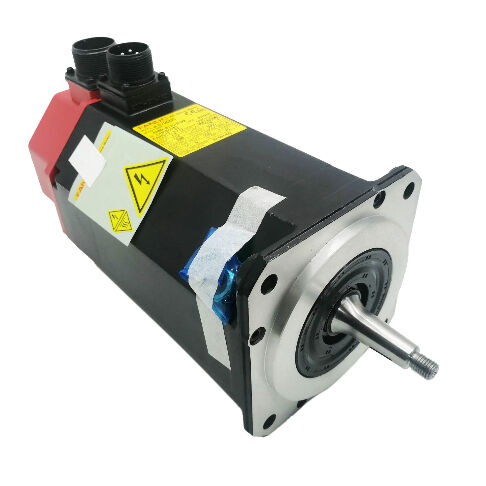
Fanuc A06B-0153-B075 | Alpha Series AC Servo Motor α30/3000 — 4.8kW, 30Nm, 3000RPM, 17A, 168V, Straight Shaft, A64 Encoder, IP65
Part Number: A06B-0153-B075 (also A06B0153B075)
Series: Fanuc Alpha (α) Series AC Servo Motor
Model: α30 / 3000
Configuration: Straight Plain Shaft, No Brake, A64 Incremental Encoder, IP65
Rated Output: 4.8 kW
Stall Torque: 30 Nm
Maximum Speed: 3,000 RPM
Motor Voltage: 168 VAC
Rated Current: 17 A
Rated Frequency: 200 Hz
Phase: 3-Phase
Compatible CNC: Series 0, 15, 16, 18, 20, 21
Condition: New / Refurbished / Surplus
Overview
The Fanuc A06B-0153-B075 is an Alpha series AC servo motor — model α30/3000 — rated at 4.8 kW with 30 Nm stall torque and a 3,000 RPM maximum speed.
Running at 168V three-phase, 200 Hz, and 17A on a straight plain shaft, with IP65 sealing and the A64 incremental pulsecoder, this is one of the higher-torque members of the original Fanuc Alpha generation: a motor built for the primary feed axes of small to medium CNC machine tools where 30 Nm continuous stall torque provides the force authority to drive heavy tables and sustain aggressive cutting cycles without the servo entering following error under load.
The "red cap" designation — referring to the distinctive connector cover colour that identifies this generation of Fanuc Alpha motors — marks the A06B-0153-B075 as the original Alpha generation, not the Alpha i successor series.
This distinction matters for spare parts sourcing: the original Alpha and Alpha i generations share the same physical mounting interfaces but differ in encoder technology, amplifier interface, and some electrical parameters.
The A06B-0153-B075 is the part number for the α30/3000 without brake, straight plain shaft, standard #7008 connector configuration.
At 30 Nm stall torque, the α30/3000 sits at the upper end of the Alpha series compact feed motor range, well above the α6 and α12 class motors that serve smaller axes on the same generation of machine tools.
Its application context — small to medium sized machine tool primary axes — reflects a balance: large enough to handle the inertia and cutting forces of a mid-range machining centre, compact enough that it fits the motor cavity designed for the standard Alpha series form factor.
Key Specifications
| Parameter |
Value |
| Rated Output |
4.8 kW |
| Stall Torque |
30 Nm |
| Maximum Speed |
3,000 RPM |
| Motor Voltage |
168 VAC |
| Rated Current |
17 A |
| Rated Frequency |
200 Hz |
| Phase |
3-Phase |
| Shaft Type |
Straight Plain (No Keyway) |
| Brake |
None |
| Encoder |
A64 Incremental Pulsecoder |
| Encoder Resolution |
64,000 ppr |
| Sealing |
IP65 |
| Series |
Fanuc Alpha — A06B-0153 |
| Compatible CNC |
Series 0, 15, 16, 18, 20, 21 |
α30/3000 in the Alpha Series Torque Hierarchy
The Fanuc Alpha series named its motors by stall torque — the number before the slash is the rated stall torque in Newton-metres.
Stepping through the range makes the progression clear: the α6/2000 provides 6 Nm, the α12/2000 provides 12 Nm, the α22/2000 provides 22 Nm, and the α30/3000 provides 30 Nm — five times the stall torque of the α6 class from the same motor generation, in a physically larger but still servo-cabinet-compatible housing.
The α30/3000 is the highest-torque, highest-speed combination in the compact Alpha feed motor range before the physical scale steps up to the larger α40 class with its fan cooling package. At 4.8 kW, 30 Nm, and 3,000 RPM on a single motor without forced cooling, the thermal management of the α30/3000 is handled entirely by the IP65 sealed housing's natural convection — the motor dissipates heat through its surface area and the machine mounting structure.
This puts a ceiling on the duty cycle: the motor can sustain rated torque continuously at 3,000 RPM within its thermal envelope, but environments with elevated ambient temperatures or restricted airflow around the motor body require confirming that the sustained thermal load remains within the motor's rated operating range.
The 3,000 RPM ceiling — compared to the 2,000 RPM of the α30/2000 (A06B-0152-B075) — means the α30/3000 serves axes where higher rapid traverse speed is required without sacrificing torque.
At a 10mm ball screw pitch and 1:1 coupling, 3,000 RPM delivers 30 m/min rapid traverse while maintaining the full 30 Nm torque throughout the speed range.
30 Nm at 17 Amps — Power and Current Context
The 30 Nm stall torque at 17A rated current reflects the motor's electromagnetic design: the Alpha series uses ferrite permanent magnets in the standard (non-C) configuration, and the α30 frame is sized to produce this torque at the 168V, 200 Hz electrical operating point that corresponds to 3,000 RPM.
At 17A and 168V, the motor's electrical power input at rated conditions is approximately 4.9 kVA before accounting for power factor.
The 4.8 kW rated output reflects the conversion efficiency of the permanent magnet synchronous motor at this operating point — in practice, the Alpha series achieves high efficiency across its operating range, which contributes to the low heat generation per unit output that makes natural convection cooling viable at this power level without a fan.
The A64 encoder at 64,000 pulses per revolution provides the position and velocity feedback to the Alpha servo amplifier.
At 3,000 RPM, the encoder outputs approximately 3.2 million pulses per second — well within the Alpha amplifier's feedback processing capability and providing sufficient velocity feedback resolution for smooth, low-noise speed control across the full speed range down to very low crawl speeds.
Straight Plain Shaft — No Keyway
The B075 suffix identifies the straight plain shaft without keyway configuration. All torque transmission from the motor to its driven component — timing pulley, coupling hub, or pinion — occurs through friction between the shaft surface and the hub bore.
At 30 Nm stall torque, the coupling design is a serious engineering consideration: the clamping force, hub bore fit, and shaft surface condition collectively determine the friction torque capacity of the interface, and they must be assessed against the motor's peak torque output — which can reach 90 Nm or more during maximum current transients.
The plain shaft has the same assembly advantage as in smaller Alpha motors: the hub can be positioned at any axial location and any rotational orientation before clamping, without the alignment constraint of a keyway.
This flexibility is useful for timing belt drives where the belt orientation determines the correct pulley position.
The penalty is that there is no physical interlock — correct clamping torque, correct hub bore tolerance, and periodic re-check of clamping torque are the only safeguards against coupling slip.
For applications where the axis torque loading is cyclic with frequent direction reversals under high load — as in aggressive machining cycles — the keyed shaft variant (available as A06B-0153-B075#7008 with the appropriate coupling specification) provides the positive rotational interlock that makes coupling slip impossible regardless of the clamping torque condition.
The B075 plain shaft is appropriate for axes where the torque loading is moderate relative to the clamping capacity, or where the coupling arrangement has been explicitly verified for the motor's peak torque output.
A64 Encoder — Incremental Pulsecoder, 64,000 ppr
The A64 pulsecoder is the incremental encoder used across the original Fanuc Alpha generation.
It provides 64,000 pulses per revolution of incremental position feedback — sufficient resolution for the positioning accuracy requirements of the machine tools the Alpha series was designed for. At 3,000 RPM and 10mm pitch ball screw with 1:1 coupling, 64,000 ppr gives approximately 0.16 μm per pulse at the table — finer than the accuracy of the mechanical system it drives.
As an incremental encoder, the A64 requires a reference return (homing) cycle at every power cycle. The CNC must traverse the axis to its reference switch before accepting programmed position commands.
On machines with multiple Alpha series axes, the startup sequence includes reference returns on all axes — a procedure that takes 30–90 seconds depending on machine configuration and reference switch positions.
This startup overhead is the primary operational difference from the absolute encoder variants (A64K or A1000) used on other motors in the same generation.
The A64 pulsecoder is integrated into the motor's rear assembly, protected within the IP65 housing.
The feedback connector at the motor rear is the component most vulnerable to damage during motor removal and maintenance — physical shock to the connector or partial disengagement produces feedback errors at the CNC that typically manifest as servo alarms rather than obvious connection symptoms.
IP65 Sealing and Alpha Generation Identity
The IP65 sealing of the A06B-0153-B075 covers the motor body completely against dust ingress and water jets from any direction.
This is the standard sealing specification for the Alpha generation, appropriate for the CNC machine tool environments — coolant mist, cleaning jets, cutting fluid splash — where these motors operate throughout their service lives.
The #7076 suffix variant of the same motor (A06B-0153-B075#7076) carries IP67 sealing for more demanding fluid exposure environments.
The #7008 is the standard IP65 version; the #7076 is the IP67 upgrade for applications where the motor body may be directly submerged or exposed to high-pressure coolant delivery. Both share identical electrical and mechanical specifications — only the sealing level differs.
The "red cap" identification of this motor generation refers to the connector cover fitted over the feedback cable connection at the motor rear.
This colour coding was consistent across the original Alpha series production run and is a reliable visual identifier when distinguishing Alpha generation motors from the later Alpha i series (which use a different connector style) on mixed-generation machines.
FAQ
Q1: What is the difference between the A06B-0153-B075 and the A06B-0152-B075?
Both are α30 class Alpha series motors with 30 Nm stall torque, identical shaft, encoder, and IP65 specifications. The difference is the maximum speed: the A06B-0153-B075 is the α30/3000 at 3,000 RPM maximum; the A06B-0152-B075 is the α30/2000 at 2,000 RPM maximum.
At the same stall torque and lower maximum speed, the α30/2000 typically produces slightly higher rated output within its 2,000 RPM envelope for applications that do not require the higher rapid traverse speed.
For direct replacement, confirm the machine's servo amplifier parameters specify the correct motor type code — α30/2000 and α30/3000 have different motor ID parameters at the CNC.
Q2: What servo amplifier is compatible with the A06B-0153-B075?
The α30/3000 is compatible with the Fanuc Alpha series servo amplifier modules — the A06B-6079 SVM series (Type A interface) and the A06B-6096 FSSB-interface series — in the 80A current class appropriate for the 17A rated / 34A peak current demand of this motor.
The specific SVM module type (Type A vs FSSB) depends on the machine's CNC generation: Type A serves Series 0-C, 15, 16, 18, 20, 21 in the standard Alpha configuration; FSSB serves the Alpha i generation controls. Confirm the interface type before sourcing the amplifier or motor, as the two series are not interchangeable.
Q3: Does the A06B-0153-B075 require homing at every startup?
Yes. The A64 incremental encoder has no stored absolute position memory — each power cycle begins with an unknown shaft position. The CNC must execute a reference return on this axis, traversing to the reference switch at reduced speed, before the axis accepts programmed position commands.
If power is interrupted mid-cycle, the reference return must restart from the beginning when power is restored.
For machines where reference return time is operationally significant, the A64K or A1000 absolute encoder variants in the same motor frame provide absolute position retention that eliminates this requirement.
Q4: What are the most important checks when evaluating a used A06B-0153-B075?
Rotate the shaft by hand to check for smooth bearing movement — at 30 Nm stall torque and the corresponding rotor mass, bearing condition is the primary service life determinant. Inspect the shaft surface for fretting from previous coupling installation.
Check the A64 pulsecoder connector at the motor rear for damaged pins and verify the cable exit strain relief is intact.
Measure winding resistance across all three phases for balance and check insulation resistance to earth with a megger — at 17A rated and 4.8 kW, winding insulation condition directly affects service life.
A bench run-up on a compatible Alpha amplifier to 3,000 RPM with current monitoring and encoder feedback verified is the correct final check before installation on a production machine.
Q5: Is the A06B-0153-B075 still available new, and what are the alternatives if it is not?
The original Alpha generation is discontinued by Fanuc, and new units are only available through surplus channels.
Refurbished and exchange units remain available from specialist CNC motor repair companies who maintain stock of this generation. The current Fanuc equivalent for new supply is the Alpha i series motor at the equivalent torque and speed class.
Migrating from an original Alpha motor to an Alpha i motor requires the machine's CNC to support the Alpha i amplifier (FSSB interface or compatible Alpha i PSM/SVM modules) and parameter updates for the new motor type — it is a system change, not a simple drop-in swap.
For machines where maintaining the original configuration is preferred, refurbished exchange units with a verified service life are the practical path.


 Your message must be between 20-3,000 characters!