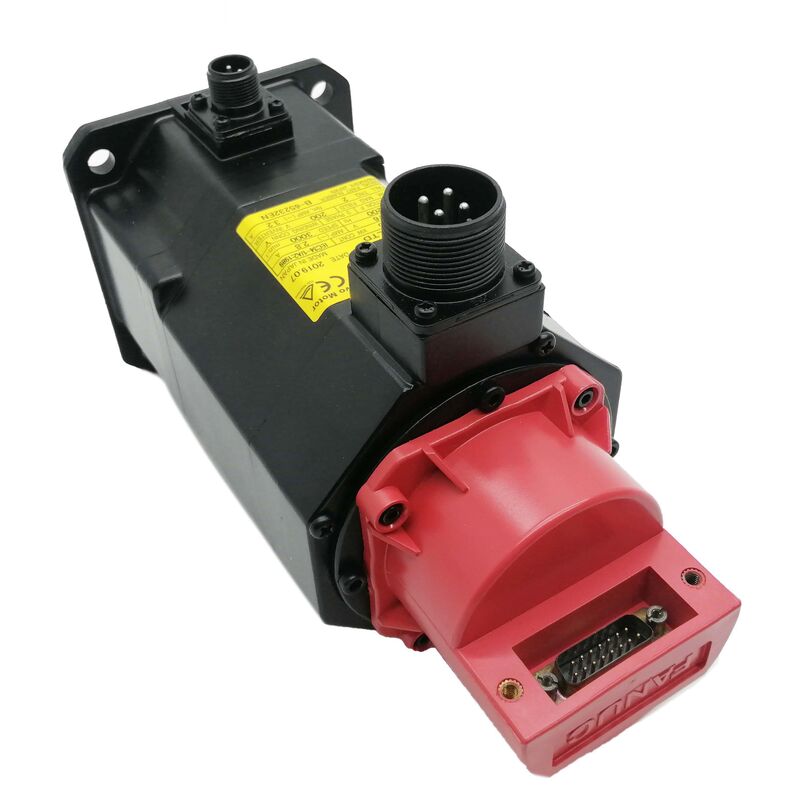
Fanuc A06B-0032-B577 | BETA Series AC Servo Motor B2/3000 — Tapered Shaft, Oil Sealed
Part Number: A06B-0032-B577
Series: BETA AC Servo Motor
Model: B2 / 3000
Condition: New / Refurbished / Exchange Available
Overview
The Fanuc A06B-0032-B577 is a compact BETA series AC servo motor — model B2/3000 — purpose-built for the lighter axis drive requirements of small CNC machine tools. Running to 3,000 RPM on a 3-phase 176 V supply at 200 Hz, and rated at 0.5 kW continuous output, this is a motor that knows its lane.
It was never designed to push heavy saddles or resist aggressive cutting forces. Its job was to provide accurate, repeatable axis motion on compact lathes, small drilling machines, and dedicated single-purpose CNC equipment where the mechanical loads are modest, the installation space is tight, and the axis needs to do its work reliably, shift after shift.
The red end cap is the visual marker of this BETA generation, and two features distinguish the A06B-0032-B577 from other B2/3000 variants: a tapered output shaft and standard oil seals.
Both are specific to particular drive train configurations and operating environments, and both matter when specifying or sourcing a replacement. Getting either wrong means a mechanical mismatch that delays installation rather than resolving the original fault.
Key Specifications
| Parameter |
Value |
| Output Power |
0.5 kW |
| Supply |
3-Phase, 176 V |
| Rated Frequency |
200 Hz |
| Maximum Speed |
3,000 RPM |
| Shaft Type |
Tapered Shaft |
| Sealing |
Standard Oil Seals |
| Series |
BETA |
| Model |
B2 / 3000 |
| End Cap |
Red (BETA Generation) |
| Application |
CNC Axis Drive — Small Machine Tools |
Built for Small Machine Applications
There is a tendency in industrial motor sourcing to treat "small" as a compromise. With the B2/3000, it is a design position. Fanuc engineered the BETA series specifically for machine tool applications where the axis loads fall below what the ALPHA family was sized for — and where fitting an oversized motor creates its own problems: excess inertia, larger coupling requirements, more drive current than the amplifier module needs to supply, and a motor running well below its thermal capacity.
The 0.5 kW output at 3,000 RPM suits the ballscrew drives, positioning mechanisms, and light-duty feed axes found on compact CNC platforms. At 200 Hz rated frequency, the servo amplifier generates the drive conditions the motor needs to reach its full speed range cleanly.
This is handled entirely within the drive system — the machine's supply connection is standard industrial voltage, and the 200 Hz figure is an internal operating parameter, not a supply requirement.
The B2 designation sits at the lighter end of the BETA torque hierarchy. For the class of machine this motor was fitted to, that is precisely correct. A motor well matched to its load runs cooler, draws less current, and typically outlasts an oversized unit doing the same job.
Tapered Shaft — What It Means in Practice
The tapered shaft is the defining mechanical characteristic of the A06B-0032-B577, and it is the feature most likely to catch out an uninformed replacement order.
Unlike a straight shaft — plain or keyed — a tapered shaft uses a precision-ground conical profile to create a self-centering, high-friction interference fit with the mating component. Pulleys, couplings, and drive elements designed for this shaft type seat concentrically without relying on keyways or clamping collars alone, and they can be removed and reinstalled cleanly when the taper engagement is broken correctly.
In spindle and precision positioning applications where concentricity and minimal shaft runout are critical, the tapered shaft is a deliberate engineering choice rather than a variant convenience. Machines designed around this shaft type will have components — pulleys, coupling hubs, collet-style adapters — bored to match the taper angle.
Fitting a straight shaft motor in that position requires replacing those components, which turns a motor swap into a significantly larger job. Always verify the shaft type on the installed motor before ordering a replacement.
Oil Seals & Environmental Protection
The standard oil seals fitted to the A06B-0032-B577 protect the motor's bearing cavities and internal components from the airborne contamination, coolant mist, and fine particulate that are routine in CNC machining environments.
On a motor this compact, bearing contamination is one of the primary causes of premature failure — the bearing cavities are small, and even modest ingress of fine abrasive or coolant breaks down lubrication quickly.
Standard oil seals cover the operating conditions of the small machine tools this motor was designed for. They are not rated for high-pressure coolant jet exposure or continuous submersion — applications with those conditions would warrant a higher-rated ingress protection level.
For the typical installation environment of a compact CNC lathe or drilling machine, the oil seal specification is appropriate and has proven adequate across the long service history of the B2/3000 in these applications.
Seal condition is worth checking on any used unit. A hardened, cracked, or worn shaft seal is a straightforward maintenance item when the motor is out of the machine, and addressing it during a refurbishment prevents the kind of slow bearing contamination that shortens motor life without announcing itself with any obvious immediate symptom.
Drive & Control Compatibility
The A06B-0032-B577 is compatible with Fanuc BETA series servo amplifier modules and integrates with the Fanuc CNC control platforms that were paired with BETA series motors during this generation's production run — including Series 0, 0i, and related controls used on the smaller machine tools where the B2/3000 was a standard axis drive choice.
Servo amplifier parameters must be configured with the correct motor type code for the B2/3000 before the axis is commissioned. At 0.5 kW and the modest current draw of the B2 frame, the amplifier module requirements are light — but the motor type parameter still needs to reflect the actual motor installed.
Leaving parameters set for a different motor produces velocity loop behaviour ranging from slightly sluggish response to outright instability, depending on how far off the setting is from the B2/3000 specification.
Sourcing & Inspection
The A06B-0032-B577 is available through the refurbished and surplus servo motor market. When inspecting a used unit, the tapered shaft deserves particular attention — check the taper surface for fretting marks, scoring, or any evidence that the mating component was removed incorrectly (typically by hammering rather than using a proper taper breaker).
Fretting on the taper compromises the interference fit with the mating pulley or coupling hub and can produce runout that manifests as vibration or axis positioning error after installation.
Check the oil seals for hardening and cracking at the lip — a common finding on motors that have been sitting in storage for extended periods.
Measure three-phase winding resistance for balance and verify insulation resistance to earth. Rotate the shaft by hand to feel for bearing drag or roughness.
The encoder connector and cable exit should be clean and undamaged. A bench test including a no-load run-up to rated speed is the right verification standard for any unit going back into a production machine.
FAQ
Q1: Why does this motor have a tapered shaft rather than a straight shaft?
The tapered shaft provides a self-centering, high-friction interference fit with mating pulleys and coupling hubs that straight shaft clamping cannot always match in terms of concentricity and holding reliability.
It is used in applications where shaft runout must be minimised and where the drive component needs to be removable and reinstallable with predictable engagement. Machines built around this shaft type have components bored to the matching taper — fitting a straight shaft motor requires replacing those components, which is why shaft type verification before ordering a replacement is essential.
Q2: What CNC controls and drives is the A06B-0032-B577 compatible with?
The B2/3000 BETA motor is designed for use with Fanuc BETA series servo amplifier modules and is compatible with Fanuc CNC control platforms including Series 0, 0i, and related generations used on small CNC machine tools.
The servo drive motor type parameter must be set correctly for the B2/3000 specification before the axis is operated. As with any BETA series motor, confirm amplifier compatibility before installation — particularly if the machine has had any control or drive upgrade since original build.
Q3: What does "standard oil seals" mean compared to IP-rated motor protection?
Standard oil seals protect the bearing cavities from airborne contamination, coolant mist, and fine particulate ingress under normal machining environment conditions. They are not the same as a formally rated IP65 or IP67 sealed motor housing, which provides documented protection against directed water jets or temporary immersion.
For the small machine tool applications this motor was designed for, standard oil seals are adequate. If the motor location is subject to direct high-volume coolant spray, additional shielding or a higher ingress-rated motor variant should be considered.
Q4: Is 0.5 kW enough output for a CNC axis drive?
For the machine class this motor was designed for — compact CNC lathes, small drilling and tapping machines, and dedicated single-purpose CNC equipment with light mechanical loads — 0.5 kW is appropriately specified, not a compromise.
A motor correctly sized for the axis load runs more efficiently and with better thermal headroom than an oversized motor doing the same job. If the application involves heavier axis loads, longer travels, or faster traverse requirements, the next frame size up in the BETA or ALPHA series would be the correct specification to evaluate.
Q5: How do I inspect a used A06B-0032-B577 before reinstalling it?
Start with the tapered shaft surface — check for fretting, scoring, or impact damage from improper removal. These defects compromise the interference fit with the mating component and are difficult to correct without specialist machining. Check the oil seals for hardening or cracking at the lip.
Measure three-phase winding resistance for balance across all phases and verify insulation resistance to earth.
Rotate the shaft by hand to assess bearing condition. Inspect the encoder connector for pin corrosion and the cable exit for damage. For any motor with an uncertain service history, a no-load bench run-up to 3,000 RPM with encoder signal verification is the correct standard before returning it to service.


 Your message must be between 20-3,000 characters!