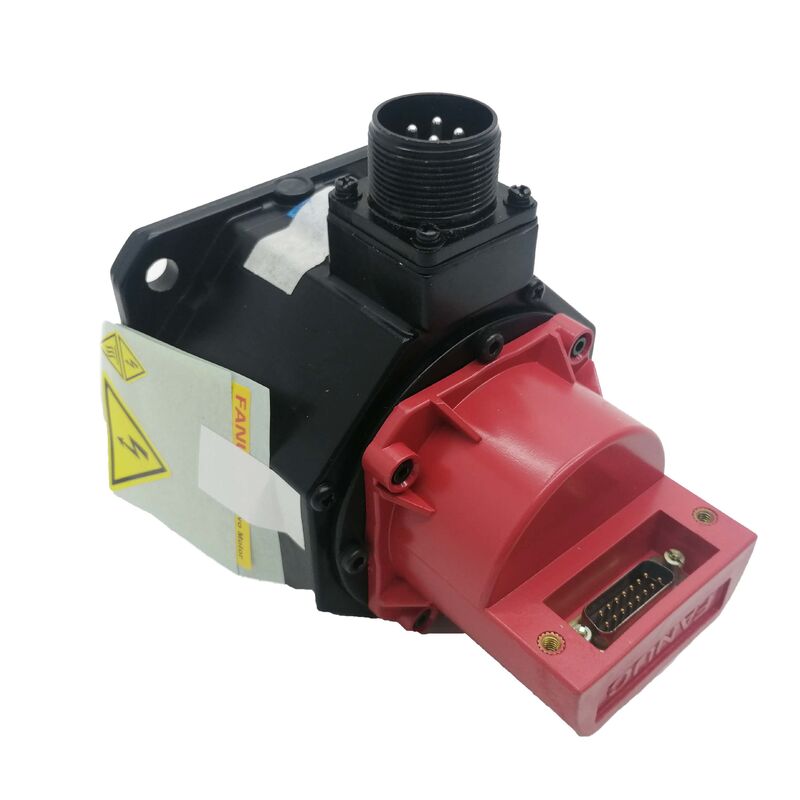
Fanuc A06B-0033-B077 | B-Series AC Servo Motor B3/3000 — Straight Shaft, I32B Encoder
Part Number: A06B-0033-B077
Series: B-Series AC Servo Motor
Model: B3 / 3000
Condition: Refurbished / Exchange / Surplus
Overview
The Fanuc A06B-0033-B077 is a compact B-series AC servo motor — model B3/3000 — representing one of the more capable units in Fanuc's earlier servo motor generation before the ALPHA and BiS families took over.
Rated at 0.5 kW continuous output, 5.3 A, and 191 V, it runs to a maximum of 3,000 RPM and delivers reliable closed-loop axis performance through its integrated I32B incremental encoder.
The straight shaft and clean motor profile made it straightforward to integrate into the CNC machine tool drivetrains of its era, and many of those machines are still running today.
The B3/3000 sits one step above the B2/3000 in the B-series torque hierarchy.
That incremental step in motor frame size brings a modest but meaningful increase in torque output relative to the B2 — enough to matter on axes that pushed the lighter motor harder than ideal. At 0.5 kW, both are firmly in the compact servo category, but the B3's slightly larger frame means more consistent thermal performance under sustained duty cycles where the B2 would run warmer.
This is a motor that earned its reputation through years of production-floor service, not through impressive headline numbers.
It is not a high-power unit by any modern measure — but on the machines it was designed for, it handled its assigned axis reliably, accumulated long service intervals, and proved straightforward to maintain. That track record is why there is still an active market for serviceable A06B-0033-B077 units.
Key Specifications
| Parameter |
Value |
| Output Power |
0.5 kW |
| Rated Current |
5.3 A |
| Rated Voltage |
191 V |
| Maximum Speed |
3,000 RPM |
| Motor Series |
B-Series |
| Model |
B3 / 3000 |
| Shaft Type |
Straight Shaft |
| Encoder |
I32B Incremental |
| Application |
CNC Axis Drive |
The B-Series in Fanuc's Motor History
The B-series AC servo motors belong to an earlier chapter of Fanuc's servo development — a generation that predates the ALPHA red-cap motors and the later BiS absolute encoder series.
These motors were designed and built when the CNC machine tool industry was transitioning from DC servo drives to AC servo technology, and they provided a reliable platform during that shift.
The machines they were installed in are older now, but a significant number remain productive assets in job shops, maintenance facilities, and production lines where the economics of keeping a proven machine running outweigh the cost of replacement.
For the B3/3000 specifically, the 3,000 RPM speed rating placed it in the middle of the B-series range — not the compact top-speed units at the lighter end, and not the slower, heavier torque motors further up the family.
It was a capable general-purpose servo for the axes it was assigned to, and its 191 V / 5.3 A electrical ratings are well within what Fanuc's servo amplifiers of that generation were designed to handle continuously.
I32B Encoder & Closed-Loop Control
The I32B is an incremental encoder mounted at the rear of the motor, providing the position and velocity feedback signals the servo drive needs for accurate axis control.
Incremental encoders generate position data relative to a reference marker pulse, which means the machine establishes absolute axis position through a homing sequence on each startup. This is standard practice for the CNC platforms this motor was paired with — the control manages homing as part of its normal operational sequence.
The I32B's pulse output feeds directly into the servo amplifier's feedback input, closing the velocity and position control loops.
Its resolution is appropriate for the positioning accuracy requirements of the machine tool applications the B3/3000 was designed for. Critically, any replacement motor sourced for this application must carry the same I32B encoder specification — fitting a motor with a different encoder type or resolution without corresponding servo drive parameter changes will produce position scaling errors and may trigger encoder fault alarms during axis operation.
On used units, the encoder is often the component most worth scrutinising. Contamination through coolant ingress, connector corrosion, and accumulated vibration fatigue are the most common encoder failure modes on B-series motors with long service histories.
A motor with a faulty encoder will typically present as an axis position error or runaway condition at the drive — not always immediately obvious as an encoder fault until proper diagnostics are applied.
Straight Shaft & Mechanical Integration
The plain straight shaft on the A06B-0033-B077 is designed for use with precision servo couplings — bellows, jaw, or disc types — that transmit torque through clamping force on the shaft diameter. This is the standard arrangement for servo-coupled ballscrew axes on the class of machines the B3/3000 was fitted to.
Without a keyway, shaft installation relies on correct coupling clamping torque, and this should be verified during reinstallation rather than assumed.
The motor's compact physical dimensions follow B-series standards for the B3 frame class.
Mounting bolt patterns, shaft dimensions, and connector positions are consistent within the series, which simplifies replacement sourcing — a correctly specified like-for-like unit should fit the existing machine mounting without modification.
Availability & Practical Sourcing
The A06B-0033-B077 is no longer in active production. Availability depends on the refurbished motor market, surplus new-old-stock channels, and exchange programs run by specialist servo repair companies.
For facilities running machines that depend on this motor, the choice is usually between a refurbished original unit and a full axis drive upgrade — and for many older machines, the cost-benefit analysis favours maintaining the original specification as long as serviceable motors can be sourced.
When evaluating a refurbished A06B-0033-B077, insist on documented test results rather than a visual inspection alone.
A motor that passes a visual check can still have compromised winding insulation, marginal bearing condition, or degraded encoder output that only shows up under load.
Refurbished units from reputable servo repair facilities will have been tested across these parameters before sale — and on a motor this age, that verification matters.
FAQ
Q1: What Fanuc servo drive and CNC control is compatible with the A06B-0033-B077?
The B3/3000 is designed for use with Fanuc B-series compatible servo amplifiers from the same generation as the motor. It integrates with older Fanuc CNC control platforms that were current during this motor's production period.
When using the motor in a retrofit or repair scenario, confirm that the servo amplifier supports the I32B encoder interface and that the motor type parameter matches the B3/3000 specification. Mixing motor generations without verifying drive compatibility is a common source of commissioning problems.
Q2: Is the A06B-0033-B077 still available new from Fanuc?
No. This motor is no longer in active production. Sourcing options are refurbished originals, verified surplus new-old-stock units, and exchange programs from specialist servo motor repair companies.
For machines that depend on this motor, establishing a relationship with a reliable refurbishment supplier — or holding a vetted spare on the shelf — is the most practical contingency against unplanned downtime.
Q3: What is the difference between the B3/3000 and the B2/3000 in the same series?
Both motors run to 3,000 RPM and share the same I32B encoder and straight shaft configuration. The B3 occupies a slightly larger frame than the B2, which provides a modest increase in continuous torque output and improved thermal headroom under sustained duty.
The electrical ratings differ accordingly. They are not directly interchangeable — mounting dimensions, shaft size, and servo drive parameters all need to match the installed motor specification.
Q4: How do I identify an I32B encoder failure on this motor?
Encoder failure on the B3/3000 typically presents as an axis position error, erratic velocity behaviour, or an encoder fault alarm at the servo drive. Common causes include coolant contamination inside the encoder housing, connector pin corrosion, and signal degradation from accumulated vibration.
Confirming encoder failure specifically requires checking the encoder signal output with an oscilloscope or servo test unit — a clean quadrature signal at the correct pulse count rules out the encoder as the fault source.
Q5: What should I inspect on a used A06B-0033-B077 before installation?
Check three-phase winding resistance for balance across all phases and measure insulation resistance from windings to earth — both indicate winding condition. Rotate the shaft by hand to feel for bearing roughness or drag.
Inspect the encoder connector for corrosion and the cable exit for damage or chafing. Verify the shaft is straight with no visible runout or damage at the coupling contact area. For any unit with an unknown service background, a full bench test including a no-load run-up and encoder signal verification is the minimum standard before putting it back into production service.


 Your message must be between 20-3,000 characters!