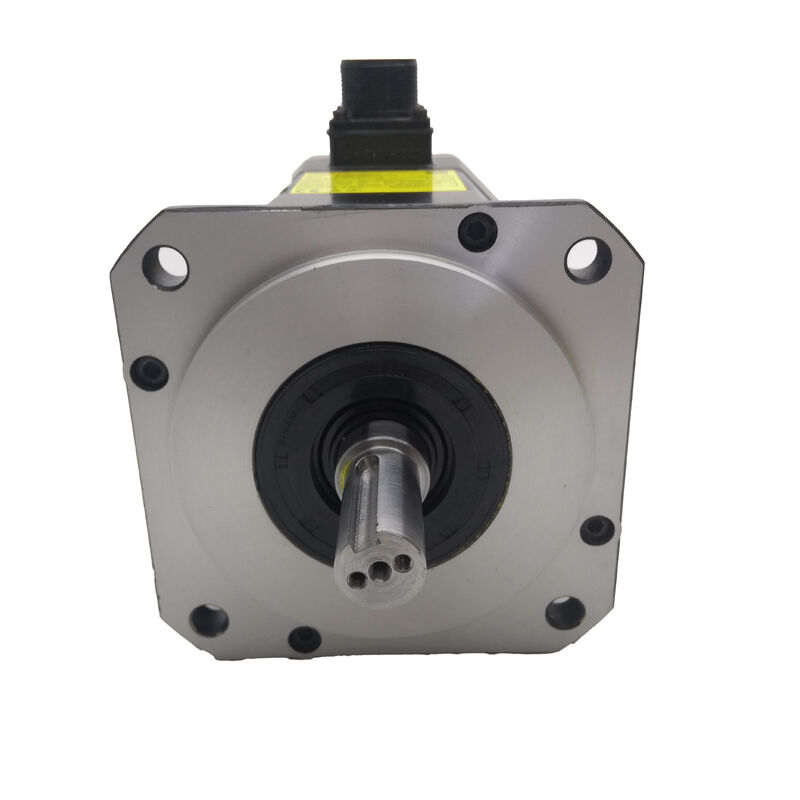
Fanuc A06B-0075-B203 | Beta iS Series AC Servo Motor BiS 8/3000 — 1.2 kW, Straight Shaft
Part Number: A06B-0075-B203
Series: Beta iS (BiS) AC Servo Motor
Model: BiS 8 / 3000
Condition: New / Refurbished / Exchange Available
Overview
The Fanuc A06B-0075-B203 is a compact, high-speed AC servo motor from Fanuc's Beta iS series — the BiS 8/3000, a light-frame motor built for CNC axis applications where precision positioning, fast dynamic response, and a small physical footprint all matter.
Producing 1.2 kW continuously with a 7 Nm stall torque and a maximum speed of 3,000 RPM, this is a motor calibrated for the lighter end of the axis drive spectrum — secondary axes, sub-axis positioning drives, and the kind of auxiliary CNC functions where a compact, well-integrated servo does its job quietly and reliably over a long service life.
The BiS family was Fanuc's practical answer to a real industry question: how do you give machine tool builders a modern, digitally integrated servo motor that performs consistently without the overhead cost of the Alpha iS series for every axis on the machine?
For lighter-load axes where the BiS 8/3000's torque and speed range is a proper fit, the answer is straightforward. This motor has found its way onto a wide range of CNC lathes, small vertical machining centers, and multi-axis production machines where the drive demands are well-defined and the available installation space is limited.
Key Specifications
| Parameter |
Value |
| Output Power |
1.2 kW (continuous) |
| Stall Torque |
7 Nm |
| Rated Voltage |
153 V |
| Rated Current |
4.9 A |
| Supply Input |
200 – 230 VAC, 50/60 Hz |
| Rated Frequency |
133 Hz |
| Maximum Speed |
3,000 RPM |
| Phases |
3-Phase |
| Series |
Beta iS (BiS) |
| Model |
BiS 8 / 3000 |
Compact Frame, Capable Output
The 8 in the BiS 8/3000 model designation puts this motor at the lighter end of the Beta iS torque range. That is not a limitation — it is a specification. A motor matched to its load runs more efficiently, generates less heat, and lasts longer than an oversized unit operating well below its rated output.
The 7 Nm stall torque and 1.2 kW continuous output are right-sized for the ballscrew pitch and inertia loads typical of compact CNC axis configurations, and the 3,000 RPM maximum speed gives it genuine flexibility across both positioning and cutting feedrate demands.
At 133 Hz rated frequency, the drive system generates the electrical conditions the motor needs to reach that 3,000 RPM ceiling with clean torque delivery.
This frequency is produced internally by the servo amplifier from the 200–230 VAC supply input — the mains connection is standard industrial voltage, and the drive handles the frequency conversion transparently.
The 4.9 A rated current is modest compared to the larger BiS frame sizes, which means the amplifier module current requirements are correspondingly light — a practical point when the drive cabinet space or electrical infrastructure is a consideration.
Where This Motor Is Used
The A06B-0075-B203 appears most frequently on the lighter axis drives of small CNC lathes, compact vertical machining centers, coordinate drilling machines, and wire EDM equipment where axis loads are consistent and well within the motor's continuous rating.
It also turns up on auxiliary axes of larger machines — fourth-axis rotary tables, sub-spindle Z drives, or tailstock positioning — where the mechanical demand is light but precise servo control is still required.
Given the broad compatibility of the BiS series with Fanuc's digital servo amplifier range and multiple CNC control generations, this motor also shows up in retrofit projects where an older axis drive needs to be brought up to current feedback and drive standards without a full control replacement.
The BiS 8/3000 is a practical choice in those scenarios when the axis load is within range.
Drive & Control Compatibility
The A06B-0075-B203 is compatible with Fanuc Beta series digital servo amplifier modules and integrates with a broad range of Fanuc CNC control platforms — including the Series 0i-Mate, 0i, 16i, 18i, and 21i.
The servo amplifier must be parameterized with the correct motor type code for the BiS 8/3000 before the axis is run under load. Getting the motor type parameter right matters: an incorrect setting produces velocity loop behaviour that ranges from slightly degraded performance to outright instability, depending on how far off the parameter is from the actual motor specification.
For machines that have undergone control or drive upgrades since original build, verify that the existing servo amplifier supports the BiS series encoder interface. Earlier analogue drive generations may not be directly compatible and may require an interface change alongside the motor.
Encoder & Feedback
The B203 suffix indicates this variant uses the Fanuc BiA 128 series encoder — a serial absolute-capable encoder that supports high-resolution position feedback.
Depending on the specific drive and control configuration it is paired with, this encoder supports both absolute and incremental feedback modes, giving this motor flexibility across a range of Fanuc control generations with different feedback handling.
As with all servo motor replacements, the encoder specification on the replacement unit must match the original. Installing a motor with a different encoder type — even within the same BiS frame class — can affect absolute position retention behaviour, homing sequences, and in some cases the drive's ability to recognize the motor correctly at startup.
Sourcing & Condition Notes
The A06B-0075-B203 is actively traded in the refurbished and surplus servo motor market. When evaluating a used unit, inspect the encoder connector carefully — this is statistically the most common failure point on BiS series motors with extended service history, and connector pin corrosion or cable damage at the exit is easy to overlook visually but will cause intermittent position errors that are frustrating to diagnose on the machine.
Measure three-phase winding resistance for balance, check insulation resistance to earth, and rotate the shaft by hand to confirm bearing condition. A clean, lightly-used unit from a reputable source should test well across all these checks and run up smoothly on a bench test before installation.
FAQ
Q1: What servo drive and CNC control does the A06B-0075-B203 work with?
This motor is designed for use with Fanuc Beta series digital servo amplifier modules. It is compatible with Fanuc CNC control platforms including the 0i-Mate, 0i, 16i, 18i, and 21i families. Before commissioning, the servo amplifier motor type parameter must be set to match the BiS 8/3000 specification.
An incorrect motor type code is one of the most common sources of axis instability after a motor replacement and should always be verified before the first axis move.
Q2: What does the 7 Nm stall torque figure mean for axis selection?
Stall torque is the motor's maximum torque output at zero speed — the peak force available for axis acceleration from rest and for holding position against an applied load. It is distinct from the continuous rated torque, which reflects the thermal limit for sustained operation.
When selecting a motor for an axis, stall torque is the figure that determines whether the motor can accelerate the axis's combined mechanical inertia within the required cycle time. For axes where the BiS 8/3000 is a correct match, 7 Nm is adequate; for heavier loads, a larger frame BiS or Alpha iS motor should be evaluated.
Q3: Is 1.2 kW enough for a primary CNC machining axis?
It depends on the machine and axis. On compact CNC lathes and small vertical machining centers where the moving mass is light and cutting forces are moderate, 1.2 kW is fully appropriate for primary X and Z axis drives.
On larger machines with heavier saddles, worktables, or aggressive cutting requirements, a higher output motor would be the correct specification. Matching the motor to the actual axis load — not simply using the largest motor available — is the correct engineering approach.
Q4: What is the difference between the A06B-0075-B203 and other variants in the A06B-0075 series?
The A06B-0075 family shares the same BiS 8 motor frame and base specifications across variants. The suffix (B103, B203, B303, etc.) typically indicates differences in encoder type, brake configuration, or shaft specification.
The B203 variant uses a specific encoder type and has no integrated brake. Before cross-referencing with another suffix, confirm the encoder type, shaft configuration, and brake status all match the machine's requirements — functional differences between suffix variants can cause compatibility issues if substituted without verification.
Q5: What inspection steps are most important for a used A06B-0075-B203?
Prioritise the encoder connector and cable exit — contamination or corrosion here is the most common cause of position feedback faults on used BiS series motors. After that, measure three-phase winding resistance for balance across all phases and check insulation resistance to earth (a healthy motor reads well above 1 MΩ).
Rotate the shaft by hand to assess bearing condition — roughness or drag indicates bearing wear. For any unit with an unknown service history, a full bench test including encoder signal verification and a no-load run-up to 3,000 RPM is the right standard before reinstalling in a production machine.



 Your message must be between 20-3,000 characters!