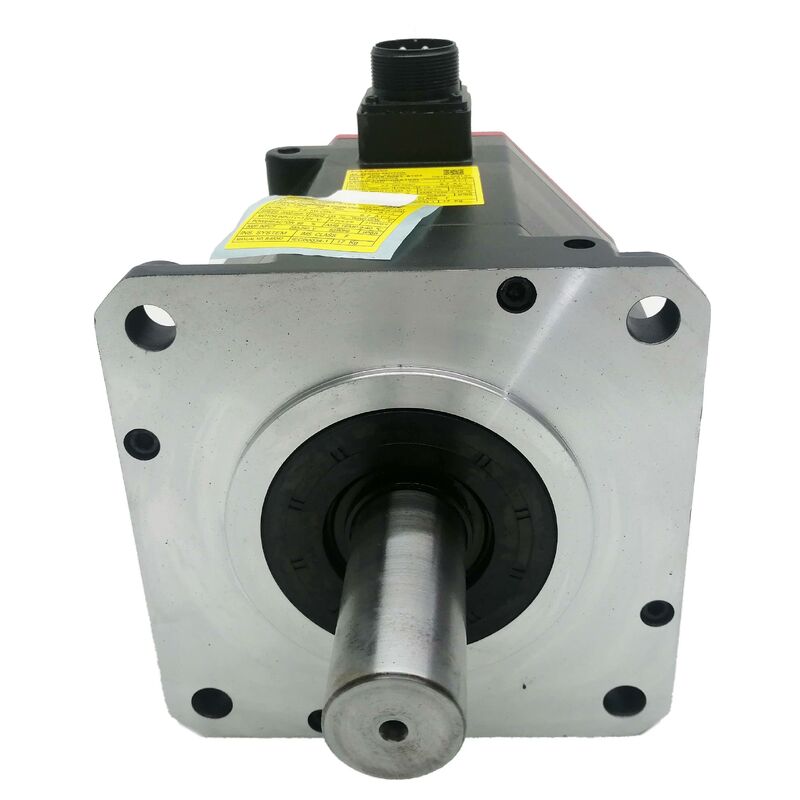
Fanuc A06B-0085-B101 | Beta iS Series AC Servo Motor BiS 22/2000 — Straight Shaft, No Brake
Part Number: A06B-0085-B101
Series: Beta iS (BiS) AC Servo Motor
Model: BiS 22 / 2000
Condition: New / Refurbished / Exchange Available
Overview
The Fanuc A06B-0085-B101 is an AC servo motor from Fanuc's Beta iS series — the BiS 22/2000 model, built to cover the mid-range torque demands of CNC machine tool axis drives without the bulk or cost of a larger frame motor.
The BiS (Beta intelligent Servo) generation represented Fanuc's effort to bring digital drive integration and improved feedback technology to a broader class of machines, including smaller machining centers, lathes, and dedicated production equipment where cost efficiency and drive compatibility matter as much as raw performance.
The 22 in the model designation indicates the motor's torque class — 22 Nm — while the 2000 marks its maximum speed ceiling.
Together, these define a motor optimised for sustained, low-to-moderate-speed axis work: the kind of continuous feedrate control and axis positioning that most CNC cutting operations depend on. This is a motor that earns its keep on the shop floor through consistency rather than headline specifications.
The A06B-0085-B101 features a straight shaft with no integrated brake, a clean mounting profile suited to a range of machine axis configurations, and compatibility with the Fanuc digital servo drive systems that underpin a significant portion of the current global CNC installed base.
Key Specifications
| Parameter |
Value |
| Series |
Beta iS (BiS) |
| Model |
BiS 22 / 2000 |
| Torque Class |
22 Nm |
| Maximum Speed |
2,000 RPM |
| Output |
2.5 kW |
| Stall Torque |
20 Nm |
| Supply Input |
200 – 240 VAC, 50/60 Hz |
| Shaft Type |
Straight Shaft |
| Brake |
None |
| Application |
CNC Axis Drive |
The Beta iS Series — Designed for the Machine, Not Just the Spec Sheet
The BiS family sits below the Alpha iS series in Fanuc's servo motor hierarchy, but that positioning is about application scope rather than engineering compromise.
The Beta iS motors were developed specifically for machine tools where the axis demands are well defined, consistent, and don't require the extended speed range or peak torque capability of the Alpha series. For these applications — which account for a large proportion of practical CNC machine tool production work — the BiS series delivers everything needed without the cost overhead of a larger motor class.
The BiS 22/2000 in particular occupies a useful sweet spot. At 22 Nm torque class and 2,000 RPM, it handles the X, Y, and Z axis drives on compact to mid-range vertical machining centers, turning centers, and tapping machines with consistent performance.
Its 2.5 kW output and 20 Nm stall torque are well matched to the ballscrew and linear drive arrangements typical in this class of machine, providing enough force to maintain programmed feedrates under realistic cutting loads without the drive amplifier hunting or limiting.
Straight Shaft, No Brake — and Why That's Often the Right Choice
The A06B-0085-B101 is a brakes-free, straight-shaft variant. For horizontal axis applications — X, Y, and most Z configurations where the axis does not carry an unsupported gravity load — this is entirely appropriate.
The servo drive maintains active position holding when the axis is stationary, and the absence of a brake circuit simplifies installation, reduces wiring complexity, and eliminates one category of maintenance consideration.
The straight shaft without a keyway works cleanly with the precision bellows, jaw, and disc couplings that are standard on CNC ballscrew axis connections.
Torque transmission relies on the coupling's clamping force on the shaft diameter, which is adequate for the load profiles this motor handles in its intended applications. If the installation involves a pulley, belt drive, or any coupling arrangement subject to frequent shock loads or continuous high-torque reversals, a keyed shaft variant should be evaluated instead.
Drive & Control Compatibility
The BiS series motor was engineered to work with Fanuc's Beta series servo amplifier modules and integrates with Fanuc CNC control platforms including the Series 0i-Mate, 0i, 16i, 18i, and 21i families. This broad compatibility reflects the machine tool market the BiS series was aimed at — the Beta amplifier / BiS motor combination was a standard pairing on many OEM machine builds, and its integration characteristics are well documented.
Servo drive parameters must be configured with the correct motor type code for the BiS 22/2000 specification.
This is particularly important during replacement work — a drive left with parameter settings from a different motor model will either fault on motor type mismatch or produce velocity loop behaviour that degrades axis performance until corrected. Confirming parameter alignment before the first axis move is a standard commissioning step that gets skipped under time pressure more often than it should.
Where the BiS 22/2000 Is Typically Found
The BiS 22/2000 appeared across a wide cross-section of CNC machine tools built around Fanuc Beta series drive systems. Common applications include compact vertical machining centers, CNC lathes with driven tool capability, drilling and tapping machines, and multi-axis turning centers in the small-to-medium class.
It was also used in some robotic positioner axes and auxiliary CNC axis applications where its torque class and 2,000 RPM ceiling were a good match for the mechanical drive arrangement.
Because Fanuc designed the BiS series for high-volume machine tool production, the motor and its matching drive components are widely available in the refurbished and surplus market. This is a practical advantage for facilities managing ageing machines — replacement options are more accessible than for some of the older or more specialised motor generations.
Sourcing & Inspection Notes
When evaluating a used or refurbished A06B-0085-B101, start with the encoder and shaft. Inspect the encoder connector for pin corrosion and verify the cable exit is undamaged and the strain relief is intact — encoder cable damage is a common cause of position feedback faults on motors with extended service history.
Check the straight shaft for runout and any evidence of coupling fretting or impact at the shaft tip. Measure three-phase winding resistance for balance across all phases and verify insulation resistance to earth. Rotate the shaft by hand to assess bearing condition.
Units from reputable refurbishment suppliers will have been tested under load before sale — ask for documentation rather than accepting a visual inspection sign-off on a motor this age.
FAQ
Q1: What servo amplifier and CNC control is compatible with the A06B-0085-B101?
The BiS 22/2000 is designed for use with Fanuc Beta series servo amplifier modules.
It integrates with Fanuc CNC control platforms including the 0i-Mate, 0i, 16i, 18i, and 21i families. The amplifier must be configured with the motor type parameter matching the BiS 22/2000 specification. Using an incorrectly set motor type parameter is one of the most common commissioning errors during motor replacement and will produce axis instability or drive faults until corrected.
Q2: Is the Beta iS series comparable in performance to the Alpha iS series motors at the same torque class?
Both series share Fanuc's core servo motor technology, but they target different application requirements. The Alpha iS series offers extended speed ranges, higher peak torque ratios, and greater drive system flexibility.
The Beta iS series is optimised for consistent performance within a defined operating envelope that suits the majority of standard CNC machine tool axis applications — delivering what those machines actually need without the cost associated with a higher-specification motor series. For most mid-range CNC axis drives, the BiS 22/2000 is entirely adequate.
Q3: This motor has no brake — can it be installed on a vertical axis?
With caution. A vertical axis with significant gravity load — a milling spindle head, a heavy tool changer arm, or a worktable — requires mechanical holding capability when the servo is de-energized.
Without a brake, position holding on a gravity-loaded axis depends entirely on the servo drive's active torque retention, which is lost during E-stop, servo alarm, or power failure. For these applications, a brake variant is the correct specification. The A06B-0085-B101 is best suited to horizontal axes or lightly loaded vertical drives where the axis will not drop under gravity.
Q4: What does the 22 Nm rating mean in practical axis terms?
The 22 Nm figure represents the motor's continuous torque output — the force it can sustain indefinitely at rated current without thermal overload.
In a CNC ballscrew axis, this torque translated through the drive mechanism determines the maximum sustained cutting force the axis can resist while maintaining feedrate accuracy.
A motor that is correctly sized for the axis load will run comfortably below its continuous torque limit during normal cutting, with headroom available for acceleration and occasional heavy passes.
Q5: How do I verify a refurbished A06B-0085-B101 is fit for production before installation?
Request documented test results from the supplier: minimum requirements are balanced three-phase winding resistance, insulation resistance to earth well above 1 MΩ, confirmed encoder signal output, and a no-load run-up to rated speed confirming smooth bearing operation with no thermal anomalies.
Inspect the shaft for straightness and the encoder connector for pin condition. Any supplier of refurbished BiS series motors who cannot provide test documentation for a unit going back into a production machine is not an adequate source.


 Your message must be between 20-3,000 characters!