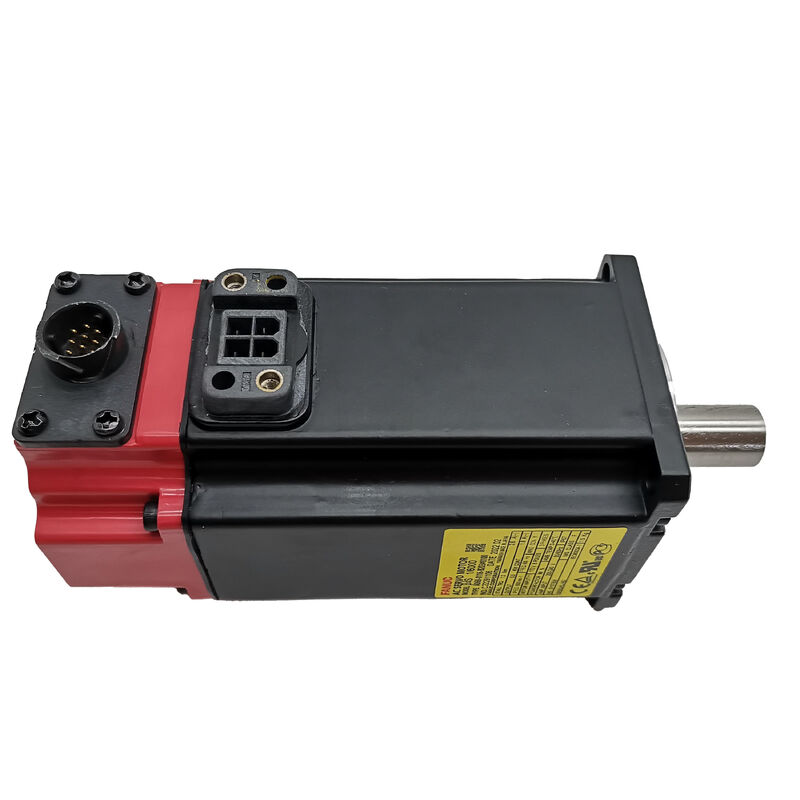
FANUC A06B-0116-B204 | Beta iS 1/6000 AC Servo Motor — 5 kW / 6000 rpm / B64iA Absolute / Straight Keyed Shaft
5 kW at 6000 rpm in 1.4 kg
The A06B-0116-B204 is a BiS 1/6000 — FANUC's Beta iS series motor at 5 kW and 6,000 rpm in a 1.4 kg package. That power-to-weight ratio is not accidental. The BiS series was engineered for compact CNC machine tool formats where the installation envelope around the drive axis is constrained and a larger motor simply does not fit without redesigning the machine structure around it.
The 400 Hz operating frequency is what enables the 6,000 rpm speed rating. The servo amplifier rectifies the standard 200–240V AC mains input to a DC bus, then inverts it to a variable-frequency output matched to the commanded motor speed. The 400 Hz figure is the rated electrical frequency at maximum speed — it is internal to the drive-motor system, not the supply frequency. The 172V / 400 Hz condition at the motor terminals is what the servo amplifier generates; the machine connects to a standard industrial power supply.
For applications where rapid traverse rates, fast positioning cycle times, or high-speed contouring are priorities, the 6,000 rpm ceiling delivers meaningfully better performance compared to the 2,000 or 3,000 rpm motors common on lower-speed axis configurations.
B64iA Absolute Encoder — No Homing Cycle
The B64iA is an absolute serial encoder. It retains shaft position data through power-down cycles, so the CNC reads the exact position of the axis at every restart without driving it to a reference point first. In production environments this matters: machines with absolute feedback resume from exactly where they stopped — useful after maintenance windows, unplanned power interruptions, or mid-cycle E-stops.
When replacing the A06B-0116-B204, the replacement must carry the same B64iA encoder specification. Substituting a different encoder type requires servo drive parameter changes and affects absolute position retention behaviour.
Key Specifications
| Parameter | Value |
|---|
| Part Number | A06B-0116-B204 |
| Motor Model | BiS 1/6000 |
| Rated Output | 5 kW |
| Max Speed | 6,000 rpm |
| Motor Voltage | 172V / 400 Hz |
| AC Input | 200–240V AC |
| Encoder | B64iA absolute |
| Shaft | Straight + keyway |
| Weight | 1.4 kg |
| Compatible Drive | FANUC αi series |
Keyed Shaft — Positive Coupling at 6000 rpm
At 5 kW and 6,000 rpm, the acceleration and deceleration torque loads on the coupling are significant. The keyed shaft provides a positive, slip-resistant mechanical connection — torque transfers through the key rather than through friction clamping alone. A plain-shaft friction coupling can develop micro-slip under repeated high-torque transients that a keyed interface handles without degradation.
During maintenance, the keyed shaft ensures the coupling hub reinstalls in the correct angular position every time. Verify keyway dimensions against the existing coupling hub before fitting the replacement motor.
FAQ
Q1: What is the practical difference between the B64iA absolute encoder and incremental encoder BiS motors?
The B64iA retains shaft position through power cycles — at startup the CNC reads current position directly without a homing cycle. Incremental encoder motors lose position reference at power-down and require each axis to travel to a physical reference point before the machine can run. For production environments, absolute feedback means faster restarts and no risk of homing reference errors.
Q2: Why does the motor specification list 400 Hz when the supply is 50/60 Hz?
The 400 Hz is the motor's internal operating frequency at maximum speed — the electrical frequency the servo amplifier generates to drive the windings at 6,000 rpm. The amplifier takes the standard 200–240V AC / 50–60 Hz mains, rectifies it to a DC bus, and inverts it to variable frequency. The 172V / 400 Hz at the motor terminals is what the drive produces; the user connects to standard industrial supply at the drive input.
Q3: What servo amplifier and CNC are compatible with the A06B-0116-B204?
FANUC αi series digital servo amplifiers that support BiS series absolute encoder feedback. Compatible CNC platforms: Series 0i, 16i, 18i, 21i, 30i/31i/32i, and Power Motion i. Older FANUC drive generations that predate the BiS motor series may not interface correctly with the B64iA encoder without hardware adaptation.
Q4: Can this motor be used with a plain-bore coupling hub not designed for a keyed shaft?
A keyed shaft motor can be installed with a plain-bore clamping coupling — the key is left in place and the coupling grips the shaft diameter. However, if the coupling bore is sized for a plain shaft without a keyway slot, the hub will not seat fully. The hub must be replaced with a keyed-bore version or re-bored to accept the key. Do not file down or modify the motor keyway — this affects shaft balance and integrity at 6,000 rpm.
Q5: What should be inspected on a used A06B-0116-B204 before installation?
Encoder condition is the priority — confirm the encoder connector is undamaged and check that the absolute backup battery (where applicable) is current. Check the keyed shaft for fretting at the keyway and verify bearing condition by rotating the shaft by hand. Winding resistance should be balanced across all three phases with healthy insulation resistance to earth.


 Your message must be between 20-3,000 characters!