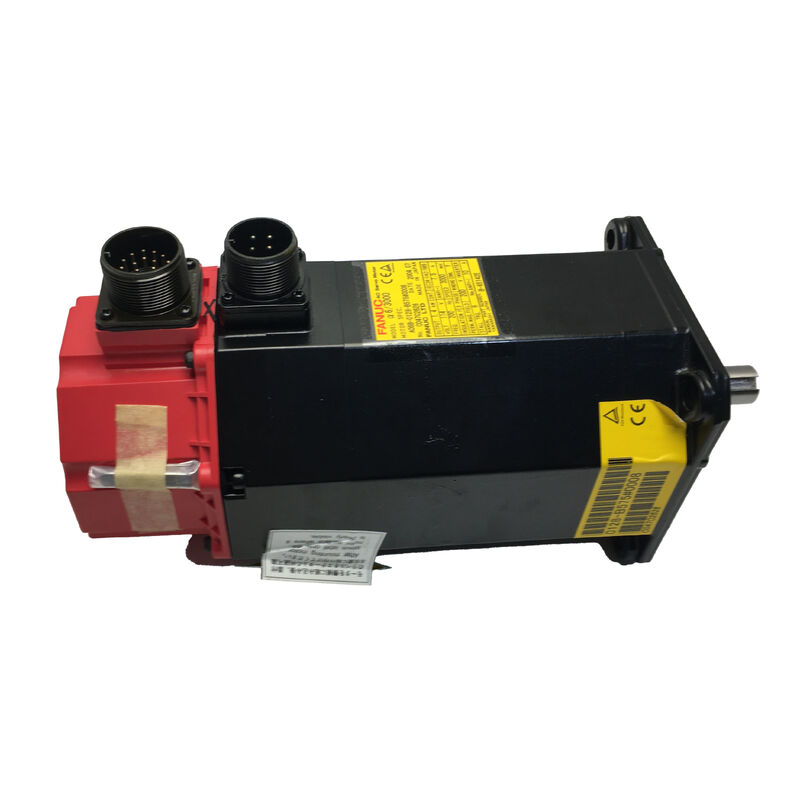
Fanuc A06B-0121-B077 | AC Servo Motor AC3/2000 — Taper Shaft, I64 Pulse Coder
Part Number: A06B-0121-B077
Model: AC3 / 2000
Encoder: I64 Pulse Coder
Shaft: Taper Shaft
Status: Discontinued by Manufacturer — Refurbished & Surplus Stock Available
Condition: Refurbished / Exchange / Surplus
Overview
The Fanuc A06B-0121-B077 is an AC servo motor from Fanuc's earlier AC servo generation — model AC3/2000 — running to 2,000 RPM with an I64 pulse coder for closed-loop feedback and a taper shaft output for precision mechanical coupling.
This motor predates the ALPHA and BETA series families that followed it and belongs to the period when Fanuc was establishing the AC servo architecture that would go on to define CNC machine tool drives for decades.
Fanuc has since discontinued this model, but that does not retire the machines it was built into.
CNC equipment built around the AC3/2000 remains productive in shops and facilities where the economics of maintaining a proven machine outweigh the cost and disruption of a full retool. For those operations, a reliable source of serviceable A06B-0121-B077 units is not a convenience — it is a maintenance necessity.
The taper shaft and I64 pulse coder are the two features that make this a specific rather than interchangeable item.
Both define the mechanical and electrical interface the motor makes with the machine, and both must match exactly when sourcing a replacement. Understanding what each does and why it matters is the practical starting point for anyone working with this motor in the field.
Key Specifications
| Parameter |
Value |
| Model |
AC3 / 2000 |
| Maximum Speed |
2,000 RPM |
| Shaft Type |
Taper Shaft |
| Encoder |
I64 Pulse Coder |
| Application |
CNC Axis Drive |
| Manufacturer Status |
Discontinued |
The AC3/2000 in Fanuc's Servo History
The AC3 designation placed this motor in a specific torque class within Fanuc's early AC servo motor range — one step above the AC2 and below the heavier AC6 and AC12 families that handled the more demanding axis drives of the era.
At 2,000 RPM maximum, the AC3/2000 was applied to axes where moderate speed and controlled torque output were the priorities — the kind of steady feedrate performance and repeatable positioning that production CNC work demands.
These motors were paired with Fanuc AC servo drive systems of the same generation and integrated with the Fanuc CNC control platforms that were current during their production period. By the standards of what came after, the electronics are older — but the fundamental motor construction is durable, and units that have been properly maintained and stored continue to perform reliably in their original applications.
The AC3/2000 was fitted to a range of small and medium CNC machine tools across multiple OEM brands that standardised on Fanuc servo systems during this period.
The installed base is wide enough that the motor's failure modes, service requirements, and performance characteristics are well understood within the specialist servo repair community.
Taper Shaft — Precision Coupling by Design
The taper shaft on the A06B-0121-B077 is a machined conical profile that creates a self-centering interference fit with the mating drive component — typically a pulley, coupling hub, or direct drive element bored to the matching taper.
This design produces a concentric, backlash-free mechanical connection without relying on keyways or shaft clamping alone, and it allows the driven component to be removed and reinstalled with repeatable engagement each time — provided the correct removal procedure is followed.
On a machine designed around a taper shaft motor, the driven components — pulleys, hubs, whatever the motor connects to — are bored to match this specific taper geometry. Replacing with a straight shaft motor requires changing those components as well, turning what should be a motor swap into a significantly larger mechanical job.
This is why verifying shaft type before ordering a replacement is not optional: arriving on site with the wrong shaft configuration delays the repair and adds cost that could have been avoided.
When inspecting or removing the drive component from a taper shaft, the taper must be broken correctly — using a proper puller or taper-breaking method — rather than driving the component off with impact tools.
Improper removal scores the taper surface, which degrades the interference fit on reinstallation and can produce runout that causes vibration or positioning error during operation.
I64 Pulse Coder
The I64 is a pulse coder — Fanuc's terminology for the incremental encoder integrated into the rear of the motor housing — that provides position and velocity feedback signals to the AC servo drive.
It generates position pulses referenced to a marker channel, with the machine's homing sequence establishing the absolute axis reference at each startup. This is the standard feedback architecture for the CNC platforms this motor was paired with.
The "64" in the I64 designation refers to the encoder's pulse count characteristic, which determines the resolution of position feedback available to the servo drive.
This resolution must be matched between the motor and the drive system — fitting a motor with a different pulse coder specification without updating the servo drive parameters will produce position scaling errors and may generate encoder fault alarms that prevent the axis from operating.
Pulse coder condition is one of the first things to evaluate on any used AC3/2000 motor. On units with long service histories or evidence of coolant exposure, the pulse coder housing and its connector are common failure points.
Damaged connectors, corroded pins, and contamination inside the pulse coder housing all produce intermittent or degraded feedback signals that present as axis position errors or runaway conditions at the drive — often misdiagnosed as drive faults before the pulse coder is identified as the source.
Discontinued Status and What That Means for Users
Fanuc discontinued the A06B-0121-B077 as the product line evolved and newer motor generations superseded it. The motor is no longer produced, and new factory stock is not available through standard channels.
For facilities running machines that depend on it, the options are refurbished originals sourced from specialist servo motor companies, verified new-old-stock units where available, and exchange programs that return a like-for-like refurbished unit in exchange for the failed core.
A well-executed refurbishment on an AC3/2000 motor covers winding inspection and testing, bearing replacement, pulse coder evaluation and if necessary replacement or repair, taper shaft inspection, and a full run-up test before the unit is returned to stock.
This is the standard that matters — a motor that passes visual inspection alone is not the same thing as a motor that has been tested under load and verified across all its key parameters.
For high-uptime facilities, holding a vetted spare A06B-0121-B077 on the shelf is a straightforward risk mitigation.
On a discontinued motor, the market fluctuates and availability is not guaranteed. Finding out that serviceable units are scarce at the moment your machine goes down is the worst time to discover that fact.
FAQ
Q1: The A06B-0121-B077 is discontinued — are refurbished units reliable for production use?
Yes, provided they come from a reputable servo repair facility that performs documented testing rather than visual inspection alone.
A properly refurbished AC3/2000 will have had its bearings replaced, windings tested for resistance balance and insulation integrity, the pulse coder evaluated, and a full no-load run-up completed before sale. Refurbishment quality varies significantly between suppliers — ask for test documentation before committing to a unit for a production-critical axis.
Q2: Can the A06B-0121-B077 be upgraded to a newer Fanuc ALPHA or BETA series motor?
In principle, a generation upgrade is possible, but it is not a simple swap. The taper shaft, mounting dimensions, connector pinouts, and feedback interface all differ between the AC3 generation and later ALPHA or BETA series motors.
A servo drive upgrade is typically required alongside the motor change, and the CNC control must support the new motor and encoder type. For machines where a full drive upgrade is already planned, this can make sense — for a straightforward motor replacement, a like-for-like AC3/2000 unit carries far less risk and disruption.
Q3: What happens if the I64 pulse coder is damaged — can the motor still be used?
Not for closed-loop servo operation. The pulse coder is the position and velocity feedback source the servo drive requires to close the control loop. A failed or degraded pulse coder produces position errors, axis drift, or encoder fault alarms that prevent normal operation.
In some cases the pulse coder can be replaced as a separate assembly by a specialist servo repair facility — whether this is viable depends on the extent of damage and the condition of the motor's encoder mounting interface.
Q4: How critical is correct taper shaft removal when servicing this motor?
Very. The taper shaft relies on a precision interference fit between the motor shaft taper and the mating drive component. If the pulley or coupling hub is forced off with impact tools rather than removed with a proper taper-breaking puller, the taper surface is scored.
A scored taper produces an imperfect interference fit on reinstallation, which results in shaft runout — and runout at the axis drive manifests as vibration, position error, and accelerated bearing wear. Correct removal procedure is not optional on a taper shaft motor.
Q5: What are the most common failure modes on the AC3/2000 at this age?
Bearing wear is the most frequent finding on motors with long service histories — the symptoms are shaft roughness, audible noise during operation, and eventually vibration that affects axis accuracy.
Pulse coder failure from coolant contamination or connector degradation is the second most common issue, typically presenting as position feedback errors or axis alarms. Winding insulation degradation from sustained overload or coolant ingress is less common but more serious — it requires rewinding to restore the motor to service. All three are identifiable through proper bench testing before reinstallation.


 Your message must be between 20-3,000 characters!