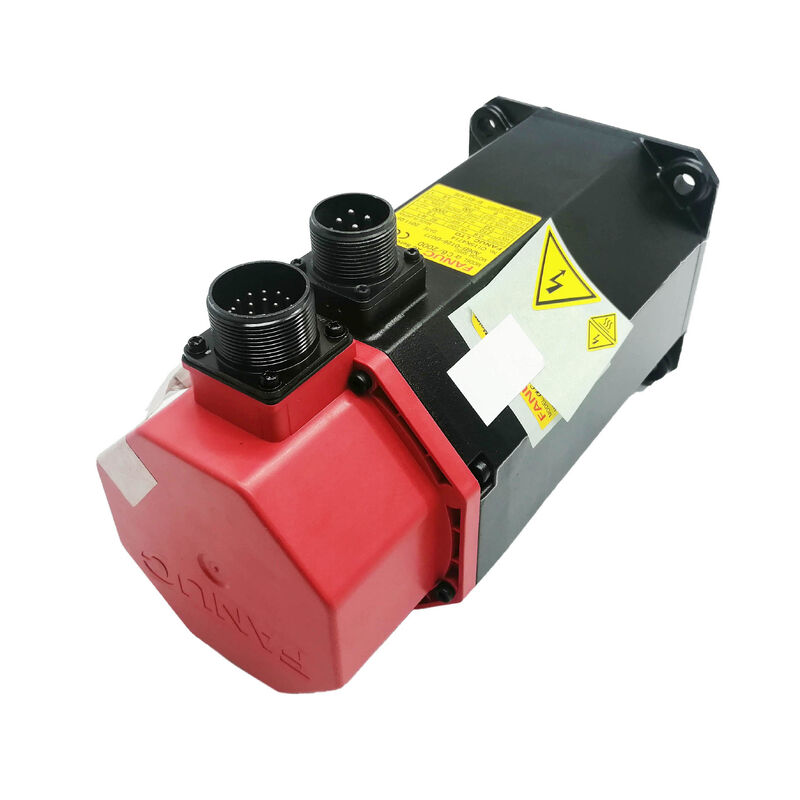
Fanuc A06B-0126-B077 | ALPHA Series AC Servo Motor aC6/2000 — 0.6kW, Taper Shaft, I64 Encoder
Part Number: A06B-0126-B077
Series: ALPHA AC Servo Motor
Model: aC6 / 2000
Status: Discontinued by Manufacturer — Refurbished & Surplus Stock Available
Condition: Refurbished / Exchange / Surplus
Overview
The Fanuc A06B-0126-B077 is a compact ALPHA series AC servo motor — model aC6/2000 — built for the lighter axis drives and auxiliary positioning functions of small to medium CNC machine tools. At 0.6 kW rated output, 6 Nm stall torque, 2,000 RPM maximum speed, and 3.6A continuous current, this is one of the lighter-duty motors in the ALPHA mid-range family.
What it lacks in raw power it compensates in precision and reliable everyday operation — the qualities that matter most on the kind of secondary axes, indexing mechanisms, and compact positioning drives where it was routinely fitted.
Weighing 13 kg and carrying an ALPHA series tapered shaft with I64 incremental pulse coder, the aC6/2000 was a familiar presence on the machine tools of its generation.
The red end cap identifies it as the ALPHA series — a product generation whose installed base remains active in shops and production facilities where proven machines continue running long after the motors that drive them have left Fanuc's active catalogue. This motor is discontinued, but replacement demand continues, and the refurbished and surplus market for the A06B-0126-B077 reflects that ongoing reality.
Key Specifications
| Parameter |
Value |
| Rated Output |
0.6 kW |
| Stall Torque |
6 Nm |
| Rated Current |
3.6 A (RMS) |
| Maximum Speed |
2,000 RPM |
| Encoder |
I64 Incremental Pulse Coder (64,000 ppr) |
| Shaft Type |
Tapered Shaft |
| Brake |
None |
| Weight |
13 kg |
| Series |
ALPHA — aC6/2000 |
| Manufacturer Status |
Discontinued |
0.6 kW with 6 Nm Stall Torque — The aC6/2000 in Context
The 0.6 kW output and 6 Nm stall torque place the aC6/2000 at a specific point in the ALPHA family lineup. The stall torque is the same as the A6/2000 (A06B-0127-B077) and A6/3000 (A06B-0128-B077) variants — 6 Nm is the torque class.
What changes between these variants is the speed ceiling and the associated electrical characteristics: the aC6/2000 runs to 2,000 RPM at a lower operating voltage and current than the higher-speed variants, which produces a different continuous power rating at the same stall torque.
This is not a compromise — it is a design choice.
A 0.6 kW motor at 6 Nm stall torque with a 2,000 RPM ceiling is sized for axes that operate at low to moderate speeds under consistent but modest load.
The servo amplifier driving this motor handles lower current demands, the motor runs with more thermal headroom relative to its rated current, and the overall axis drive system operates within its ratings without stress — provided the application loads are matched to the motor's capability.
On the small machining centres, drilling machines, and multi-axis lathes where the aC6/2000 was fitted, this motor handled secondary axes — fourth-axis rotary positioning, tailstock drives, tool magazine mechanisms, and sub-axis functions — where the combination of 2,000 RPM speed and 6 Nm torque was the right specification for the mechanical load and cycle rate involved.
Taper Shaft — Precision Connection in a Compact Package
Despite the motor's modest output rating, the taper shaft specifies a precision coupling geometry that places it in the same design category as the larger taper-shaft variants across the ALPHA family.
The conical shaft profile self-centres the driven component — coupling hub, pulley, or gearbox input — concentrically on the shaft axis. The interference fit this creates is more consistent and more resistant to eccentricity accumulation over long service life than a plain clamping-only straight shaft arrangement.
At 0.6 kW and 6 Nm, the taper shaft is not necessary to handle the torque — clamping couplings manage lower torques easily.
Its presence reflects the precision requirements of the axis applications this motor served: compact positioning axes where shaft runout affects positioning repeatability, and where the taper's self-centering geometry eliminates a variable that would otherwise require careful alignment at each service intervention.
The sub-variant suffix system within the B077 family indicates different sub-specifications: the #7000 is a plain taper shaft, while the #7075 suffix indicates the sealed IP67 version of the same motor with the same taper shaft. Confirming which sub-variant is installed before sourcing a replacement prevents mechanical mismatch at the coupling interface.
I64 Pulse Coder
The I64 provides 64,000 position pulses per shaft revolution — the standard incremental feedback for the ALPHA series axis architecture.
At 2,000 RPM, the encoder generates 2.13 million pulses per second, feeding the ALPHA servo amplifier's velocity and position control loops with the resolution needed for accurate feedrate regulation and tight position endpoint control across the full operating speed range.
Incremental operation means the machine establishes absolute axis position at each startup through a homing sequence.
On the compact machine types that used the aC6/2000, homing is typically quick — a short traverse to a reference position on a secondary axis takes seconds, not minutes — and it is a routine part of the startup sequence that operates without issue when encoder and reference switch are both in good condition.
On used motors with extended service histories, the encoder connector and its cable exit are the components most exposed to degradation.
At 13 kg this motor is lighter than many in the series, but the encoder's exposure to the operational environment — humidity, temperature cycling, incidental contact during maintenance — follows the same failure pattern as on larger motors. Connector inspection and signal verification remain the priority checks before installation.
Drive & Control Compatibility
From the FANUC ALPHA amplifier pairing documentation, the A06B-0126 motor series pairs with SVM series amplifiers in the SVM2-12/20, SVM2-20/20, SVM3-12/12/20, SVM3-12/20/20, and SVM3-20/20/20 families — the lighter current class modules appropriate for this motor's 3.6A continuous operating current. It integrates with Fanuc CNC control platforms including Series 0, 0i, 15, 16, 18, and 21.
The servo amplifier motor type parameter must be set to the correct code for the aC6/2000 before axis operation.
At this current class, an incorrectly configured motor type parameter produces the same consequences as on larger motors — incorrect velocity loop tuning, wrong current limit settings, and speed scaling errors — just at a lower power scale where the fault may be less dramatic but equally present.
Discontinued Status and the Case for Refurbishment
Fanuc's discontinuation of the A06B-0126-B077 is part of the normal product cycle for a motor series that ran its course. The aC6/2000 has been off the active catalogue for years, but the machines it served have not stopped running.
The repair community familiar with ALPHA series motors handles the aC6/2000 routinely — at 13 kg, it is one of the easier ALPHA series motors to handle in the shop, and the common failure modes (bearings, encoder connector, winding insulation after coolant exposure) are well-understood and addressable.
For facilities maintaining machines with the aC6/2000, the refurbished replacement path is typically the fastest and most cost-effective return to production.
A well-refurbished unit from a specialist servo repair shop — with documented bearing replacement, winding test, encoder verification, and run-up test — is a direct drop-in that restores the axis to original specification without the machine modification that a cross-generation motor substitution would require.
FAQ
Q1: How does the A06B-0126-B077 differ from the A06B-0127-B077 in the same torque class?
Both motors carry 6 Nm stall torque and a tapered shaft, and both run to 2,000 RPM. The A06B-0126-B077 is rated at 0.6 kW continuous and draws 3.6A; the A06B-0127-B077 is rated at 1.0 kW and draws 4.6A.
The higher continuous power of the B077/0127 reflects a different winding design that delivers more power at rated speed while maintaining the same stall torque. They are not interchangeable — the motor type parameters and servo amplifier current ratings differ. Verify the exact part number on the machine nameplate before sourcing a replacement.
Q2: What servo amplifier modules are compatible with the A06B-0126-B077?
This motor is compatible with Fanuc ALPHA series SVM modules in the 20-unit current class — SVM2-12/20, SVM2-20/20, SVM3-12/12/20, SVM3-20/20/20, and related configurations. The amplifier must be parameterised with the motor type code for the aC6/2000.
Given the machine's age, confirm the installed amplifier's encoder interface supports the I64 incremental pulse coder before installing a replacement motor. Incompatible encoder interface configuration will produce encoder alarm codes at startup.
Q3: This motor is discontinued — is a cross-generation substitution from the Alpha i or Beta i series practical?
Technically possible but not trivial. Current-generation motors in the same torque class use different connector pinouts, different encoder protocols, and require different servo amplifier types.
A cross-generation substitution requires mechanical mounting verification, new cabling, and typically a drive amplifier upgrade alongside the motor.
For a single failed motor on an otherwise functional machine, sourcing a refurbished A06B-0126-B077 is the lower-disruption path and restores the axis to the machine's original specification without additional engineering work.
Q4: What is the significance of the #7075 sub-variant compared to the standard #7000?
The #7000 is the standard taper shaft configuration with the motor's default sealing specification. The #7075 is a sealed variant of the same motor, carrying IP67 ingress protection for installations where coolant exposure at the motor position is a concern.
Electrically and mechanically they are identical — the difference is the housing sealing. If the installed motor is a #7075, the replacement should match to maintain the environmental protection at that axis position.
Q5: What should be checked when evaluating a used A06B-0126-B077?
Start with the taper shaft surface — inspect for scoring, fretting, or impact damage from improper previous removal. Taper surface damage compromises the interference fit and cannot be repaired in the field. Check the I64 encoder connector for corroded pins and the cable exit for damage.
Measure three-phase winding resistance for phase balance and check insulation resistance to earth — at 13 kg this motor is easy to handle during inspection.
Rotate the shaft by hand to check bearing condition. A bench run-up to 2,000 RPM with encoder signal verification on a Fanuc ALPHA amplifier is the correct standard before this motor returns to production service.



 Your message must be between 20-3,000 characters!