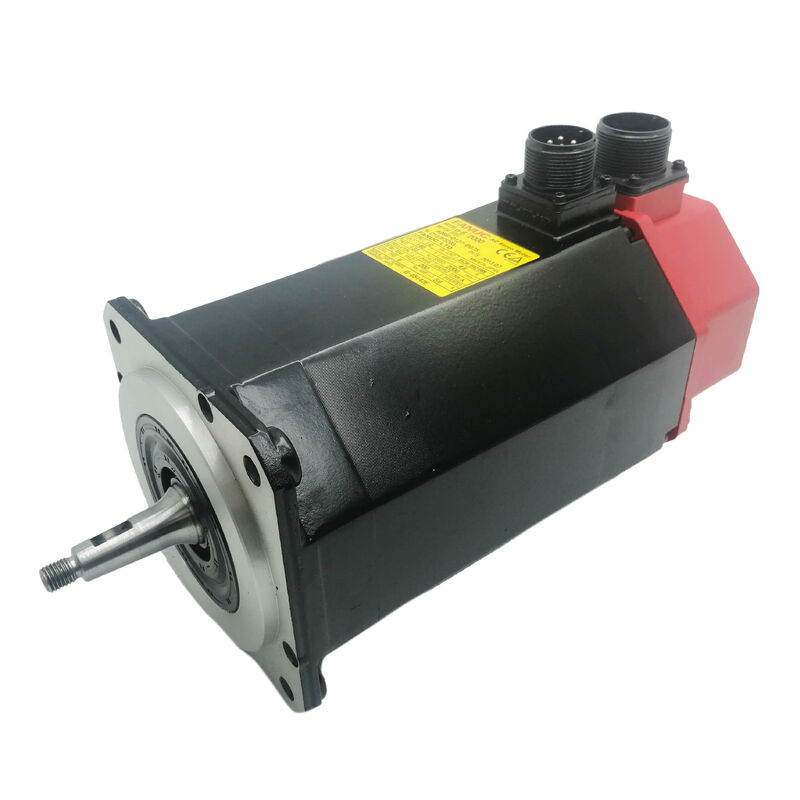
Fanuc A06B-0127-B077 | ALPHA Series AC Servo Motor A6/2000 — 1.0kW, Taper Shaft, I64 Encoder
Part Number: A06B-0127-B077
Series: ALPHA AC Servo Motor
Model: A6 / 2000
Configuration: Tapered Shaft with Keyway, I64 Incremental Encoder, No Brake, IP65
Condition: New / Refurbished / Exchange / Surplus Available
Overview
The Fanuc A06B-0127-B077 is a 1.0 kW AC servo motor from Fanuc's ALPHA series — model A6/2000 — built for the lighter axis drives of small to medium CNC machine tools where compact dimensions, reliable positioning, and precision shaft coupling are the priorities.
Running to 2,000 RPM at 140V three-phase, 133Hz, and drawing 4.6A continuous, it delivers 6 Nm stall torque through a tapered shaft with keyway — a purposeful combination for axes where concentricity and positive torque engagement matter more than simplicity of coupling.
The A6/2000 occupies a specific and practical niche in the ALPHA family. With a torque constant of 1.08 Nm per ampere and a back-EMF constant of 38V per 1000 RPM, the motor's electrical characteristics are calibrated for the servo amplifier systems it was designed to work with.
At 7.5 kg it is genuinely compact and relatively easy to handle during installation and maintenance — a relevant consideration on machines where the axis motor sits in a confined position with limited access.
The red end cap marks this as an ALPHA generation motor — a series that defined the servo axis performance standard for a wide class of CNC machine tools over its production life. The A06B-0127-B077 remains actively traded in the refurbished and surplus market, and continues to serve the installed base of machines that were built around it.
Key Specifications
| Parameter |
Value |
| Rated Output |
1.0 kW (Continuous) |
| Stall Torque |
6 Nm |
| Torque Constant |
1.08 Nm / A |
| Rated Current |
4.6 A |
| Stall Current |
10 A |
| Motor Voltage |
140 V |
| Rated Frequency |
133 Hz |
| Phase |
3-Phase |
| Maximum Speed |
2,000 RPM |
| Back-EMF Constant |
38 V / 1000 RPM |
| Encoder |
I64 Incremental Pulse Coder (64,000 ppr) |
| Shaft Type |
Tapered Shaft with Keyway |
| Brake |
None |
| Ingress Protection |
IP65 |
| Insulation Class |
F |
| Weight |
7.5 kg |
| Series |
ALPHA — A6/2000 |
A6/2000 — Where It Fits and What It Does
The A6 torque class sits at the lighter end of the ALPHA mid-range family — 6 Nm stall torque makes this a motor for mechanisms that move with purpose but without extreme force requirements.
The 2,000 RPM ceiling is the companion parameter that completes the picture: at this speed rating and torque class, the A6/2000 was well matched to auxiliary positioning axes on compact machining centres, dedicated drilling and tapping machines, small turning centres, and general-purpose CNC equipment where the servo axis moves a moderately light mechanism through defined positions at production cycle rates.
Comparing the A6/2000 to the A6/3000 variant within the same torque class is instructive.
The 3,000 RPM A6/3000 prioritises traverse speed; the 2,000 RPM A6/2000 delivers its 6 Nm more efficiently at lower speed, with a torque curve better suited to axes that spend more time at low-to-mid speed than at maximum traverse.
The 133Hz rated frequency — compared to 200Hz for the 3,000 RPM variant — reflects this lower speed ceiling and the different electromagnetic design optimisation it enables.
The 1.08 Nm/A torque constant tells a practical story for anyone sizing drives or diagnosing axis current draw: at 4.6A rated current, the motor produces approximately 5 Nm of continuous torque, with the stall torque of 6 Nm achievable at 10A for short acceleration bursts. This relationship defines the power envelope the ALPHA servo amplifier works within on this axis.
Tapered Shaft with Keyway
The tapered shaft on the A06B-0127-B077 is machined to a precision conical profile with an integrated keyway. The taper creates the self-centering interference fit that positions the driven component concentrically on the shaft axis — eliminating the small eccentricities that can accumulate in clamping-only connections over time.
The keyway adds positive rotational engagement: the key physically interlocks the shaft and coupling hub, preventing rotational slip under the direction reversals and acceleration-deceleration cycles that CNC axis operation generates continuously.
Together, these two features address the two main torque transmission failure modes of servo axis drives: concentricity loss and coupling slip.
On machines designed around this shaft type, both the taper angle and the keyway dimensions are built into the driven component — pulleys, coupling hubs, and gearbox input flanges are machined to match.
A replacement motor must carry the same taper and keyway geometry for the installation to work without mechanical modification.
The #7200 sub-variant of this motor adds high-performance (HP) bearings to the standard specification — relevant for applications with higher radial or axial shaft loading than the standard bearing arrangement supports. Where the machine specification calls for HP bearings, the standard bearing variant is not a direct substitution.
I64 Pulse Coder
The I64 is a 64,000 pulse-per-revolution incremental encoder mounted at the rear of the motor housing. It provides the position and velocity feedback signals the ALPHA servo amplifier uses to close the control loops for accurate axis positioning and feedrate regulation.
At 2,000 RPM maximum speed, the encoder generates 2.13 million pulses per second — the feedback bandwidth the amplifier needs for smooth velocity control and tight position endpoint accuracy across the full working speed range.
Incremental operation means absolute axis position is established through a homing sequence at each machine startup.
The CNC drives the axis to its reference position, the encoder's marker pulse sets the position counter, and the axis operates from that reference through the rest of the shift. For the machine types and axis functions the A6/2000 typically serves, homing is a routine startup step.
The encoder body is mounted behind the motor's rear bearing and is protected by the IP65 motor housing.
The encoder cable exit and connector are the exposure points that require attention on used motors — pin corrosion from humidity or coolant mist, and cable damage at the exit strain relief, are the most common encoder-related service findings on motors with long service histories.
IP65 Sealing
The A06B-0127-B077 carries IP65 sealing — fully dust-tight and protected against directed low-pressure water jets from any direction. This rating covers the daily operational exposure of a small CNC machine tool environment: coolant mist, incidental splash during cutting operations, and residual fluid contact during workpiece loading and unloading.
The distinction from the IP67 sealing found on the A6/3000 variant (A06B-0128-B077) is worth noting for installations near active coolant zones. IP65 protects against jets but not against temporary immersion. For most auxiliary axis positions the A6/2000 serves, IP65 is adequate. For positions with heavier direct fluid exposure, additional shielding or specifying a higher-rated variant is worth considering.
Drive & Control Compatibility
The A06B-0127-B077 is compatible with Fanuc ALPHA series servo amplifiers and integrates with the Fanuc CNC control generations current during this motor's production period — Series 0, 0i, 15, 16, 18, and 21. The servo amplifier must be parameterised with the motor type code for the A6/2000 before axis operation.
Given that many machines using this motor have had control or drive components updated over the years, confirming the installed amplifier supports the I64 encoder interface and is correctly parameterised for this motor specification is a necessary step before installing a replacement.
FAQ
Q1: What is the practical difference between the A6/2000 and the A6/3000 for axis selection?
Both motors share the same 6 Nm stall torque and similar physical frame. The A6/2000 runs to 2,000 RPM at 133Hz — optimised for lower-speed axes where efficient torque delivery at moderate traverse rates is the priority. The A6/3000 runs to 3,000 RPM at 200Hz for faster positioning on higher-speed axes.
The electrical specifications differ: 140V / 4.6A for the A6/2000 versus 114V / 7.5A for the A6/3000. The servo amplifier pairing and motor type parameters differ accordingly — they are not interchangeable without reconfiguring the drive.
Q2: What is the taper shaft, and why can't a straight shaft motor be used as a direct replacement?
The tapered shaft creates a precision self-centering interference fit with the driven component, which is machined to the matching taper angle. A straight shaft motor cannot seat in a taper-bored hub — the geometries are incompatible.
Installing a straight shaft motor in a taper shaft position would require replacing the coupling hub or pulley, adding cost and time beyond the motor itself. Verify the shaft type on the installed motor before ordering to ensure the replacement matches exactly.
Q3: What does the #7200 sub-variant with HP bearings provide, and when is it needed?
The #7200 variant adds high-performance (HP) bearings to the standard A06B-0127-B077 specification. These bearings are rated for higher radial and axial loads than the standard bearing arrangement. They are specified where the shaft loading — from belt tension, overhung coupling mass, or direct axial force from the driven mechanism — exceeds the standard bearing's dynamic load rating.
For standard coupling arrangements within the motor's rated torque envelope, the standard bearing variant is appropriate. Substituting the HP bearing variant in a standard application provides no benefit and substituting standard bearings in an HP application shortens bearing life.
Q4: What servo drive is required for this motor?
The A06B-0127-B077 requires a Fanuc ALPHA series SVM or SVU servo amplifier module sized for at least 4.6A continuous and 10A peak output current. It integrates with Fanuc CNC controls including Series 0, 0i, 15, 16, 18, and 21.
The motor type parameter in the servo drive must be set to the correct code for the A6/2000 specification. On machines with mixed motor models on different axes, confirm the specific amplifier module assigned to this axis is configured for the A6/2000, not the type code for a larger or smaller motor in the same cabinet.
Q5: What are the most important checks when evaluating a used A06B-0127-B077?
Inspect the taper shaft surface carefully for fretting marks, scoring, or impact damage from improper previous removal — taper surface damage degrades the interference fit and cannot be corrected in the field. Inspect the keyway for fretting at the key contact faces.
Check the I64 encoder connector for pin corrosion and the cable exit for damage. Measure three-phase winding resistance for balance and check insulation resistance to earth. Rotate the shaft by hand to assess bearing condition — the 7.5 kg motor is light enough to hold while doing this, making the bearing feel assessment straightforward.
A no-load bench run-up to 2,000 RPM with encoder signal monitoring is the correct final verification before returning a used unit to a production axis.


 Your message must be between 20-3,000 characters!